

Optical Level vs Laser Level: Which Should You Use?
Quick Answer
Whether you're a surveyor, construction manager, or concrete contractor, choosing between an optical automatic level and a rotary laser level can significantly impact your productivity and accuracy. This guide compares both technologies to help you decide which tool is right for
Whether you're a surveyor, construction manager, or concrete contractor, choosing between an optical automatic level and a rotary laser level can significantly impact your productivity and accuracy. This guide compares both technologies to help you decide which tool is right for your specific applications. We'll cover accuracy, ease of use, cost, and when each excels—plus recommended equipment from industry leaders like Topcon, Trimble, and Spectra Precision.
Quick Verdict
Superior accuracy and precision for surveying work; trusted standard in the industry.
Fast setup and visible beam over large areas; ideal for grading and general construction.
Entry-level automatic levels offer excellent value without sacrificing core functionality.
High-end solutions with maximum accuracy, durability, and integration capabilities.
Optical Automatic Level Overview
What Is an Optical Automatic Level?
An optical automatic level (also called a dumpy level or auto level) uses a telescope with crosshairs and an automatic compensator to establish a perfectly level line of sight. The operator looks through the eyepiece and reads measurements on a leveling rod held by an assistant. Gravity-based compensation ensures the instrument stays level even on slightly uneven ground.
Advantages
- Extremely high accuracy for precise surveying
- No batteries or electronic components to fail
- Portable and relatively lightweight
- Excellent for detailed elevation work
- Works in bright sunlight without interference
- Minimal training required to operate
- Clear line of sight visible to entire crew
Disadvantages
- Requires two crew members (operator + rod holder)
- Slower over large, open areas
- Not visible to equipment operators without spotting
- Limited to line-of-sight measurements
- Cannot work in complete darkness
- Rod reading errors from parallax
- Poor visibility in dust or rain
Recommended Optical Levels from Express Tools
- Topcon AT-G5: Compact, automatic compensator, ±1.5mm/km accuracy
- Trimble DiNi 0.2: Digital readout option, sealed for dusty conditions
- Leica DNA03: Digital laser technology, high-end surveying standard
- Sokkia B40: Budget-friendly, smooth focusing, reliable performer
- SitePro SAL26: Entry-level auto level, excellent value proposition
Rotary Laser Level Overview
What Is a Rotary Laser Level?
A rotary laser level projects a visible laser beam that rotates around 360° at a constant elevation, creating a perfectly level plane. A receiver (detector) mounted on a rod picks up the beam and alerts the operator with sound and/or light. This allows a single operator to quickly establish level references across large areas and guide heavy equipment in real-time.
Advantages
- Single operator can cover large areas
- 360° horizontal coverage
- Very fast setup and use
- Visible to equipment operators
- Excellent for grading and trenching
- Real-time grade control without assistant
- Ideal for establishing slope grades
- Works well in poor visibility with detector
Disadvantages
- Lower accuracy than optical levels
- Battery-dependent operation
- Requires separate detector/receiver
- Laser beam difficult to see in bright sunlight
- Requires clear line of sight
- Not suitable for precision surveying
- Rotating beam can be disorienting indoors
- Safety considerations with laser exposure
Recommended Rotary Lasers from Express Tools
- Topcon RL-H5A: 500m range, dual-slope, automatic grade control
- Spectra Precision LL300: Affordable, reliable, excellent receiver sensitivity
- Trimble SPS987: Integration with grade control systems, smart receiver
- Sokkia LP610: Long-range, dual-axis capability for slopes
- Leica Roteo 35: Compact, fast setup, emergency mode
Head-to-Head Comparison
Which Should You Buy? Buyer Scenarios
🏗️ General Contractor (Grading & Drainage)
Choose: Rotary Laser Level
For site grading, drainage ditches, and slope work, a rotary laser like the Topcon RL-H5A or Spectra Precision LL300 is unbeatable. One operator can guide excavators and graders in real-time across the entire project. The ±20mm accuracy is more than sufficient, and the time savings pay for itself quickly.
📐 Land Surveyor (Benchmark & Layout)
Choose: Optical Automatic Level
For establishing benchmarks, creating elevation contours, and precise boundary surveys, an optical level like the Topcon AT-G5 or Leica DNA03 is essential. The superior accuracy (±1.5mm/km) meets professional surveying standards and ensures your data is defensible in legal disputes.
Express Tools specializes in laser grade-control and layout equipment. For field documentation, Gradelog organizes your job logs, calibration records, and as-built reports — free to start.
🔨 Concrete Contractor (Flatwork)
Best: Rotary Laser Level + Optical Level
For parking lots and large concrete slabs, a rotary laser provides fast, visible grade guidance. However, for final floor finish verification (especially critical tolerance slabs), pair it with an optical level for precision confirmation. This hybrid approach balances speed and accuracy.
🏠 Small Residential Builder (Foundation & Lot)
Choose: Budget Rotary Laser or Entry Optical
For modest-sized projects, a budget rotary laser (Spectra Precision LL300) or entry optical level (SitePro SAL26) covers most needs. If you work regularly, the rotary laser's speed advantage over multiple optical setups justifies the slightly higher cost.
Optical Level vs Laser Level: Detailed Comparison
Accuracy Considerations
Optical levels dominate here. A quality optical automatic level can achieve ±1.5 to ±3 mm per kilometer—suitable for surveying, precise benchmarking, and regulatory compliance. Rotary lasers typically offer ±10 to ±25 mm per 30 meters, which is excellent for construction grading but insufficient for survey-grade work.
Verdict: If accuracy below ±10mm is required, choose optical. For ±20–50mm tolerance work, rotary laser is adequate and faster.
Operational Efficiency
Rotary lasers are more efficient for large areas. An optical level requires multiple setups and rod readings across a site, needing two crew members. A rotary laser operator can work alone and see the beam across the entire job from one position, especially for grading work.
Verdict: For tight, precise layouts: optical. For sprawling grading: rotary laser.
Durability & Maintenance
Optical levels are more rugged. With no batteries or electronics to fail, an optical level endures decades of field use. Rotary lasers require battery management and electronic maintenance, though modern units (Topcon, Trimble) are built tough for construction sites.
Verdict: Long-term durability favors optical; rotary laser requires battery discipline.
Environmental Conditions
Optical levels win in direct sunlight. A laser beam fades in bright daylight, requiring a receiver to find it. Optical levels work perfectly in bright sun. Conversely, rotary lasers excel in dawn/dusk work without sunlight interference.
Verdict: Sunny job: optical. Dust, dusk, indoor work: rotary laser with receiver.
When to Use Both
Many professional contractors own both tools:
- Optical level for initial site surveys, final elevation verification, and precision benchmarking
- Rotary laser for active grading, equipment guidance, and daily construction layout
This combination ensures accuracy where it matters and efficiency where speed counts.
Frequently Asked Questions
Can a rotary laser replace an optical level for surveying?
Not for professional surveying. A rotary laser lacks the accuracy (±10–25mm vs. ±1.5–3mm/km) required for legal surveys, benchmark establishment, or contour mapping. However, for construction-grade grading and layout, a rotary laser is superior in speed and coverage.
Do I need a receiver for a rotary laser level?
For outdoor use in daylight, yes—the laser beam is difficult to see with the naked eye. However, rotary lasers project a visible dot indoors and in low-light conditions. Most professional rotary lasers (Topcon RL-H5A, Spectra LL300) are purchased with or sold separately from smart receivers that provide audio/visual feedback to the rod operator or equipment.
What's the typical lifespan of each tool?
Optical levels: 20–50 years with proper care; mostly mechanical. Rotary lasers: 10–20 years depending on battery treatment and electronic components. Quality brands like Topcon, Trimble, and Leica build instruments that last two decades or more with standard maintenance.
Which tool is better for machine control (GPS grading)?
Rotary laser levels integrate seamlessly with modern GPS/GNSS grade control systems in dozers and graders. Optical levels are manual reference tools. If you're considering machine control, rotary laser is the better foundation—though many contractors also use optical levels for initial/final verification.
Are there hybrid laser-optical instruments?
Yes. Digital levels (like Leica DNA) combine optical viewing with laser measurement and digital readout. These offer optical accuracy with electronic convenience, but at higher cost ($4,000–$8,000). They're ideal for surveyors wanting digital workflow integration.
Do I need field management software with this equipment?
Gradelog is an AI field assistant designed for contractors using precision grade equipment. Free calculators for grade percentage, cut/fill, elevation, and slope are available with no account required. Paid plans add job logs, equipment tracking, and as-built exports.
How do I document grade work on a job site?
GradeLog replaces paper grade logs with digital field records — shot logs, daily reports, as-built generation. $19–$149/mo.
Do I need field management software with this equipment?
Gradelog is an AI field assistant designed for contractors using precision grade equipment. Free calculators for grade percentage, cut/fill, elevation, and slope with no account required. Paid plans add job logs, equipment tracking, and as-built exports.
How do I document grade work on a job site?
GradeLog replaces paper grade logs with digital field records — shot logs, daily reports, as-built generation. $19–$149/mo.
What
Calculate Your Grade Before You Buy
Before selecting between these instruments, use Gradelog's free field calculators to verify your project requirements — grade percentage, cut and fill, elevation, slope, and more. No account required.
Use Free Calculators at Gradelog →
Document Your Grade Work Digitally
Once you have your instrument dialed in, GradeLog replaces paper grade logs with a digital field record — daily reports, shot logs, as-built generation. Pairs with every instrument on this page. $19–$149/mo.
Try GradeLog →
Our Verdict
Optical Level vs Laser Level: Which Should You Use?
* {
margin: 0;
padding: 0;
box-sizing: border-box;
}
body {
font-family: -apple-system, BlinkMacSystemFont, 'Segoe UI', Roboto, 'Helvetica Neue', Arial, sans-ser
For the full breakdown, see the sections above covering specifications, pros and cons, and use case recommendations for each option.
Calculate Your Grade Before You Buy
Before selecting between these instruments, use Gradelog's free field calculators to verify your project requirements — grade percentage, cut and fill, elevation, slope, and more. No account required.
Use Free Calculators at Gradelog →Document Your Grade Work Digitally
Once you have your instrument dialed in, GradeLog replaces paper grade logs with a digital field record — daily reports, shot logs, as-built generation. Pairs with every instrument on this page. $19–$149/mo.
Try GradeLog →Our Verdict
Optical Level vs Laser Level: Which Should You Use? * { margin: 0; padding: 0; box-sizing: border-box; } body { font-family: -apple-system, BlinkMacSystemFont, 'Segoe UI', Roboto, 'Helvetica Neue', Arial, sans-ser
For the full breakdown, see the sections above covering specifications, pros and cons, and use case recommendations for each option.

Built for equipment owners
Run the jobsite around your equipment
Gradelog is the AI field platform for contractors — grade shots, photo documentation, calibration tracking, and as-built reports, all tied to your gear.
- Equipment & calibration tracking
- Photo + grade documentation
- AI field assistant, 8 languages
Free 14 days with every Express Tools purchase
Your equipment. Your data. All in one place.
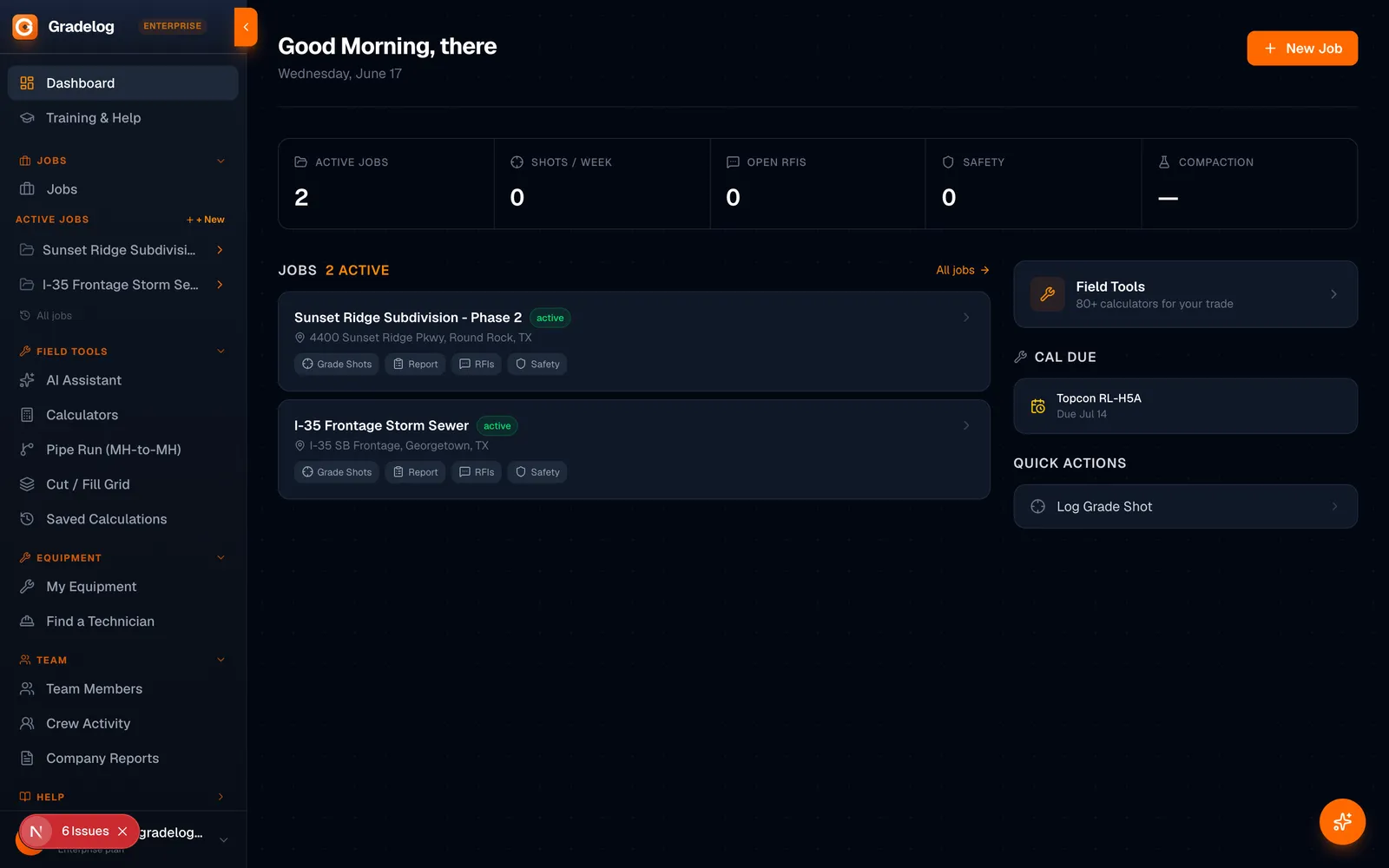
Gradelog is the field-execution platform built for grading and earthwork crews. Log grade shots, track cut/fill, document phases with photos, and generate as-built reports — from the cab to the office.
- Grade shots & cut/fill tracking per job
- Photo documentation by phase, task, and equipment
- As-built reports ready for inspector sign-off
- AI field assistant — troubleshoot on the jobsite
Built by the same team as Express Tools
Try Free →14 days
Free trial
8 languages
Supported
iPhone + Android
Works on