

Best Rotary Laser for Site Grading: What Grading Contractors Actually Use
Quick Answer
Field-tested rotary lasers for earthwork, rough grading, and large-scale site prep—with real accuracy specs and machine control compatibility.
Field-tested rotary lasers for earthwork, rough grading, and large-scale site prep—with real accuracy specs and machine control compatibility.
Grading contractors measure rotary lasers differently than layout crews. You need dual-slope capability, rugged IP67 housings that survive drops from equipment, and receivers that cut through dust and diesel smoke on active sites. After 15 years supplying earthwork contractors across the Southwest, we've seen which models hold grade stakes through Arizona summers and Colorado freeze-thaw cycles.
This guide covers rotary lasers specifically for site grading, land development, and earthwork operations. We're talking 800-foot diameters minimum, ±1/16" accuracy at 100 feet, and receivers that mount on excavator masts and dozer blades. If you're running GPS machine control, these lasers complement your system for secondary cuts, utility rough-in, and backup grade reference.
Top Rotary Lasers for Grading Work
- Best Overall: Topcon RL-H5A — dual-slope, 2,600 ft diameter, works with all LS-series receivers
- Best Value: Spectra Precision GL722 — dual-grade, 3,500 ft range, aggressive pricing
- Best for Large Sites: Leica Rugby 640 — 4,000 ft diameter, motorized alignment, multi-receiver support
- Budget Pick: CST/Berger RL25HV — single-slope only, but solid accuracy for $1,200
Specs Comparison: Grading Rotary Lasers
Detailed Analysis: Field Performance for Grading Contractors
Topcon RL-H5A: The Standard for Mid-Size Grading Operations
The RL-H5A dominates job trailers from Denver to Dallas because it balances range, durability, and receiver ecosystem. The 2,600-foot diameter covers 13-acre pads without repositioning. Dual-slope capability handles parking lot cross-slopes and drainage planes—critical for commercial site work where you're holding 2% slopes across 400-foot runs.
What grading contractors actually care about: this laser works with Topcon's LS-80L and LS-100D receivers, which mount directly to Trimble, Leica, and Topcon excavator control systems. You're not buying into a closed ecosystem. The horizontal accuracy of ±1/16" at 100 feet translates to ±3/4" over an 800-foot diagonal—acceptable for rough grading before your GPS rovers make final passes.
Battery runtime hits 100 hours on alkaline D-cells, or 60 hours using the rechargeable BT-65Q. Contractors running two 10-hour shifts appreciate not swapping batteries mid-week. The IP67 rating survives pressure-washing, and we've seen units take direct hits from thrown grade stakes without losing calibration.
Spectra Precision GL722: Best Range-to-Price Ratio
Trimble's Spectra line delivers 3,500-foot diameter coverage at $400–$600 below comparable Topcon and Leica units. For large earthwork contractors grading 20+ acre pads, that extra 900 feet of range means one setup instead of two. The dual-grade capability extends to 15% slopes—steeper than most site work requires, but useful for embankment faces and detention pond slopes.
The GL722 pairs with Spectra's RC502 and RC602 receivers. If you're already running Spectra pipe lasers or total stations, your crews know the interface. The RC602 receiver features a graphic display showing elevation offset in tenths—faster than counting beeps during rough-in. Contractors report the 5-foot drop rating survives real-world abuse, including tumbles off tailgates and grade checker impacts.
One limitation: the GL722 uses a mechanical leveling system rather than electronic auto-leveling. Setup takes an extra 30 seconds per placement, but the tradeoff is simpler electronics and fewer calibration drift issues over multi-year spans. For contractors who set up once per area and leave the laser running all day, mechanical leveling is actually preferable.
Check GL722 Availability + Receiver Bundles →
Leica Rugby 640: When You Need Motorized Slope Adjustment
The Rugby 640 justifies its $3,500 price point on projects requiring frequent slope changes. Motorized dual-slope adjustment via the RRC380 remote lets you dial in precise cross-slopes without approaching the laser—critical when it's centered on an active haul road or surrounded by staked utilities. The 4,000-foot diameter covers 28-acre sites from a single setup point.
Multi-receiver support is the Rugby 640's hidden advantage. Unlike lasers that slow rotation speed with multiple receivers, the 880 maintains 600 RPM with up to four receivers active. Your dozer, excavator, and two skid steers all get real-time grade reference without signal lag. For contractors running mixed equipment fleets without machine control, this capability keeps all iron working to grade simultaneously.
The Rugby 640's construction matches its price point: die-cast housing, optical-glass laser window, and sealed electronics that survive job site flooding. We've seen 8-year-old Rugby 640s still holding calibration—that's $437/year depreciation over its working life, comparable to mid-range units that need replacement after four seasons.
Hilti PR 30-HVS: Solid Mid-Tier Alternative
Hilti's PR 30-HVS rarely appears in "best of" lists, but grading contractors appreciate its build quality and Hilti's tool-fleet integration. The 2,300-foot range suits most subdivision and commercial pad work. Dual-slope capability is manual adjustment only—you're turning physical dials on the laser head—but the slopes lock solidly without drift.
Where the PR 30-HVS shines: receiver compatibility. It works with Hilti's PRA 30 receiver plus most third-party units expecting a standard rotation speed. Your existing laser receivers likely work fine. Hilti's on-site tool service network means same-day calibration checks and warranty support in major metros—valuable when your laser drops from a loader bucket and you need verification before tomorrow's inspection.
The battery system uses standard Hilti 22V packs that cross-function with impact drivers, rotary hammers, and other fleet tools. Contractors who've standardized on Hilti cordless platforms reduce battery inventory and charger proliferation across their tool trailers.
Hilti PR 30-HVS Package Details →
CST/Berger RL25HV: Budget Option With Limitations
The RL25HV serves small grading contractors doing residential pads, driveway subgrade, and light commercial work. At $1,200, it's half the cost of the Topcon RL-H5A. The accuracy spec of ±3/32" at 100 feet means ±1" over 800 feet—acceptable for rough grading but not finish work. The 2,000-foot diameter covers 7-acre sites.
Single-slope-only capability is the major limitation. You're setting level grades or single-axis slopes, nothing more. No parking lot crowns, no valley drainage planes, no complex surface work. For contractors doing simple building pads and roadbed subgrade, this isn't a deal-breaker. The RL25HV pairs with CST/Berger's RD500 receiver and most universal rod-mount receivers.
Durability is adequate—IP66 rating and 3-foot drop survival—but the plastic housing shows wear faster than metal-body lasers. Figure 3–4 years of daily use before considering replacement. For operations just adding laser-based grade control, the RL25HV provides entry-level capability without $2,500+ investment.
Recommendations by Contractor Profile
Established grading operations (3+ machines, $2M+ annual): Topcon RL-H5A or Leica Rugby 640. You need proven reliability, broad receiver support, and multi-year durability. The Rugby 640's motorized slope and multi-receiver support justify the premium on complex sites.
Growing contractors (1–2 machines, adding capabilities): Spectra Precision GL722. Best performance-per-dollar, extensive range, and compatibility with future equipment additions. The mechanical leveling is actually simpler for crews learning laser-based grading.
Specialty and small operations: Hilti PR 30-HVS if you're already Hilti-aligned, or CST/Berger RL25HV for strict budget constraints. Both deliver functional grading capability without premium pricing.
Large earthwork and land development: Leica Rugby 640. The 4,000-foot range and multi-receiver support maximize productivity on 20+ acre sites. Motorized slope adjustment saves 15–20 minutes per setup when working drainage
Before selecting between these instruments, use Gradelog's free field calculators to verify your project requirements — grade percentage, cut and fill, elevation, slope, and more. No account required. Once you have your instrument dialed in, GradeLog replaces paper grade logs with a digital field record — daily reports, shot logs, as-built generation. Pairs with every instrument on this page. $19–$149/mo.Calculate Your Grade Before You Buy
Document Your Grade Work Digitally
Our Verdict
Quick Answer Field-tested rotary lasers for earthwork, rough grading, and large-scale site prep—with real accuracy specs and machine control compatibility.
For the full breakdown, see the sections above covering specifications, pros and cons, and use case recommendations for each option.

Built for equipment owners
Run the jobsite around your equipment
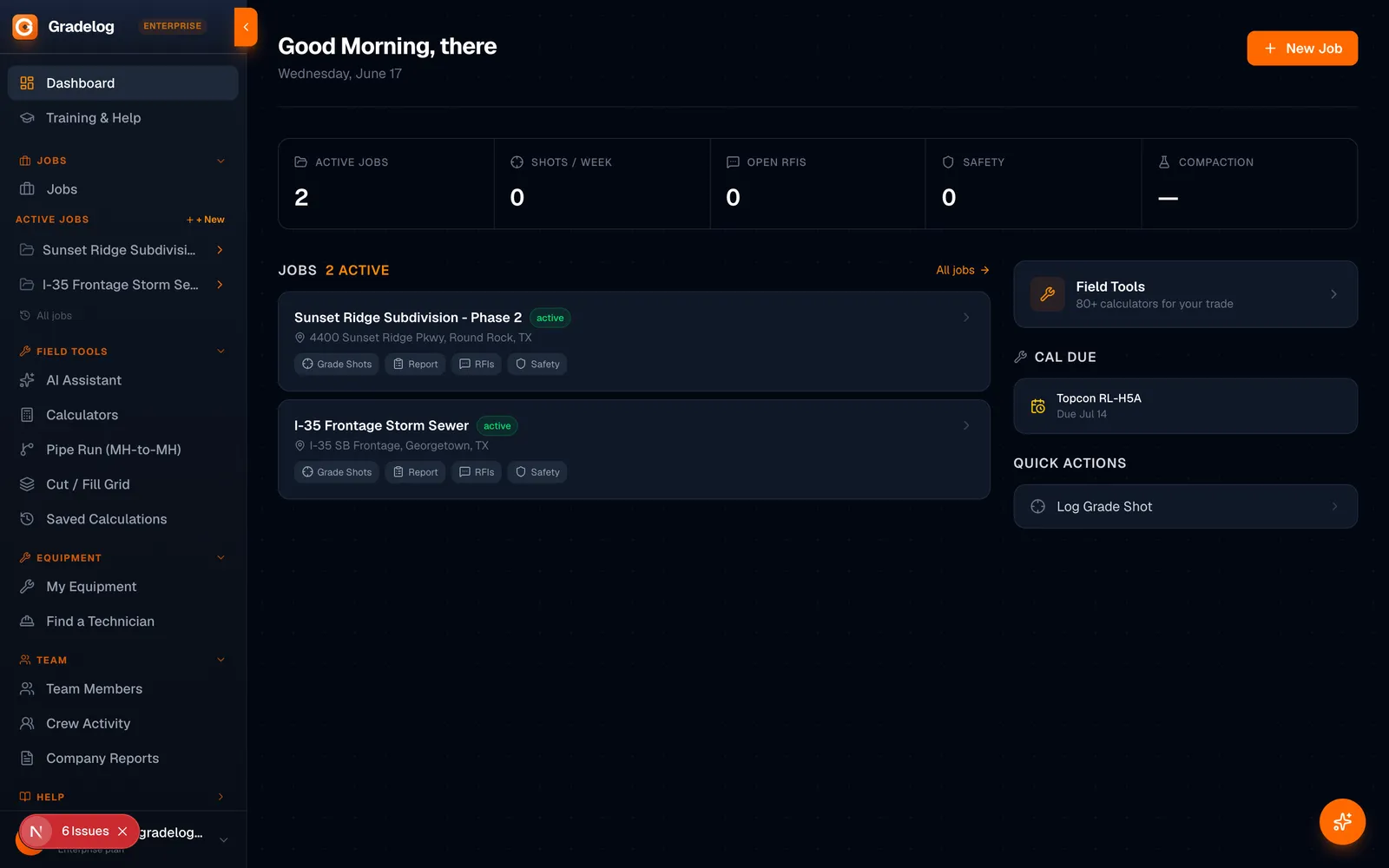
Gradelog is the AI field platform for contractors — grade shots, photo documentation, calibration tracking, and as-built reports, all tied to your gear.
- Equipment & calibration tracking
- Photo + grade documentation
- AI field assistant, 8 languages
Free 14 days with every Express Tools purchase
Your equipment. Your data. All in one place.
Gradelog is the field-execution platform built for grading and earthwork crews. Log grade shots, track cut/fill, document phases with photos, and generate as-built reports — from the cab to the office.
- Grade shots & cut/fill tracking per job
- Photo documentation by phase, task, and equipment
- As-built reports ready for inspector sign-off
- AI field assistant — troubleshoot on the jobsite
Built by the same team as Express Tools
Try Free →14 days
Free trial
8 languages
Supported
iPhone + Android
Works on