Free Shipping on orders over $500


Survey Equipment Care in Cold Weather: Winter Maintenance Tips
Cold weather does things to precision equipment that warm-weather maintenance habits do not prepare you for. Batteries that lasted all day in September quit at noon in January. Optics that were crystal clear fog up the moment you bring them inside. Calibration that was dead-on in October drifts by spring. Here is what experienced survey crews do differently in winter.
Quick Answer
How should contractors care for survey equipment in cold weather?
Cold weather introduces three main risks to survey equipment: reduced battery life (60-80% of rated capacity below freezing), condensation damage when moving instruments between cold and warm environments, and calibration drift from rapid temperature changes. Keep batteries warm until needed, seal instruments in cases before bringing indoors, allow slow warming, and verify calibration at the start of each cold-weather field session.
Battery at 32°F
~80% capacity
Battery at 14°F
~65% capacity
Warm-up time
1–2 hrs sealed case
Battery Management in Cold Weather
Lithium-ion batteries — used in every modern total station, GPS rover, and laser level — experience a significant reduction in available capacity when cold. The electrochemical reaction inside the cell slows at low temperatures, reducing the rate at which stored energy can be delivered.
Practical rules for cold-weather battery management:
- Store batteries inside the cab of the truck or in a coat pocket until needed — do not leave them in the equipment case overnight in freezing temperatures.
- Charge batteries at room temperature, not in a cold vehicle — cold charging reduces battery longevity and may trigger protection cutoffs on smart chargers.
- Carry one extra battery per instrument per half-day of winter fieldwork — budget for 60-70% of rated capacity below 14°F.
- Insert a warm battery into the instrument and allow it to sit a few minutes before powering on — avoids startup failures from brief voltage sag on initial current demand.
Condensation: The Invisible Equipment Killer
Moisture condensation inside optical systems and electronic components is one of the most common cold-weather damage mechanisms — and one of the most preventable. It occurs when a cold instrument is moved into a warm, humid environment: the instrument surfaces are below the dew point of the indoor air, causing water to deposit directly on optics and circuit boards.
The correct procedure when bringing cold equipment indoors:
- Close the instrument in its case and seal it before entering a heated building or vehicle.
- Allow the sealed case to sit at room temperature for 1-2 hours before opening. The moisture condenses on the outside of the case, not on the instrument.
- If you must open a cold instrument indoors, do so in a dry area and avoid breathing on optical components.
- Never use a heat gun or hair dryer to warm an instrument — rapid thermal shock can crack lens coatings and damage internal seals.
Condensation that does enter the instrument is not always immediately visible. Fogged optics are obvious; moisture in electronic compartments can go unnoticed until corrosion causes intermittent failures weeks later.
Calibration in Cold Conditions
Survey instruments are calibrated at a reference temperature — typically around 68°F (20°C). In cold conditions, several calibration-sensitive parameters can shift:
- Electronic distance measurement (EDM) — modulation frequency is temperature-compensated in quality instruments, but budget total stations may show systematic EDM errors at temperature extremes.
- Compensator performance — the liquid or servo compensator that corrects for non-level setups may respond differently at temperature extremes. Verify compensator function at the start of each cold day with a standard two-face observation.
- GNSS rover performance — GPS performance is generally unaffected by cold, but antenna cable connectors should be inspected for brittleness — some cable jackets crack below -20°F.
As a standard practice, perform a quick two-peg test or two-face verification at the start of each cold-weather field session before collecting production data.
Storage Between Winter Field Days
Leaving survey equipment in an unheated vehicle overnight exposes it to temperature extremes and freeze-thaw cycles that accelerate wear on seals and mechanical components. Where possible:
- Bring instruments into a temperature-controlled environment overnight.
- Remove batteries from instruments for overnight storage — leaving discharged batteries in cold instruments risks deep-discharge damage.
- Store instruments in foam-lined cases that provide some thermal insulation against overnight temperature drops if indoor storage is not available.
- Check desiccant packs in instrument cases before winter — replace spent desiccant to ensure the case interior stays dry during temperature cycling.
Cold Weather Checklist
Carry extra batteries — budget for 60-70% capacity below 14°F.
Store batteries warm (coat pocket or truck cab) until needed.
Seal instruments in cases before entering warm environments.
Allow 1-2 hours sealed warm-up time before opening cold cases indoors.
Perform two-face verification at start of cold field sessions.
Inspect cable connectors for brittleness on days below -10°F.
Replace desiccant in cases before winter season.
Remove batteries for overnight storage in freezing temperatures.
Frequently Asked Questions
How does cold weather affect survey equipment battery life?
At 32°F, batteries deliver about 80% of rated capacity. At 14°F, that drops to 60-70%. Keep batteries warm in a coat pocket or insulated pouch until needed and carry spares for winter field sessions.
How do I prevent condensation damage when moving survey equipment from cold to warm?
Seal the instrument in its case before entering a warm building. Leave the sealed case at room temperature for 1-2 hours before opening. Condensation will form on the outside of the case, not inside the instrument.
Does cold weather affect total station accuracy?
Temperature-compensated instruments maintain accuracy within spec in cold conditions. Atmospheric refraction near the ground — common on cold mornings with solar warming — is the more practical concern. Use two-face observations to detect systematic errors.
Powered by Gradelog
Keep Your Projects Moving Year-Round
Gradelog helps construction and survey teams maintain field productivity through every season with automated as-built records and real-time deviation alerts.
Try Gradelog FreeRelated Guides

Free 14 days with every Express Tools purchase
Your equipment. Your data. All in one place.
Gradelog is the field-execution platform built for grading and earthwork crews. Log grade shots, track cut/fill, document phases with photos, and generate as-built reports — from the cab to the office.
- Grade shots & cut/fill tracking per job
- Photo documentation by phase, task, and equipment
- As-built reports ready for inspector sign-off
- AI field assistant — troubleshoot on the jobsite
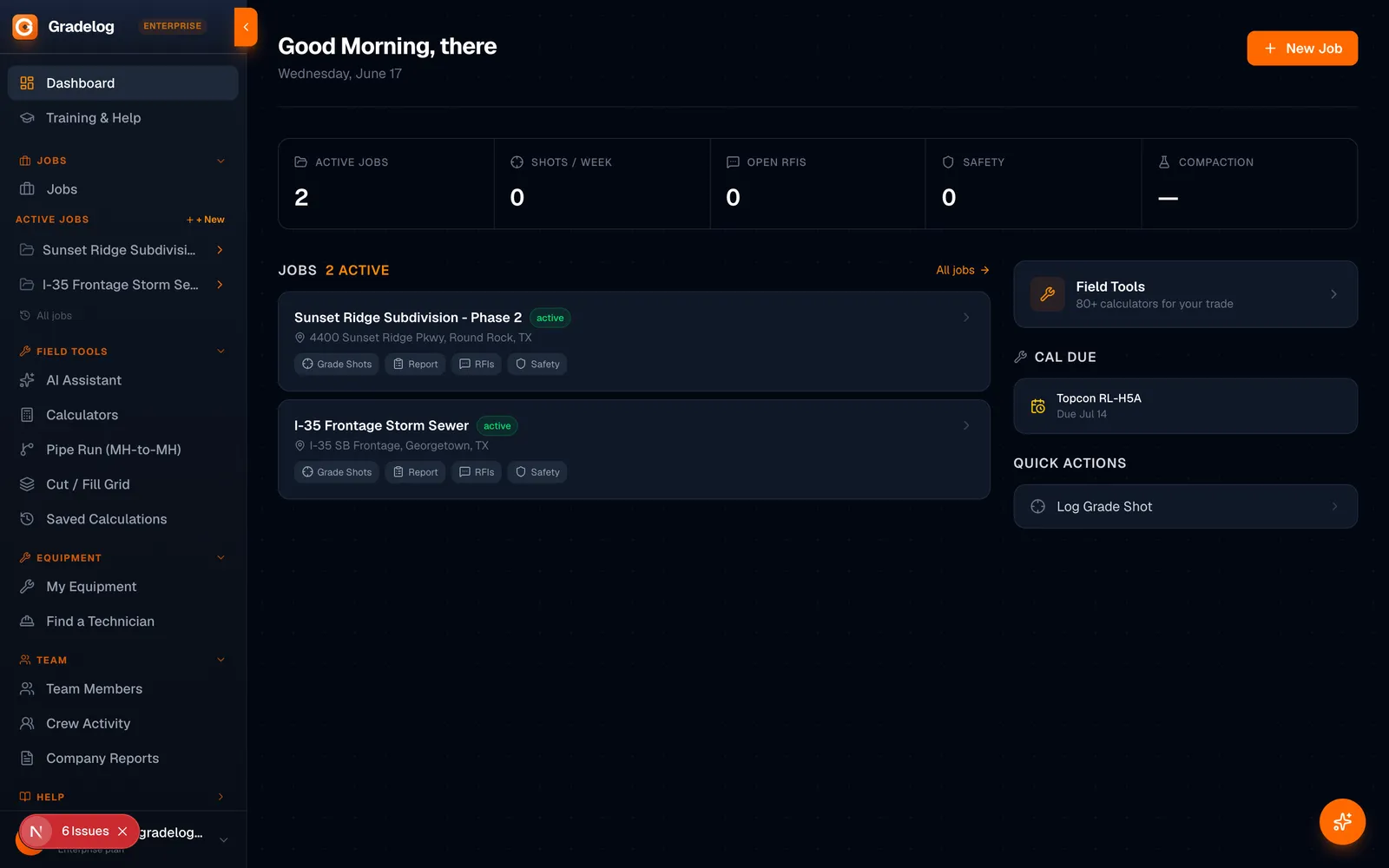
Built by the same team as Express Tools
Try Free →14 days
Free trial
8 languages
Supported
iPhone + Android
Works on