Free Shipping on orders over $500


How to Buy Used Survey Equipment: What to Check Before You Buy
Used survey equipment offers real savings, but an uninspected instrument can cost more in repair and downtime than buying new. This guide covers what to verify before handing over money — whether you are buying a total station, GPS rover, or laser level.
Quick Answer
How do I buy used survey equipment without getting burned?
Buy from reputable dealers or direct from contractors you can verify. Always test the instrument in person: power on, level, check for errors, run an accuracy verification. Ask for service records and the last calibration date. Budget for a post-purchase dealer calibration check. Avoid instruments with impact damage to the telescope or housing, missing original cases, or no software licenses.
Typical used savings
40–60% off new price
Biggest risk
Hidden impact damage
After purchase
Budget for calibration check
Physical Inspection Checklist
Before you power anything on, inspect the physical condition of the instrument.
- Check the telescope objective lens for scratches, chips, or fogging — optical damage is expensive to repair and often not worth fixing on older instruments.
- Inspect the tribrach and base plate for cracks or impact damage — even hairline cracks indicate the instrument was dropped.
- Check all physical buttons, knobs, and the display for cracks or damage.
- Open the battery compartment and inspect for corrosion — battery corrosion can damage circuits and is difficult to remediate.
- Verify the carrying case is original and intact — instruments without original cases have often been handled carelessly.
- Look at cable ports and connectors for bent pins or impact damage.
Power-On and Function Tests
Insist on a live demonstration. Never buy used survey equipment you cannot power on and test in person or through a verified dealer demonstration.
- Power the instrument on and verify it initializes without error codes.
- For total stations: run the leveling sequence, verify the tilt compensation is within spec, and rotate the instrument to verify horizontal drive movement.
- For rotary lasers: power on and verify self-leveling activates, the beam rotates continuously, and a receiver picks up the beam at range.
- For GPS rovers: power on, verify satellite acquisition, and if possible connect to a base station or network correction to confirm RTK fixed solution.
- Check battery charge holding — a battery that drains quickly in testing will drain faster under field load.
- For total stations with a data collector: verify the software licenses transfer with the instrument and that the collector connects without issues.
Accuracy Verification
Total stations: Perform a two-face measurement — measure an angle in Face 1 and Face 2 and compare. The difference should be within the instrument's published accuracy spec. Measure a known distance to a fixed target and compare against a tape measurement or previously verified distance.
GPS rovers: Set up over a published control monument and collect a fixed RTK solution. Compare against the published coordinates. Deviation larger than 2-3 cm horizontal or 5 cm vertical in a confirmed fixed solution indicates a problem.
Rotary lasers: Set up and check beam height at multiple distances in both directions (the "peg test"). Elevation difference between near and far readings indicates the instrument is out of calibration.
Red Flags to Walk Away From
- Seller refuses to power on the instrument or allow a live demonstration.
- Visible impact damage to the telescope housing or base.
- Error codes that the seller cannot explain or reproduce.
- Missing original case or accessories — prism, tribrach, data collector.
- No knowledge of service history or last calibration date.
- Price far below market — extremely cheap used instruments usually have hidden problems.
Frequently Asked Questions
Is buying used survey equipment worth it?
Yes, with a proper inspection. Savings of 40-60% off new price are common for well-maintained equipment. The key is verifying condition before purchase and budgeting for a dealer calibration check after purchase.
What should I check before buying a used total station?
Physical condition (lens, housing, base), power-on without errors, two-face angle accuracy test, distance measurement check against a known distance, and data collector software license status.
How do I verify used GPS rover accuracy before buying?
Set up over a known control monument, collect a fixed RTK solution, and compare measured coordinates to published values. Horizontal accuracy within 2-3 cm and vertical within 3-5 cm in a fixed solution is acceptable.
Powered by Gradelog
Keep Your Equipment Records in One Place
Gradelog lets you log calibration dates, service events, and accuracy verification results for every instrument in your fleet.
Try Gradelog FreeRelated Guides
Free 14 days with every Express Tools purchase
Your equipment. Your data. All in one place.
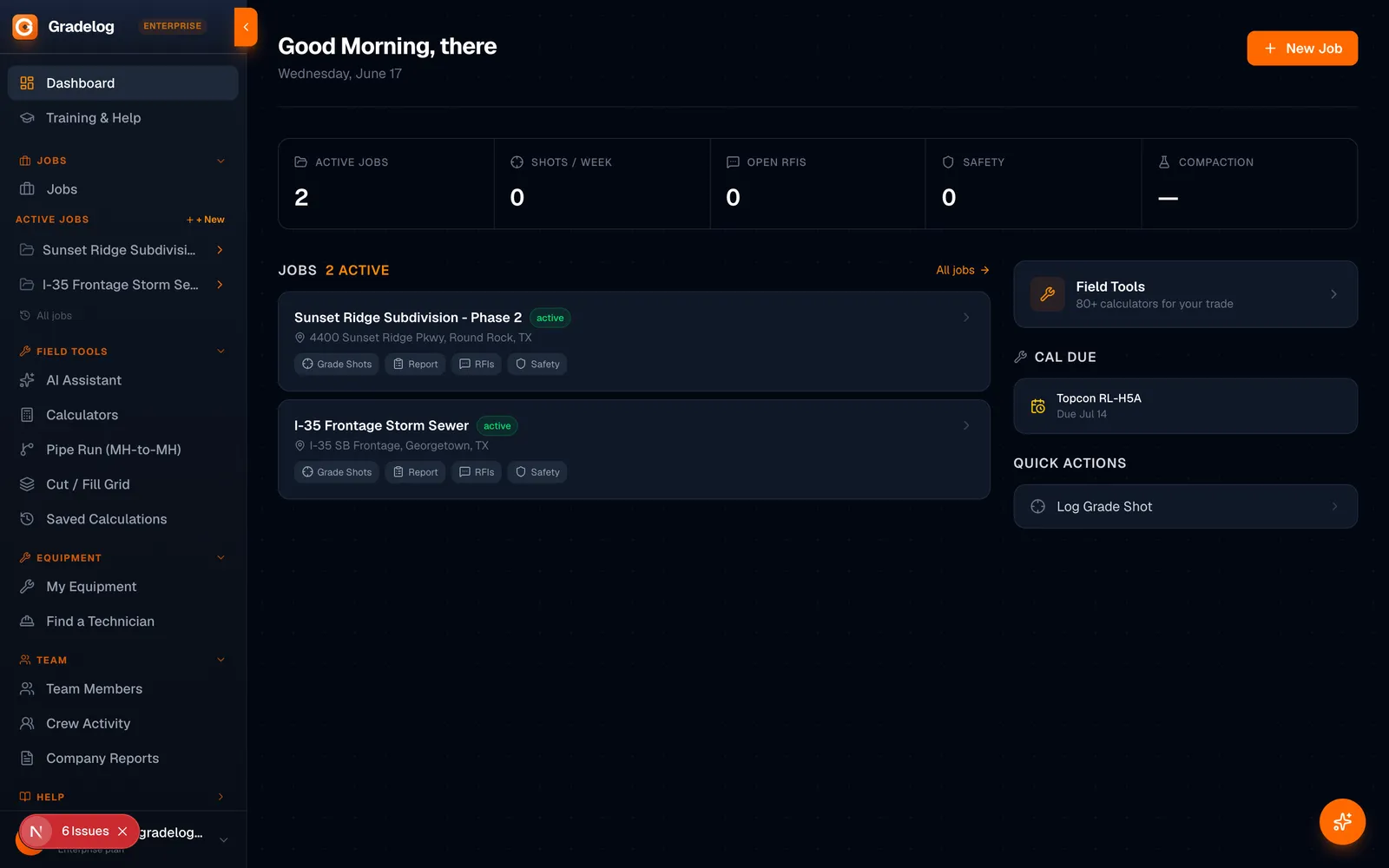
Gradelog is the field-execution platform built for grading and earthwork crews. Log grade shots, track cut/fill, document phases with photos, and generate as-built reports — from the cab to the office.
- Grade shots & cut/fill tracking per job
- Photo documentation by phase, task, and equipment
- As-built reports ready for inspector sign-off
- AI field assistant — troubleshoot on the jobsite
Built by the same team as Express Tools
Try Free →14 days
Free trial
8 languages
Supported
iPhone + Android
Works on