Free Shipping on orders over $500

Pipe Laser Buying Guide 2025: What Sewer and Utility Contractors Need
Pipe lasers are essential for gravity sewer installation where grade control directly affects system performance. A poor-quality instrument or wrong spec choice costs you in rework and failed inspections. This guide covers what actually matters when choosing a pipe laser for utility and sewer work in 2025.
Quick Answer
What should I look for when buying a pipe laser in 2025?
Focus on grade range (0-10% covers most sewer work), self-leveling speed and range, battery life for a full work day, and IP67 or better water and dust protection. Remote control capability from the target end of the pipe saves significant time on long runs. The major brands — Topcon, Spectra Precision, and Leica — all make reliable pipe lasers; choose based on your dealer support and existing equipment investment.
Grade range needed
0–10% for most sewer
Must-have protection
IP67 water/dust rated
Key time-saver
Remote grade adjustment
Key Specifications to Evaluate
Grade range: Most municipal sewer installations run grades between 0.5% and 2%. A pipe laser rated to 10% covers this range easily. Extended-range models (20-25%) are for steep terrain work and cost more. If your work is exclusively municipal utility, you do not need an extended-range instrument.
Self-leveling range: Pipe lasers self-level from the tripod or mounting system, but only within a specified range. A self-leveling range of +/- 5 degrees is typical. This matters when setting up in a sloped trench bottom — if the instrument is tilted beyond its self-leveling range, it will not level and will display an error.
Remote control: The ability to adjust grade and alignment from the target end of the pipe is a major time-saver on long runs. Without remote control, someone must walk back to the instrument each time a grade adjustment is needed. Look for this feature in any instrument you plan to use on runs longer than 50 feet.
Environmental protection: Pipe lasers work in wet, muddy, confined-space conditions. An IP67 rating (dust-tight, submersion to 1 meter) is the minimum for serious utility work. Some models are rated IP68 for extended submersion.
Top Pipe Laser Models for 2025
| Model | Grade Range | Remote | Protection |
|---|---|---|---|
| Topcon TP-L6 | ±10% | Yes | IP67 |
| Spectra Precision DG813 | ±10% | Yes | IP67 |
| Leica Piper 200 | ±10% | Yes | IP67 |
| Spectra DG613 | -12% to +40% | Yes | IP68 |
| Topcon TP-L5B | ±5% | No | IP54 |
Accessories You Actually Need
A pipe laser is only as useful as its mounting and target system. The mounting bracket needs to hold grade precisely under vibration from excavators and compactors. Verify the bracket is designed for the pipe diameter range you work in — mismatched brackets are a common cause of grade errors.
Laser targets: use the manufacturer's target for grade detection accuracy. Third-party targets may physically fit but can introduce reading errors. Keep a spare target on hand; they get lost in the trench.
Battery chargers and spare batteries: most pipe lasers run 20-40 hours per charge under normal conditions. If you work long shifts or in cold weather (which reduces battery capacity), a spare battery eliminates mid-day downtime.
Frequently Asked Questions
What grade range do I need in a pipe laser?
For most municipal sewer work, a 10% grade range covers everything you will encounter. Extended-range models (20-25%) are for steep-slope applications and cost more. Only buy extended range if your projects regularly require it.
How accurate does a pipe laser need to be for sewer work?
Modern pipe lasers achieve +/- 0.1% grade accuracy, which exceeds typical sewer installation tolerances. Practical accuracy in the field is more affected by instrument mounting stability and target reading technique than instrument specs.
Can one pipe laser work for both sewer and water main installation?
Yes. A standard pipe laser handles both gravity sewer (grade-critical) and water main (depth and alignment focused). You do not need separate instruments for different utility types.
Powered by Gradelog
Document Your Utility Grade Verification
Gradelog captures your as-built grade data and generates inspection-ready documentation automatically — no paperwork at the end of the day.
Try Gradelog FreeRelated Guides
Free 14 days with every Express Tools purchase
Your equipment. Your data. All in one place.
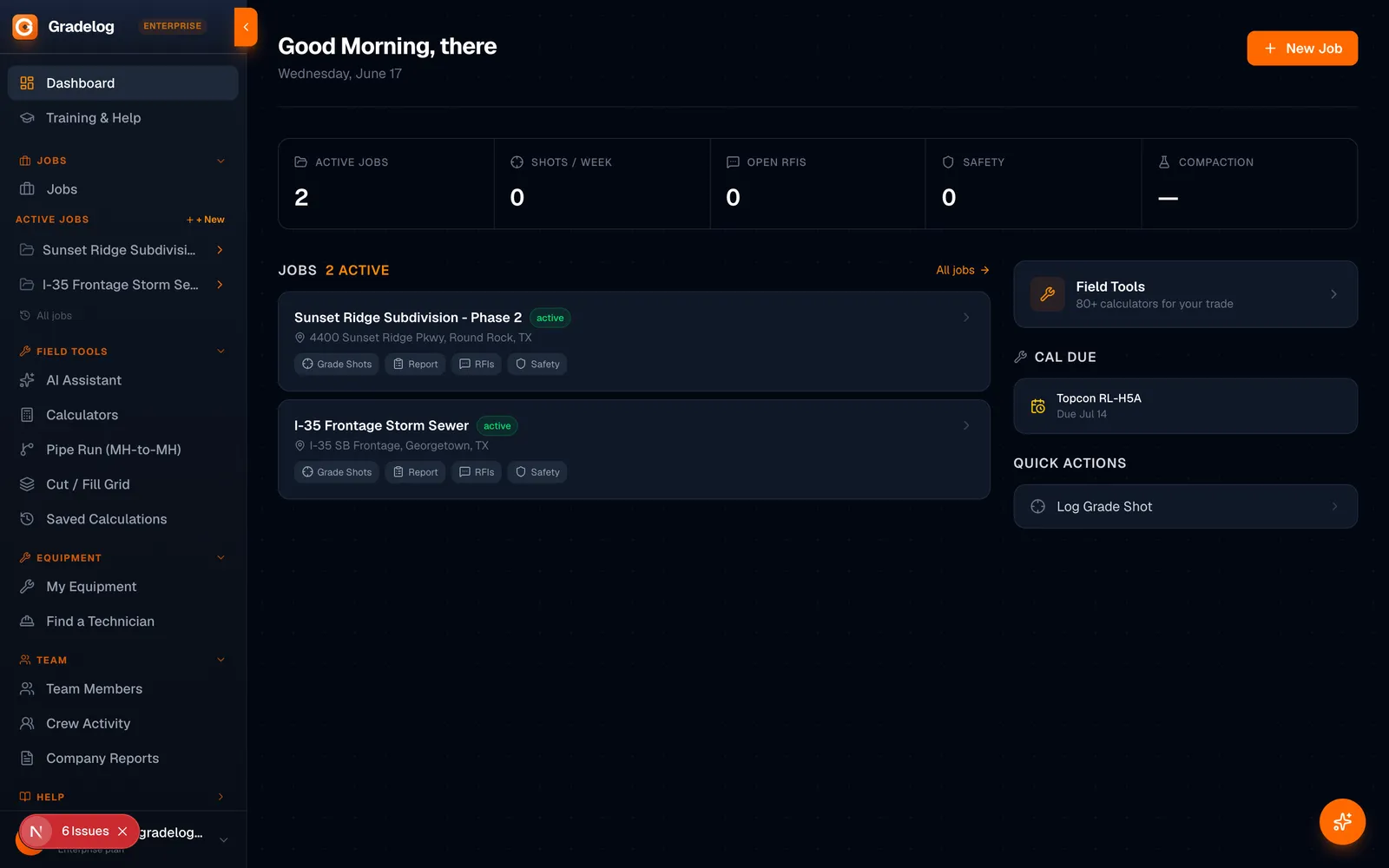
Gradelog is the field-execution platform built for grading and earthwork crews. Log grade shots, track cut/fill, document phases with photos, and generate as-built reports — from the cab to the office.
- Grade shots & cut/fill tracking per job
- Photo documentation by phase, task, and equipment
- As-built reports ready for inspector sign-off
- AI field assistant — troubleshoot on the jobsite
Built by the same team as Express Tools
Try Free →14 days
Free trial
8 languages
Supported
iPhone + Android
Works on