Free Shipping on orders over $500


How to Choose a Rotary Laser Level: Contractor's Guide
The rotary laser market ranges from sub-$200 hobby tools to $3,000 professional instruments. The difference in specs matters — a laser with the wrong feature set will either not work for your application or will not last long enough to be worth the purchase. This guide covers the key specifications to evaluate before buying.
Quick Answer
What specs matter when choosing a rotary laser level?
For construction work, prioritize accuracy (1/16 in at 100 ft or better), self-leveling range (5 degrees minimum), and whether you need single-grade or dual-grade capability. Outdoor work requires a high-power laser with a compatible detector — the naked beam is invisible in sunlight. Dual-grade is essential for flatwork with designed cross-slopes.
Standard accuracy
1/16" at 100 ft
Self-level range
5 degrees min
Outdoor range (with detector)
1,000-1,500 ft dia.
Key Specifications to Evaluate
1. Accuracy
Rotary laser accuracy is specified as the deviation from level at a given distance. Standard construction-grade instruments specify 1/16 inch at 100 feet (approximately 1.6 mm at 30 m). Some premium models achieve 1/32 inch at 100 feet. For general grading and layout, 1/16 inch is sufficient. For concrete flatwork where grade tolerance is ±0.03 ft, you need the most accurate instrument available.
2. Self-Leveling Range
Self-leveling range is how far out of level the instrument can be placed and still automatically compensate. Construction sites have uneven ground. A laser with a 3-degree self-leveling range will fail to level and lock out if the tripod is set on a 4-degree slope. Minimum 5 degrees is recommended; 8-10 degrees is better for rough site work.
3. Single Grade vs. Dual Grade
Single-grade lasers tilt in one axis (X or Y). Dual-grade lasers tilt in both axes simultaneously — required for concrete slabs with designed cross-slopes and for drainage structures that need to fall in two directions at once. Dual-grade lasers cost $400-$800 more than equivalent single-grade models. Do not buy a single-grade laser for a flatwork application that requires cross-slope control.
4. Operating Range
Laser range is specified as the diameter of the working area. Most construction lasers operate at 1,000-1,500 ft (300-450 m) diameter with a detector. Without a detector (indoor use), visible range is typically 50-150 ft. For large earthwork sites, verify the range specification against your actual work area — a 1,000 ft diameter covers a radius of only 500 ft from the instrument.
5. Indoor vs. Outdoor Use
Outdoor use always requires a laser detector. The rotary beam is invisible in sunlight regardless of laser power. For indoor concrete flatwork, a high-power laser with a detector makes setup faster and more accurate. For indoor layout work in a building, a standard model without a detector may be sufficient. If you will use the laser primarily outdoors, pay for a model with a compatible high-sensitivity receiver.
Rotary Laser Selection by Application
| Application | Required Specs | Grade Capability |
|---|---|---|
| General grading / earthwork | Standard accuracy, 5 deg self-level, 1,000 ft range | Single-grade sufficient |
| Concrete flatwork (no cross-slope) | High accuracy, detector required | Single-grade sufficient |
| Concrete flatwork (with cross-slope) | High accuracy, dual-grade, detector required | Dual-grade required |
| Interior layout / suspended ceilings | Standard accuracy, self-leveling, indoor range | Level-only (no grade needed) |
| Drainage structures / parking lots | Dual-grade, detector, waterproof rating | Dual-grade required |
| Pipe laser for sewer | Pipe laser (not rotary) — different instrument class | Fixed grade per design |
Frequently Asked Questions
What is the difference between a single-grade and dual-grade laser?
A single-grade laser tilts in one axis. A dual-grade laser tilts in both X and Y simultaneously, allowing you to set a cross-slope. Dual-grade is required for any flatwork application where the surface must drain in two directions at once.
Do I need a receiver for outdoor use?
Yes. The rotary laser beam is invisible in sunlight regardless of power level. A laser detector (receiver) is required for all outdoor work. The detector clips onto a grade rod and beeps or flashes when the beam crosses it.
How long do rotary lasers stay calibrated?
Professional-grade rotary lasers typically hold calibration for 6-12 months under normal use. Calibration should be verified after any drop or impact, and annually even if the instrument has not been dropped. Calibration verification takes about 5 minutes with a tape and a flat surface.
Powered by Gradelog
Connect Your Laser to Your Grade Documentation
Gradelog integrates with your field measurement workflow to capture elevation data and build as-built reports automatically.
Try Gradelog FreeRelated Guides
Free 14 days with every Express Tools purchase
Your equipment. Your data. All in one place.
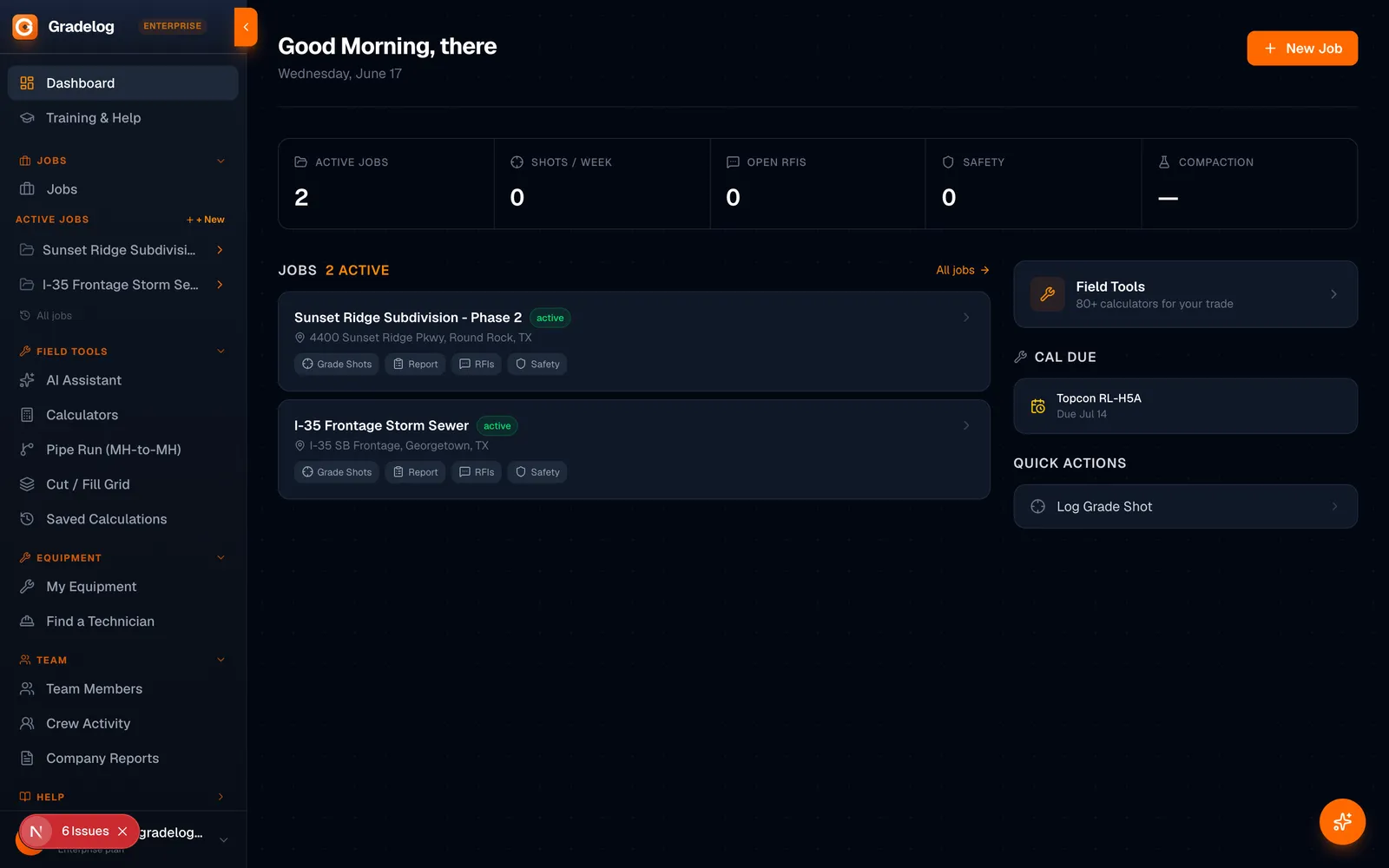
Gradelog is the field-execution platform built for grading and earthwork crews. Log grade shots, track cut/fill, document phases with photos, and generate as-built reports — from the cab to the office.
- Grade shots & cut/fill tracking per job
- Photo documentation by phase, task, and equipment
- As-built reports ready for inspector sign-off
- AI field assistant — troubleshoot on the jobsite
Built by the same team as Express Tools
Try Free →14 days
Free trial
8 languages
Supported
iPhone + Android
Works on