Free Shipping on orders over $500

How to Choose a Pipe Laser: What Sewer Contractors Look For
A pipe laser is one of the most used tools in sewer and utility installation — and one of the most abused. It sits at the bottom of a wet trench, gets hit by bedding material, and needs to hold grade all day without rechecking. Choosing the right one means understanding which specs matter in the field versus which ones only look good in a brochure.
Quick Answer
How do sewer contractors choose a pipe laser?
Sewer contractors prioritize grade range (covers project specs), self-leveling range (works on typical trench setups), beam visibility at working distance, and water/dust ingress rating. For most gravity sewer work, any brand-name pipe laser with -10% to +25% grade range and IP67 or better waterproofing is adequate. Brand choice should follow dealer service availability and compatibility with existing accessories.
Grade range needed
-10% to +25%
Accuracy required
+/- 0.05% grade
Waterproof rating
IP67 minimum
Grade Range: The Most Important Spec
Grade range is the minimum and maximum slope the pipe laser can be set to. Most gravity sewer and storm drain work falls between 0.2% and 5%. A pipe laser rated to -10% to +25% covers virtually every gravity application, plus steep utility runs and sloped site drain work.
Do not confuse grade range with self-leveling range. Self-leveling range is how much out-of-level the instrument can compensate for when you set it on a tripod in the trench — typically +/-5 degrees on quality instruments. Grade range is what slope you can dial in once the instrument is leveled. Both specs need to match your work.
Waterproofing and Durability
A pipe laser works at the bottom of a trench, where it encounters mud, standing water, groundwater infiltration, and direct contact with pipe bedding material. IP67 waterproofing (submersible to 1 meter) is the minimum acceptable rating for any pipe laser used in sewer work. Some contractors prefer IP68 instruments for deep trench applications where the laser may be partially submerged during wet weather.
Drop resistance is equally important. Look for instruments rated to 1-meter drops — the standard for quality construction laser instruments. Rubber armoring protects the instrument body in trench environments better than hard plastic housings.
Beam Visibility and Working Distance
The pipe laser beam must be visible at the target placed in the pipe at the working face. Most sewer runs are set up 100-300 feet between manholes. At 300 feet, beam diameter and output power determine whether the operator can accurately read the target. More expensive instruments use higher-power beams and tighter collimation for longer working distances.
Working in daylight versus underground darkness affects apparent beam brightness. For open-trench work in sunlight, a brighter beam or a beam detector target improves accuracy. For tunnel boring or underground work, lower-power beams are visible at close range but struggle at distance in natural light.
Brand Comparison at a Glance
| Brand/Model | Grade Range | IP Rating | Position |
|---|---|---|---|
| Trimble GCS300 | -10% to +25% | IP67 | Premium |
| Topcon TP-L5B | -10% to +25% | IP67 | Mid-premium |
| Spectra Precision LP51-2 | -10% to +25% | IP67 | Value |
| Leica Piper 100 | -10% to +30% | IP67 | Premium |
For a deeper comparison, see our full pipe laser buying guide.
What to Skip on the Spec Sheet
Stated accuracy specifications for pipe lasers are typically measured under lab conditions. For field use, factors that matter more than published accuracy include: how stable the instrument holds calibration over temperature changes, how repeatable grade settings are after moving the instrument between setups, and how easy the interface is to use in the dark at the bottom of a trench with work gloves on.
Battery life matters more than it appears. A pipe laser that runs 20+ hours on a battery pack does not require mid-shift battery swaps. Check whether the instrument accepts standard AA batteries as an emergency backup — a feature that earns its cost on remote rural job sites.
Frequently Asked Questions
What grade range do I need in a pipe laser?
For most municipal sewer and storm drain work, -10% to +25% grade range covers all applications. Verify both grade range and self-leveling range — they are different specifications and both must match your job conditions.
What pipe diameter range does a pipe laser need to cover?
Pipe lasers use a target/crosshair system placed in the pipe — the laser does not enter the pipe. Verify that manufacturer targets are available for your most common pipe diameters, especially small-diameter (4-6 inch) applications which sometimes require separate accessories.
How accurate does a pipe laser need to be for sewer work?
Most quality pipe lasers achieve +/-0.05% grade accuracy, exceeding typical spec requirements of 0.1%. At long working distances (200+ feet), beam collimation and output power affect practical accuracy more than stated specifications.
Powered by Gradelog
Track Pipe Installation Records Automatically
Gradelog captures as-installed pipe grades and elevations from your field data, automating the inspection record-keeping that typically takes hours per week.
Try Gradelog FreeRelated Guides
Free 14 days with every Express Tools purchase
Your equipment. Your data. All in one place.
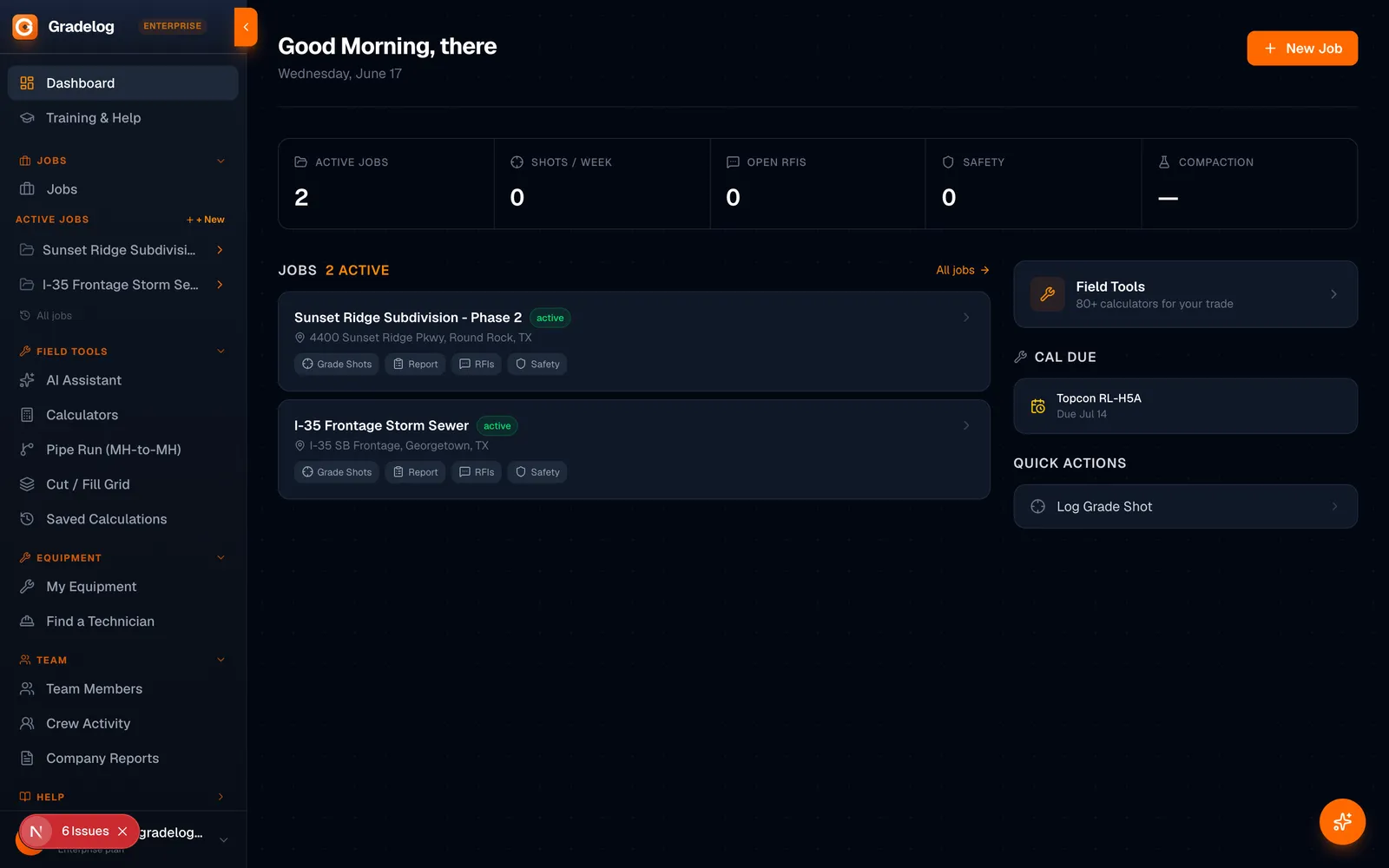
Gradelog is the field-execution platform built for grading and earthwork crews. Log grade shots, track cut/fill, document phases with photos, and generate as-built reports — from the cab to the office.
- Grade shots & cut/fill tracking per job
- Photo documentation by phase, task, and equipment
- As-built reports ready for inspector sign-off
- AI field assistant — troubleshoot on the jobsite
Built by the same team as Express Tools
Try Free →14 days
Free trial
8 languages
Supported
iPhone + Android
Works on