
Quick Answer
Top pick: Topcon RL-H5A — The RL-H5A's ±10 arc second accuracy, IP66 weatherproofing, and 80-hour battery life make it the standard for professional flatwork. The 800m working range covers even the largest commercial pours without repositioning.
Best Rotary Laser for Concrete Flatwork 2025
Concrete flatwork demands more from a rotary laser than almost any other application — you're setting screed rail elevations that will be permanent, working in dusty and wet conditions, and often coordinating across large slab areas where beam visibility matters. Here's what the best flatwork contractors use.
Top Picks at a Glance
Topcon RL-H5A — Best overall for flatwork
Price range: $1,100–$1,400
IP66, 800m range, 80hr battery, 1-meter drop resistance. The professional flatwork standard. Self-levels in under 5 seconds on a good tripod setup.
Spectra Precision LL500 — Best value for production residential
Price range: $700–$900
D-cell batteries (100hr life, no charging hassle), 500m range, ±1/16" accuracy. Ideal for production framing crews doing multiple slabs per week.
Leica Rugby 620 — Best for sloped flatwork
Price range: $900–$1,200
±25% grade range vs Topcon's ±10%. If you do parking lots, drainage pads, or any work with significant cross-slope, the Rugby 620 handles grades others can't.
Topcon RL-SV2S — Best for dual-slope flatwork
Price range: $1,400–$1,700
Sets independent X and Y slope simultaneously. Required for complex drainage work and parking structures with crown grades.
What to Look For
- Accuracy — ±1/16" per 100' is the minimum for professional flatwork. The RL-H5A, LL500, and Rugby all meet this. Don't use a consumer-grade laser on commercial concrete work.
- Weatherproofing — IP56 is the minimum for concrete work — wet concrete splashes, and dust is constant. IP66 (Topcon) is better. Avoid IP54 units for slab pours.
- Battery life — 8+ hours per charge. Pouring concrete on a deadline means you can't stop to charge. The LL500's D-cell batteries mean no charging logistics at all.
- Working range — 400m+ diameter covers most commercial slabs. For large industrial floors, 800m range (RL-H5A) eliminates any need for repositioning.
Frequently Asked Questions
What accuracy do I need for concrete flatwork?
For commercial flatwork, ±1/16" per 100 feet. For warehouse floors with strict FF/FL specifications, consider a laser that's been recently calibrated and verified — even a small calibration error compounds across a large floor.
Should I use a red or green laser for concrete work?
Red is standard for most flatwork. Green laser (Bosch GRL 300 HVG, DeWalt DCLE34020G) is more visible in bright outdoor conditions but costs more. For indoor flatwork or covered pours, red is sufficient.
What receiver should I use for concrete slab work?
For screed rail setting, the Topcon LS-80L or Spectra HR550 (with digital grade readout) are the professional choices. The digital readout on the HR550 lets you read the exact screed elevation deviation without walking back to the laser.
How do concrete contractors use screed guides with a rotary laser?
The laser receiver is mounted to a hand screed or wet screed rail, and the operator adjusts the screed height until the receiver is on-grade. The receiver beeps or flashes to indicate high/low, allowing the crew to maintain consistent slab thickness across the pour. For larger pours, a laser screed (Somero, Ligchine) integrates the laser reference directly into the powered screed system.
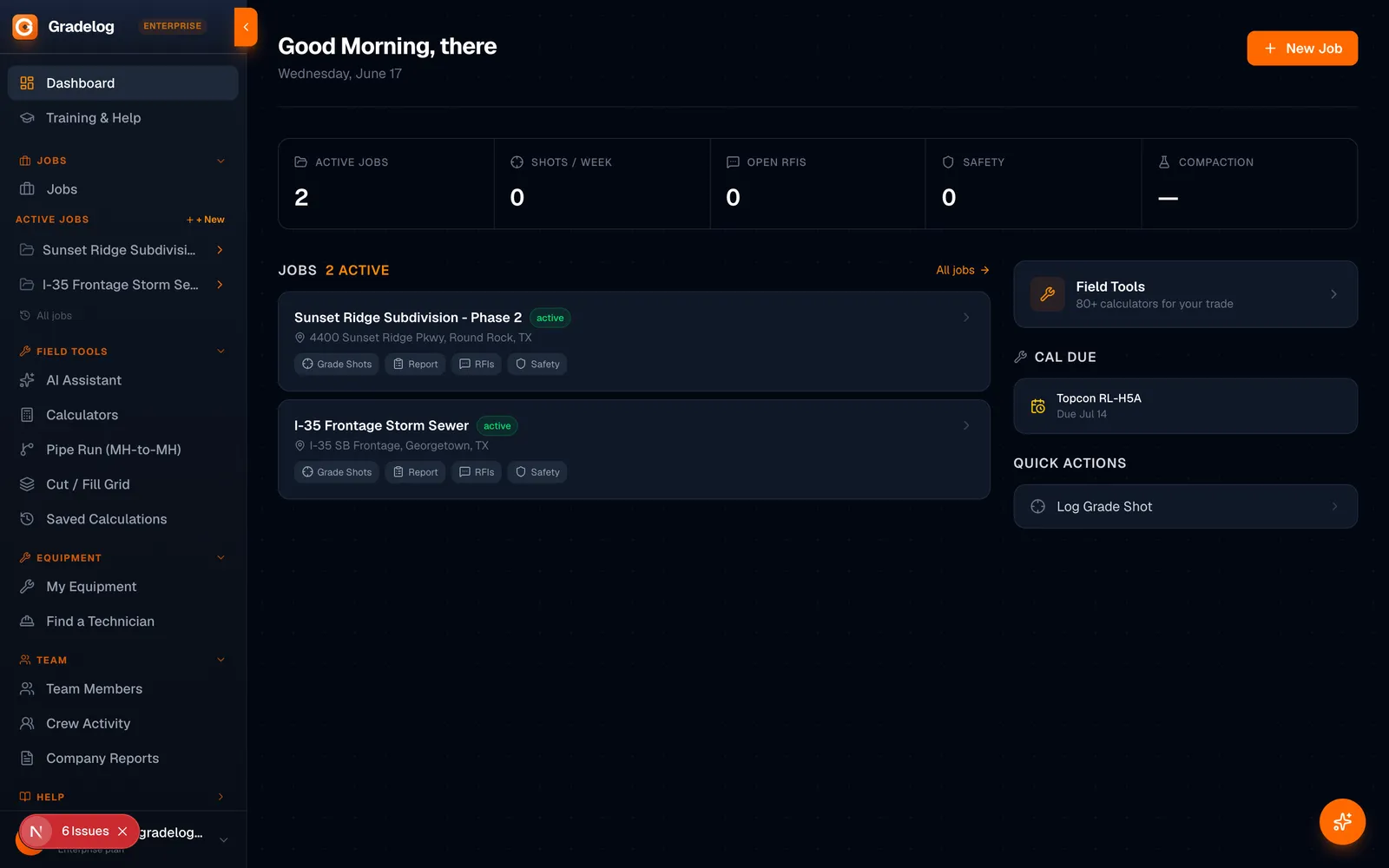
Already own this equipment? Gradelog keeps your calibration records, job logs, and equipment documentation organized. Free to start at gradelog.com.