
Quick Answer
Top pick: Topcon TP-L6G — The Topcon TP-L6G is the professional standard for gravity sewer installation, with a ±0.01° grade accuracy, 300m visible range, and IP67 waterproofing for the wet, muddy conditions inside a sewer trench. Its green beam provides superior visibility over red-beam alternatives in typical sewer trench conditions.
Best Pipe Lasers for Gravity Sewer 2025
Gravity sewer is one of the most demanding applications for a pipe laser. You're working inside a trench, often in the presence of groundwater and mud, setting grade to minimum slopes that may be as low as 0.5% — just 6 inches of fall per 100 feet. An error in grade setting can cause chronic sewer backup issues that are expensive to diagnose and even more expensive to repair after the pipe is buried.
The pipe laser lives inside the pipe or at the trench bottom for the entire installation. It gets splashed, knocked, and works in confined, humid conditions. Waterproofing and robustness aren't optional — they're the first thing to check.
Top Picks at a Glance
Topcon TP-L6G — Best overall for gravity sewer
Price range: $3,200–$4,000
Best for: Municipal sewer, storm drain, gravity drainage systems
The TP-L6G is the definitive professional pipe laser for gravity sewer work. Its green laser diode produces a 520nm beam that's substantially more visible than red in the wet, low-contrast interior of a sewer trench — particularly important when working with dark-colored pipe or muddy trench conditions. Grade accuracy is ±0.01° (approximately ±0.017%), which translates to about ±0.018" per 100 feet — well within the 0.08"/foot tolerance required on most minimum-slope sewer work. The remote grade display lets the instrument operator see current grade setting without entering the trench. Grade range is ±10%, covering the steepest practical sewer slopes. IP67 waterproofing allows full submersion to 1 meter — critical when groundwater infiltration or rain fills the trench floor. Battery life is rated at 40 hours. Includes a laser target with digital readout compatible with Topcon's LS-B10W wireless receiver for hands-free grade monitoring.
Spectra Precision DG813 — Best for contractors who prioritize simplicity
Price range: $2,800–$3,500
Best for: Contractors transitioning from optical methods, straightforward gravity sewer
The Spectra DG813 uses a red laser but compensates with a bright, tightly focused beam and an intuitive grade-setting interface. Grade accuracy is ±0.01° — identical to the TP-L6G. The DG813's main advantage is its simplified controls: grade is set via thumb wheel with a digital display that shows both target and current grade side by side, reducing setup errors. Working range is 300m. IP67 waterproofing. The DG813 is often the preferred choice for smaller contractors or crews where the instrument operator is also doing other work and needs to change grade settings quickly and confidently. Battery life is 60 hours from 4 C-cell batteries — longer than the TP-L6G and no charging needed.
Topcon TP-L5G — Best value green-beam pipe laser
Price range: $2,200–$2,800
Best for: Contractors who want green beam at reduced cost, secondary pipe lasers
The TP-L5G is the previous generation of the TP-L6G — still a professional-grade instrument with ±0.01° accuracy and IP67 waterproofing, but with a shorter battery life (30 hours) and slightly less refined controls compared to the L6G. The 300m range is identical. For contractors who want green beam visibility but can't justify the TP-L6G premium, the L5G is an excellent option. Also useful as a backup instrument on large projects where two pipe lasers are working simultaneously on different pipe runs.
What to Look For in a Gravity Sewer Pipe Laser
- Grade accuracy — ±0.01° or better. At minimum sewer slopes (0.5% or less), your grade accuracy is a significant fraction of your total tolerance. A ±0.017% accuracy error on a 0.5% design slope is a 3.4% error — still within spec but it leaves very little margin for installation variation. Use the most accurate instrument available on minimum-slope work.
- Waterproofing — IP67 minimum for sewer work. Not IP55, not IP56. Full submersion rating. Groundwater, pump failures, and rain can submerge a trench floor without warning. IP67 saves instruments.
- Beam color — Green beam (520nm) is significantly more visible inside a pipe or trench than red (635nm). For professional sewer work in any condition other than a clean, dry concrete pipe, green is worth the premium.
- Target compatibility — Wireless digital grade targets (Topcon LS-B10W, Spectra HR500W) let the rod person or pipe layer monitor grade at the pipe face without looking back at the instrument. Faster production, fewer grade errors.
Minimum Slope and Grade Setting Best Practices
For 8" and smaller sewer pipe, most municipal standards require minimum 0.4% grade (approximately 0.05 feet per 10 feet, or 0.6" per 10 feet). This is tight. Before setting grade on any minimum-slope run, verify that the pipe laser grade readout matches a hand-calculated check: set a stake at both ends of the run and verify the invert elevations match your design grade.
On long sewer runs, check grade at every 4th or 5th pipe joint by reading the laser target position at the pipe face. Grade errors that go unchecked for 10+ joints can mean cutting out and relaying a significant amount of pipe. Catching drift at the 4th joint costs 15 minutes of correction. Catching it at the 30th joint costs 2 days.
In groundwater conditions, pump the trench floor dry before setting the pipe laser. Floating or tilting the instrument in standing water introduces grade errors that are nearly impossible to diagnose until the damage is done.
Frequently Asked Questions
What is the minimum pipe size for a pipe laser?
Most professional pipe lasers (TP-L6G, DG813) are designed for 6" diameter pipe and larger. For 4" pipe, you typically need a smaller-diameter instrument or a specialized 4" bracket. Most municipal sewer work uses 8" minimum anyway.
How do I set up a pipe laser for a curved sewer alignment?
Pipe lasers only shoot a straight beam — they can't follow a curved alignment. For curved runs, you'll break the alignment into tangent sections, relocating the pipe laser at each curve point. Longer radius curves can often be run as a series of short chords without needing to re-setup the laser for every single pipe.
Can I use the same pipe laser for both sewer and storm drain on the same project?
Yes. Pipe lasers are not application-specific — the same instrument that sets sewer grade sets storm drain grade. The key difference is that storm drain often requires steeper grades (2–3%+) while sewer may be at minimum slope. Verify your pipe laser's grade range (the TP-L6G goes to ±10%) covers your steepest storm drain slope.
What grade accuracy do I need for minimum-slope sewer work?
For minimum slope work at 0.4–0.5%, use a pipe laser with ±0.01° accuracy or better. This is ±0.017% grade accuracy. On a 0.4% design grade, this means your installed grade could be as low as 0.383% — still adequate for self-cleansing velocity, but with minimal margin. Any instrument less accurate than ±0.01° is not appropriate for minimum-slope sewer.
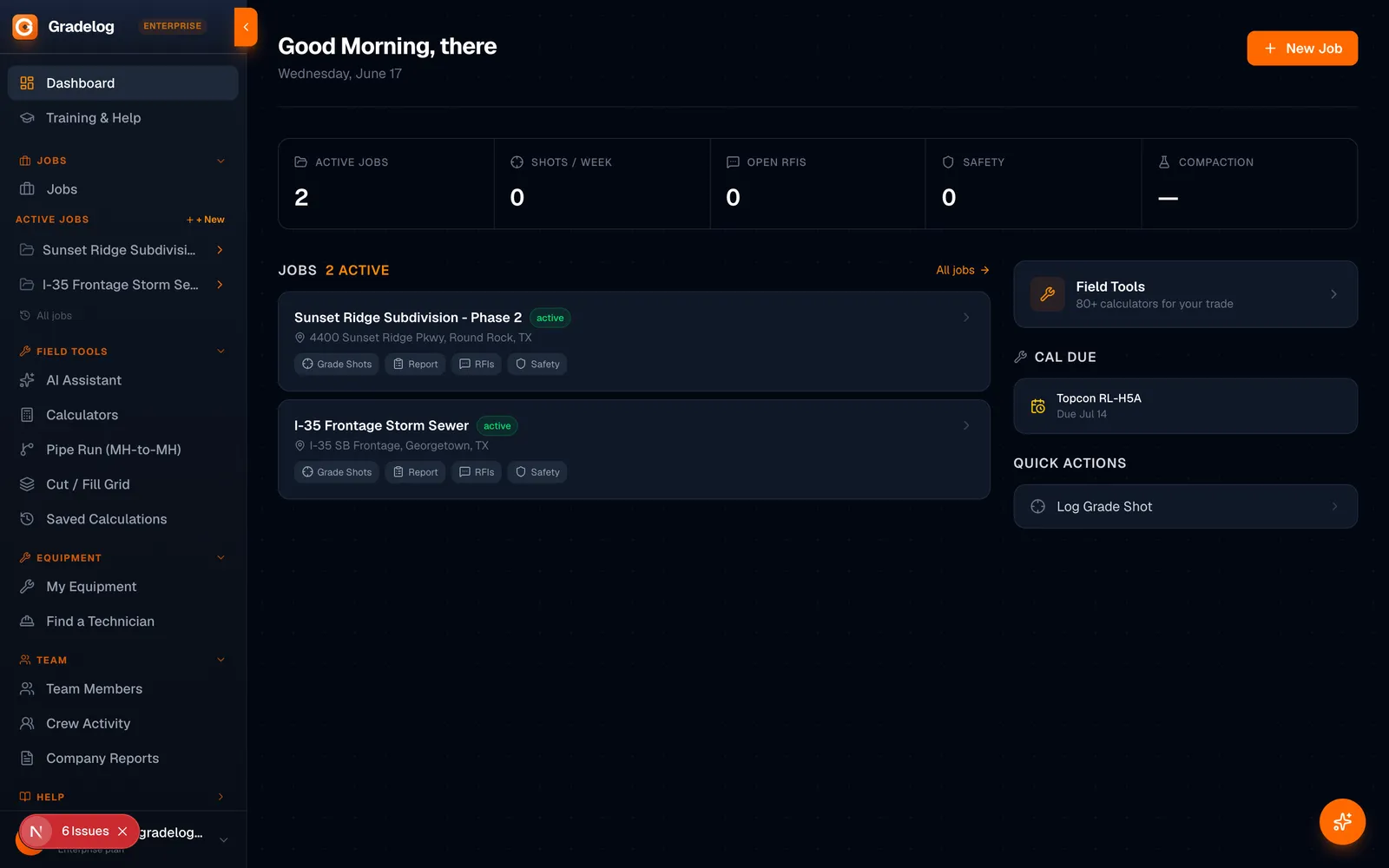
Track pipe laser calibration and as-built grade records for every sewer project. Gradelog keeps equipment records and field documentation organized for precision contractors — free to start at gradelog.com.