
Quick Answer
Top pick: Leica Lino L6R — Projects six lines simultaneously (four vertical, two horizontal) with 360-degree coverage, self-leveling, and 80m indoor range. The fastest tool for laying out building lines on concrete foundations and floor slabs — projects column lines, wall centerlines, and reference grids in minutes without a tape measure.
Best Layout Lasers for Foundation Layout 2025
Foundation layout requires transferring engineer-provided dimensions onto the ground accurately enough that walls, columns, and anchor bolts end up in the right place. A layout laser — projecting plumb and level reference lines — dramatically accelerates this work compared to tape-and-chalk methods, especially on complex floor plans with multiple offsets and non-right-angle geometries. Here is what foundation crews and concrete contractors use for efficient layout.
Top Picks
Leica Lino L6R — Best for interior foundation layout
Price: $700–$1,000
Six-line self-leveling laser: four vertical (projecting plumb lines on all four sides) and two horizontal (360-degree). 80m indoor working diameter with receiver, 30m without. IP64 rated. The L6R is the professional standard for laying out building lines inside concrete forms or on a slab after pour — projecting column grid lines, wall centerlines, and partition layout simultaneously. The 360-degree horizontal line establishes the elevation reference anywhere in the space without repositioning. Green beam for maximum visibility in daylight-lit interiors.
Topcon RL-H5A — Best for foundation elevation control
Price: $600–$900
For foundation elevation work — setting forms to finished floor elevation, checking footing depth, verifying slab thickness control — a rotary laser provides the elevation reference across the entire foundation area from a single setup. The RL-H5A's ±1mm/10m accuracy is adequate for foundation elevation work in residential and commercial construction. Pairs with any grade rod and receiver for rapid elevation checks during form setting and pour verification.
Hilti PR 30-HVS A12 — Best for rugged jobsite layout
Price: $850–$1,200
Six-line layout laser with IP65 waterproofing — the Hilti construction-grade equivalent of the Lino L6R. 100m range with receiver, Bluetooth remote leveling, rechargeable battery. The PR 30-HVS is built for repeated impact, tool crib storage, and daily abuse on active construction sites where consumer-grade lasers fail within months. The Hilti reputation for construction durability makes it the preferred choice for contractors who need a layout laser that will last 5+ years of daily professional use.
Budget / Mid-Range / Professional Tiers
- Budget ($100–$300): Cross-line lasers (Bosch GLL3-80, Dewalt DW088CG). Self-leveling, two or three lines, adequate for simple rectangular residential layouts. Limited range, no receiver compatibility, lower IP rating.
- Mid-range ($400–$700): Four to six-line self-leveling laser levels (Stabila LAX 400, Dewalt DW089LG). Adequate for commercial foundation layout in most conditions. Green beam, some IP protection.
- Professional ($700–$1,400): Leica Lino L6R, Hilti PR 30-HVS, Bosch GLL6-90. Full 360-degree coverage, receiver-compatible for extended range, IP64+, rechargeable. The correct choice for daily professional foundation layout on commercial construction projects.
What to Look For
- Number of lines — More lines means fewer laser repositions. A six-line laser projecting in all four directions from a single setup covers a complex floor plan with minimal moves. Two-line or three-line lasers require frequent repositioning on complex plans.
- Vertical line accuracy — Plumb accuracy matters for layout. Professional six-line lasers achieve ±0.2mm/m plumb accuracy — at 10m distance, the line is accurate to within 2mm. Consumer-grade lasers may be ±0.5mm/m or worse.
- IP rating — Foundation layout happens in wet, muddy conditions. IP54 minimum. IP65 for active construction sites where the laser may be hosed off or rained on directly.
- Beam color — Green beam is 4x more visible to the human eye than red in daylight conditions. For outdoor foundation layout or brightly lit interior spaces, green is worth the premium.
Frequently Asked Questions
How do I use a layout laser to set out a building foundation?
Establish your building corners from the site survey control points (using a total station or GPS rover for precise coordinate layout). Once corners are set, place the layout laser at the intersection of two primary building lines, align its beam with one reference line by rotating the instrument until the laser line crosses both endpoints, then project the perpendicular line to establish the building grid. Repeat from additional setups for complex plans.
Can a layout laser replace a total station for foundation layout?
For simple rectangular building footprints, a layout laser combined with a steel tape can handle the interior layout after the corners are set by a total station. For complex building plans, curved elements, or anything requiring accurate coordinate layout of multiple points, a total station remains necessary. The layout laser accelerates work within the building footprint; the total station establishes the building location on the site.
What is the accuracy of a six-line laser for foundation layout?
Professional six-line lasers achieve ±0.2–0.3mm/m accuracy for both horizontal and vertical lines. At 10m working distance, this means the line is within 2–3mm of true. For most foundation layout — wall layout, column centerlines, form alignment — this is more than adequate. For precision anchor bolt placement at closer tolerances, supplement laser layout with tape measurements from a verified reference line.
How do I check if my layout laser is level and accurate?
Self-leveling lasers compensate automatically within their leveling range (typically ±3–5 degrees). Verify level using the laser's self-check mode if available, or by placing the instrument on a known level surface and checking that the horizontal beam returns to the same height after rotating 180 degrees. For plumb verification, hold a plumb bob at a point on the laser's vertical line and verify they agree at distance.
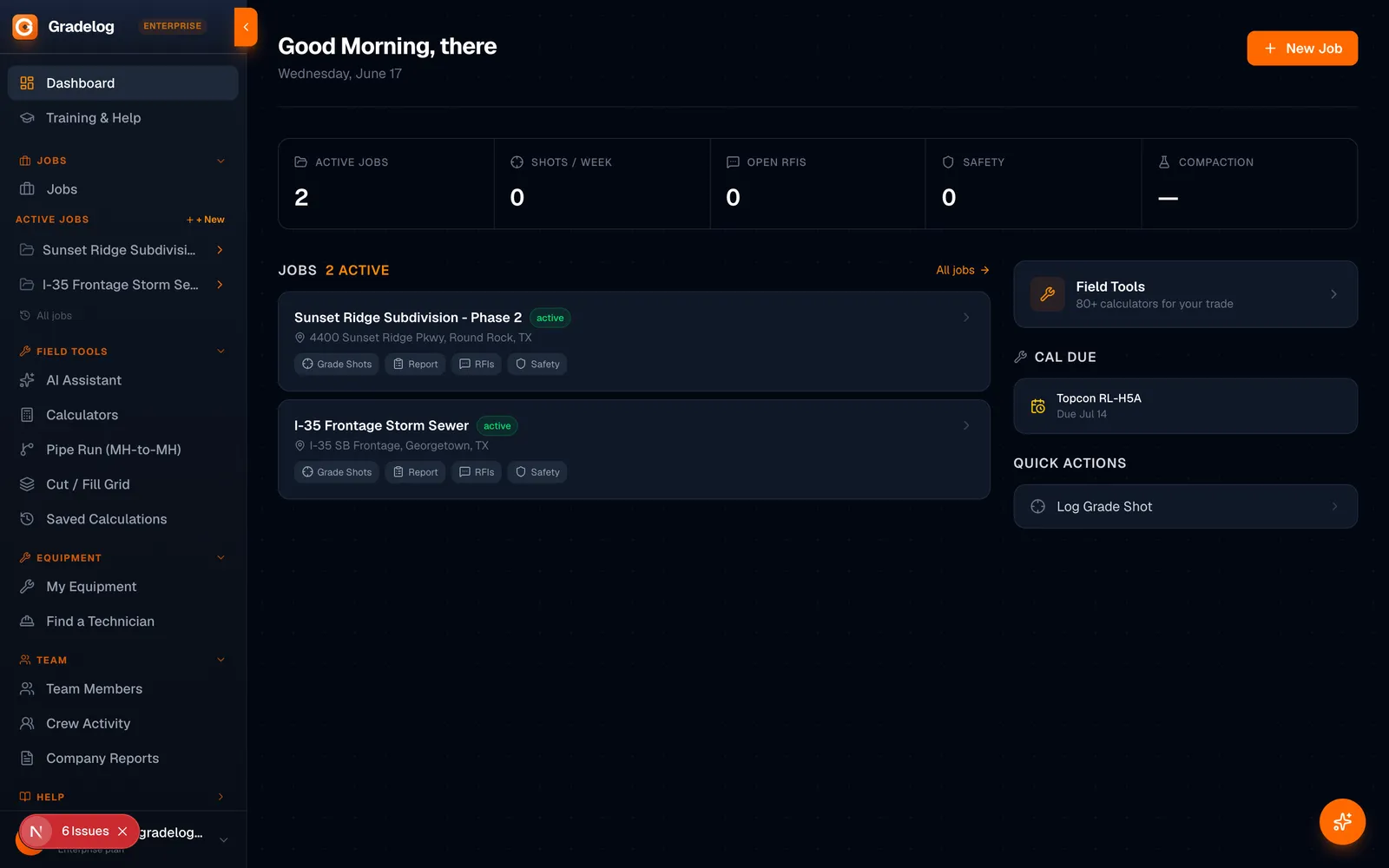
Document layout laser calibration checks, project assignments, and service history. Gradelog tracks field equipment records for foundation and concrete contractors — free to start at gradelog.com.