
Quick Answer
Survey equipment warranties typically cover one year and include defects in materials and workmanship under normal operating conditions. They do not cover impact damage (drops), water ingress beyond the IP rating, normal wear, or unauthorized modifications. Annual calibration from an authorized service center is the standard recommendation for instruments in active use — it maintains accuracy, satisfies QA requirements, and is required to keep some extended warranties valid. Always use an authorized service center for warranty work; unauthorized repair voids the warranty and may compromise calibration traceability.
Survey Equipment Warranty and Service FAQ
Understanding What Your Warranty Covers
A manufacturer warranty on survey equipment is a promise to repair or replace the instrument if it fails due to defects in materials or workmanship within the warranty period — typically one year from purchase. The warranty is not insurance against all failures. It specifically excludes operator-caused damage, environmental damage beyond the instrument's rated protection, normal consumable wear (batteries, seals, cleaning supplies), and any modifications or repairs performed by non-authorized personnel.
Reading the warranty document before a problem occurs is worthwhile. Know what is covered, what the claim process requires, and whether your purchase is from an authorized dealer (which affects warranty eligibility). Instruments purchased from unauthorized resellers may not be eligible for manufacturer warranty service.
Frequently Asked Questions
What does a standard survey equipment warranty cover?
Standard one-year warranties cover: factory defects in components that fail under normal operating conditions, optical system defects (delamination, internal fogging from manufacturing), electronic failures not caused by external damage, and compensator failures not caused by impact. Coverage typically includes parts and labor at an authorized service center. Shipping to the service center is usually the owner's responsibility; return shipping after repair is typically covered.
What does a warranty NOT cover?
Standard exclusions: drop and impact damage (most common claim denial), water ingress beyond the stated IP rating (IP54, IP65, IP67), scratched optical surfaces (from improper cleaning), battery failure (consumable), normal calibration drift (expected over time, not a defect), unauthorized repair or modification, and cosmetic damage that does not affect function. If you submit an instrument under warranty for a problem caused by impact, the service center will note this in their inspection report and deny the warranty claim.
How do I file a warranty claim?
Contact the authorized service center or manufacturer's service department with: proof of purchase (invoice or receipt showing purchase date), the instrument serial number, and a description of the failure. The service center will provide an RMA (Return Merchandise Authorization) number and shipping instructions. Ship the instrument in its original case or equivalent protective packaging. The service center inspects the instrument and either repairs under warranty or contacts you with an estimate if the failure is outside warranty coverage.
What is an authorized service center and why does it matter?
An authorized service center is certified by the manufacturer to perform repairs and calibration on specific instrument brands and models. They have access to manufacturer repair procedures, proprietary calibration software, certified test equipment, and genuine parts. Using an authorized service center maintains calibration traceability, keeps the warranty intact, and ensures repairs meet manufacturer specifications. Third-party shops may be cheaper but lack access to manufacturer tools and cannot issue manufacturer-certified calibration certificates.
What is the difference between calibration and service?
Calibration is the process of measuring the instrument's performance against known standards and adjusting it to within specification. It results in a calibration certificate documenting the results. Service (repair) addresses functional failures — components that have broken or degraded. Most service visits include a calibration check as part of the return-to-service process. Budget for calibration annually and service as needed; these are separate cost items. See the equipment calibration FAQ for detailed calibration procedures.
How often should I have survey equipment calibrated?
Annual calibration is the standard recommendation for instruments in active construction use. ISO 9001 quality systems require documented calibration records at defined intervals. Some extended warranty programs require annual calibration to remain valid. For instruments that see significant transport vibration or field exposure, semi-annual calibration may be appropriate. For low-use instruments (seasonal use only), calibrate before returning to active service. Always calibrate after an impact event before relying on the instrument for precision work.
How much does survey equipment repair and calibration cost?
Annual calibration (no adjustments needed): $150-400 for rotary lasers, $250-500 for total stations, $300-600 for RTK GNSS systems. Calibration with adjustment: add $100-300. Common repairs: compensator replacement $500-1,500, EDM module repair $800-2,500, display replacement $400-1,200, housing repair $300-800. Always get a written estimate before authorizing repairs on instruments valued under $5,000 — the repair cost sometimes approaches replacement cost for older models.
Is an extended warranty worth it for survey equipment?
Extended warranties (typically adding 1-2 years to standard coverage) are worth evaluating for high-value instruments (robotic total stations, RTK GNSS systems over $10,000) in daily use under harsh field conditions. Cost is typically $500-2,000 for a 2-year extension. One EDM or ATR repair on a robotic station can cost $2,000-5,000 — exceeding the extension cost. For simpler instruments (rotary lasers, optical levels), the extended warranty cost is usually not justified by the repair risk profile.
What happens if my instrument is damaged beyond economic repair?
If repair cost exceeds the instrument's current market value, the service center will recommend replacing rather than repairing. Some manufacturers offer trade-in or trade-up programs — particularly for current-generation models. Check whether your instrument is insured under a business property or equipment floater policy. Equipment insurance may cover replacement cost or actual cash value, depending on the policy terms. A police report is typically required for theft claims.
What is the turnaround time for factory service?
Typical service turnaround: warranty repairs 2-4 weeks at factory service centers, routine calibration 3-10 business days at authorized regional centers. Expedited service is available from most manufacturers for a 50-100% labor premium, with turnaround of 3-7 business days. For deadline-critical jobs, request expedited service in writing and confirm the commitment. Budget a rental instrument when the owned instrument is in service — see the rental FAQ for rental options.
Can I perform field calibration checks myself?
Yes — field checks differ from factory calibration. The two-peg test for levels, two-face measurement for total stations, and check shot verification for RTK GPS are field checks any operator can perform. They detect significant problems but do not substitute for factory calibration with certified test equipment. Perform field checks at the start of every precision job. See the calibration FAQ for specific procedures.
What is IP rating and how does it relate to warranty coverage?
IP (Ingress Protection) rating indicates the instrument's resistance to dust and water. IP54 means protected against splashing water from any direction. IP65 means protected against water jets. IP67 means protected against temporary immersion to 1 meter. Warranty covers water damage only if it occurs within the rated IP protection level. Submersion of an IP54 instrument, or water entry through a damaged seal, is typically not covered. Check your instrument's IP rating and operate accordingly — particularly around concrete washout, rain, and water features on job sites.
What should I do immediately after dropping a survey instrument?
After a drop or significant impact: do not assume the instrument is fine because it still powers on. Run a field check immediately — two-face measurement on a total station, two-peg test on a level, or RTK check shot for a GNSS receiver. If any anomaly appears, pull the instrument from service until a professional inspection is completed. Continuing to use a dropped instrument that is out of calibration contaminates your data and may result in construction errors far more costly than the service call. Document the impact event for warranty or insurance purposes.
How do I choose between manufacturer service and a third-party service center?
Manufacturer service (factory or authorized service center): highest confidence in calibration quality, genuine parts, warranty preservation, and calibration traceability documentation. Third-party service: potentially lower cost and faster turnaround for out-of-warranty instruments; quality varies significantly by shop. For in-warranty instruments: always use authorized service centers. For out-of-warranty instruments: third-party service is a viable cost option if the shop has demonstrable experience with your brand and can provide a calibration certificate. Ask for references and prior calibration certificates before choosing a third-party shop for precision instruments.
What records should I keep for survey equipment service history?
Keep: original purchase invoice (date and serial number), all calibration certificates, all service/repair records (dates, nature of work, service center name), and documentation of any impact events. These records support warranty claims, insurance claims, and resale value. For ISO 9001 or DOT quality programs, documented calibration records are required as part of the quality management system. Store digital copies in a location backed up independently of your office computer — losing service records is a common and avoidable problem. See the used equipment FAQ for how service records affect resale value.
What are the warranty and service policies for major brands?
Trimble: 1-year limited warranty, authorized service centers nationwide, Trimble Care extended service plans available. Topcon: 1-year limited warranty, authorized dealer service network, extended service options. Leica Geosystems: 1-year limited warranty, Leica Care service plans with extended coverage and annual calibration included. Spectra Precision: 1-year limited warranty, service through Trimble network (Trimble-owned brand). Sokkia: 1-year limited warranty, service through Topcon network (Topcon-owned brand). Contact your authorized dealer for current service plan pricing — programs change periodically and may include significant advantages for high-usage fleets.
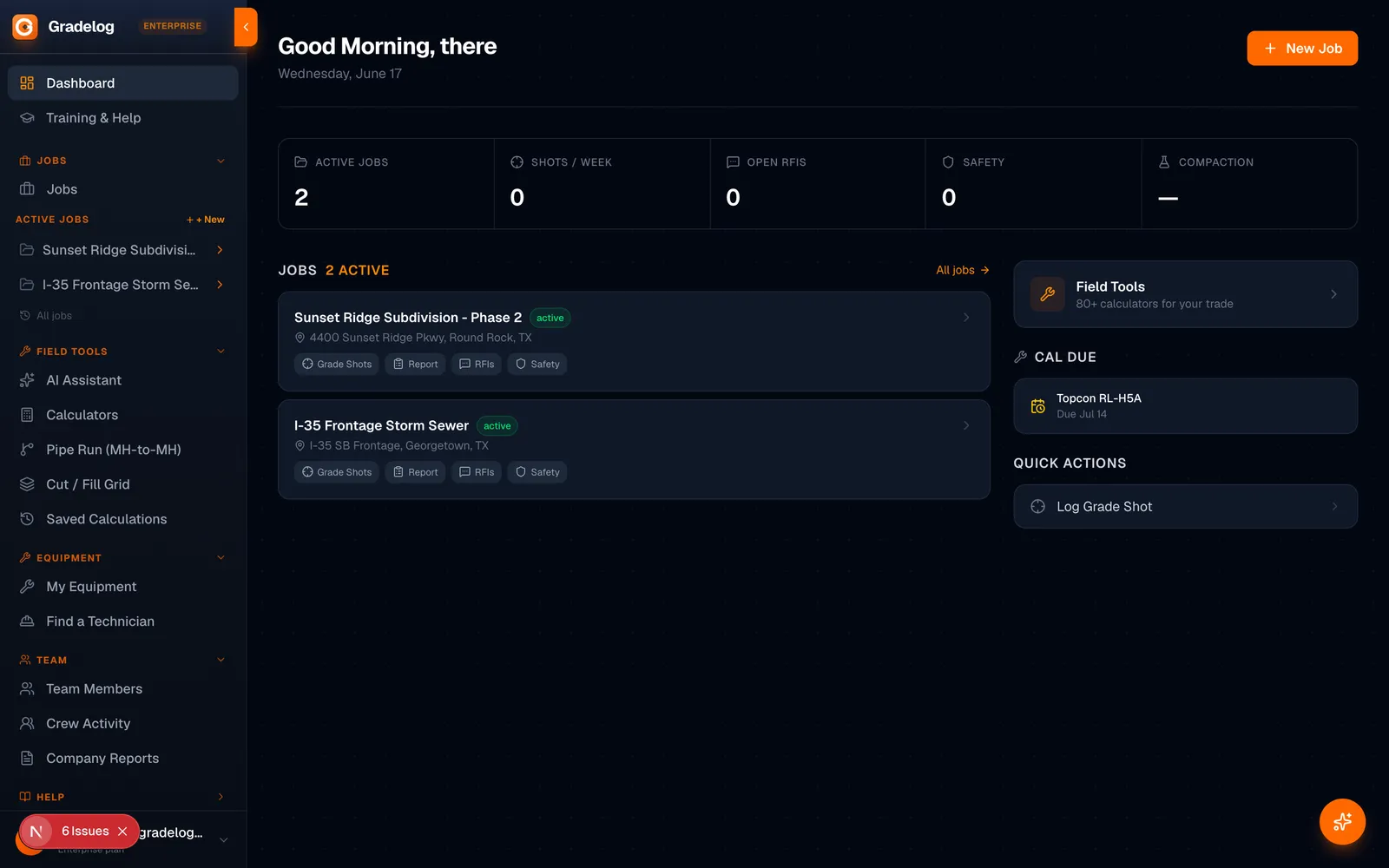
Tracking calibration records, service history, and instrument warranties across your equipment fleet? Gradelog provides equipment documentation and calibration record management tools for construction survey crews. Free to start at gradelog.com.