
Quick Answer
When buying used survey equipment, the three critical checks are: physical condition (no impact damage or cracked housing), calibration status (request a certificate dated within 12 months), and software subscription status (many licenses are not transferable or require fees to transfer). Used professional instruments (total stations, GNSS receivers) can offer 40-60% savings over new, but undisclosed service history and expired software are the biggest risks. Always buy from a seller who can provide a service history, or budget for a professional inspection and calibration check before relying on the instrument for precision work.
Used Survey Equipment FAQ: What to Check Before Buying
Why Used Survey Equipment Can Be a Good Buy
Professional survey instruments are built to last 15-20 years with proper care. A 5-year-old total station or GNSS receiver in good condition has most of its useful life remaining. The mechanical and optical components do not wear out quickly under normal use — the primary risks with used equipment are impact damage (drops) and software/firmware issues, not mechanical wear.
The savings are real: a Trimble S5 robotic total station that cost $25,000 new may be available used for $10,000-14,000 in good condition. A Topcon HiPer V GNSS kit that originally sold for $12,000 may be available for $4,000-6,000 used. These instruments perform the same measurements as their successors, often with only minor feature differences.
The Biggest Risks with Used Equipment
Impact damage is the primary mechanical risk — a dropped instrument may have damaged the compensator, EDM, or optical alignment in ways that are not externally visible but affect measurement accuracy. Always verify calibration on a used instrument before relying on it for precision work. Software subscription status is the primary financial risk — machine control software, field software subscriptions, and firmware update services are often tied to the original purchaser and may not transfer, or may transfer for a significant fee.
Frequently Asked Questions
What should I inspect physically when buying a used instrument?
External inspection checklist: check the housing for cracks, dents, or gouges (indicates impact events). Inspect all connectors for bent pins or corrosion. Check the optical surfaces (objective lens, eyepiece, EDM window) for scratches, chips, or fogging. Inspect the tribrach leveling screws for smooth operation. Check the display for dead pixels or cracks. Power on and verify all buttons and controls respond. Any signs of impact damage warrant a professional inspection before purchase.
How do I test a used total station before buying?
Set it up on a tripod, level it, and verify the electronic level display responds to adjustment. Sight a prism and fire the EDM — confirm you get a good distance reading. Rotate the instrument and confirm the horizontal angle display updates smoothly. If it is a robotic instrument, test the ATR by moving the prism and confirming the instrument tracks. Compare a measured distance to a known or taped distance if possible. Run the two-face test (measure a point in direct and reverse telescope positions) and confirm the angle differences are within specification.
How do I verify a used instrument is in calibration?
Request a calibration certificate from the seller — it should be from an authorized service center and dated within the last 12 months. If the seller cannot provide one, factor the cost of a calibration check ($150-400 depending on instrument) into your offer price. For total stations, you can do a basic field check by running a two-face measurement: measure a point in direct and reverse telescope positions and confirm the averaged angle matches the direct reading within the instrument's stated accuracy. Significant discrepancy indicates calibration drift or damage.
What is the risk of buying used GNSS equipment?
GNSS equipment has several specific risks: the antenna can be physically damaged without visible signs; firmware may be outdated and require a paid update to current versions; software subscriptions (Trimble Access, Topcon Magnet Field) may be expired or tied to the original owner. Network RTK subscriptions are personal accounts, not instrument-tied, so they are straightforward. Verify the serial number's firmware and subscription status directly with the manufacturer before purchasing high-value used GNSS equipment.
Can software licenses be transferred on used survey equipment?
It depends on the manufacturer and software type. Trimble Access and similar field software subscriptions are typically tied to the data collector serial number and can often be transferred through Trimble, sometimes for a fee. Machine control software licenses (GCS900, Topcon, Leica iCON) vary — some transfer with a transfer fee, others require a new purchase. Contact the manufacturer's support line directly with the serial number before buying used machine control equipment, and get the transfer policy in writing.
What is a legitimate service history and why does it matter?
A legitimate service history includes records of factory or authorized service center calibrations, repairs, and firmware updates. It tells you whether the instrument has been properly maintained, whether any damage was repaired, and what issues have been addressed. An instrument with a documented service history is worth more and carries lower risk than one with no records. Red flag: a seller who cannot explain why there are no service records for an instrument that is 5+ years old.
Where should I buy used survey equipment?
Best options in order of risk (lowest to highest): (1) authorized dealers who recondition and certify used equipment with a warranty; (2) contractors or survey companies liquidating equipment with documented history; (3) reputable online marketplaces with traceable sellers and return policies (avoid anonymous listings). Avoid: anonymous eBay or Craigslist listings with no service history, no returns, and no ability to inspect before payment. For instruments over $5,000, always inspect in person or have a local authorized dealer inspect before purchase.
What is a certified pre-owned instrument?
Some authorized dealers sell manufacturer-certified pre-owned (CPO) instruments — used units that have been inspected, repaired if necessary, and calibrated by the manufacturer or an authorized service center. CPO instruments typically come with a limited warranty (3-12 months) and a calibration certificate. The price premium over uncertified used equipment is 10-20%, but the warranty and calibration documentation significantly reduce purchase risk, particularly for high-value instruments.
How much should used survey equipment cost relative to new?
General used pricing guidelines: instruments 1-2 years old sell for 60-75% of new price in good condition. Instruments 3-5 years old sell for 40-60% of new. Instruments 5-10 years old with full functionality sell for 25-45% of new. Prices are higher for clean instruments with documentation and lower for instruments with unknown history, expired software, or visible damage. Compare against current new pricing before assuming a used price is a bargain — some models have been replaced and the new version is significantly improved.
What are red flags when evaluating a used instrument listing?
Red flags: seller cannot power on the instrument for demonstration; price is significantly below typical used market value (may indicate hidden damage or stolen equipment); listing describes "sold as-is" with no returns; no physical inspection allowed; serial number does not match the model described; seller cannot provide the original purchase receipt or any service records; description mentions "light impact" or "minor drop" without explaining what was done afterward.
Should I buy a previous-generation vs a current-generation instrument used?
Previous-generation instruments are often the best used value — they are mature technology with known reliability, lower used prices, and adequate performance for most construction applications. A Trimble S5 or Topcon GT-500 performs construction layout just as well as the current S7 or GT-1200 for most applications. The performance delta between generations is usually smaller than the price delta on the used market. Exceptions: if you specifically need features only in the current generation (newer firmware capabilities, specific connectivity), buying used of the older model may not satisfy your needs.
What warranty do I get when buying used survey equipment?
Private seller purchases typically carry no warranty. Authorized dealer used or CPO programs offer 3-12 month warranties. Manufacturer warranties are generally not transferable — the original buyer's warranty does not pass to you. When buying used without a warranty, the purchase price should reflect the risk of immediate repair costs. Budget for a calibration check and any deferred maintenance as part of your total acquisition cost, not just the purchase price.
How do I evaluate a used rotary laser vs a used total station?
Rotary lasers are simpler and lower-risk to buy used — fewer failure modes, field-serviceable, and relatively inexpensive to repair. Test the self-leveling mechanism (tilt the instrument past the leveling range and confirm it levels when returned to range), verify the laser outputs are visible and clean, and test the receiver at a 100-foot distance. Total stations have more complex electronics and optics — verify EDM, ATR (if robotic), and angle measurement as described above, and always request or budget for a calibration certificate.
Is a used pipe laser safe to buy?
Used pipe lasers are generally safe to buy if they pass a functional test: verify the self-leveling works, the laser beam is clean and bright, and the horizontal grade adjustment (if applicable) moves smoothly and locks securely. Pipe lasers are robust instruments with few failure modes. The main risk is impact damage from being set up in active trenches — inspect the housing and bracket mounting carefully. See the pipe laser FAQ for functional test details.
What are the best brands for used survey equipment value?
Trimble, Topcon, and Leica hold value well and have the strongest parts/service networks for older instruments. Spectra Precision and Sokkia occupy the mid-market and are good value used for general construction work. Avoid obscure brands with limited service networks — parts and service availability for older instruments from minor manufacturers is often poor. See the survey equipment buying FAQ for a full new vs used comparison framework.
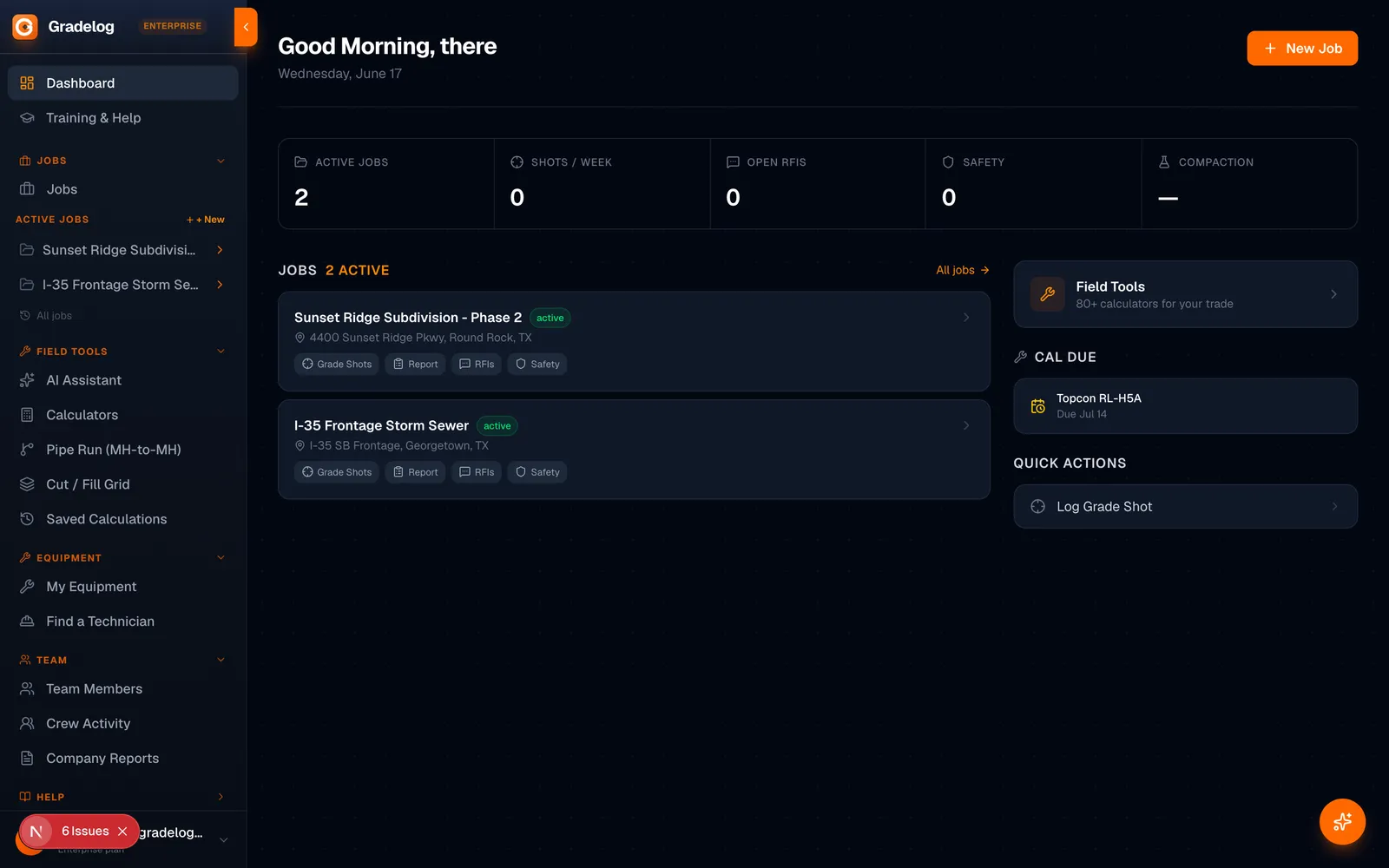
Tracking your instrument fleet, calibration records, and service history across multiple job sites? Gradelog provides equipment inventory and documentation tools for construction teams. Free to start at gradelog.com.