
Trimble vs Leica Machine Control: Which Platform is Better in 2025?
Quick Answer
Machine control systems are at the heart of modern construction and earthmoving operations. Whether you're grading, excavating, or paving, choosing between Trimble and Leica can significantly impact your productivity and bottom line. This comprehensive guide is designed for contr
Machine control systems are at the heart of modern construction and earthmoving operations. Whether you're grading, excavating, or paving, choosing between Trimble and Leica can significantly impact your productivity and bottom line. This comprehensive guide is designed for contractors, equipment managers, and construction professionals seeking to understand the key differences between these two industry-leading platforms. We'll break down specifications, capabilities, real-world performance, and cost considerations to help you make an informed decision aligned with your project needs.
⚡ Quick Verdict
Trimble Machine Control
Overview
Trimble Machine Control represents the most comprehensive and integrated machine control platform available in the market today. With decades of construction technology innovation, Trimble's system seamlessly integrates with GNSS receivers, laser systems, and total stations, while connecting to a robust ecosystem of software solutions including Project Management and Fleet Telematics.
Specifications
✓ Pros
- Widest equipment compatibility – works across Caterpillar, John Deere, Komatsu, Volvo, and more
- Seamless integration with Trimble office software (ProjectSite, Siteworks)
- Excellent network-RTK and GNSS coverage through Trimble RTX service
- Largest dealer network and technical support infrastructure
- Advanced telematics for fuel management and operator performance tracking
- Robust factory and aftermarket installation options
- Proven track record on large-scale public works projects
✗ Cons
- Higher initial system cost compared to competitors
- Ongoing subscription fees for RTX positioning service (if not using local base stations)
- Steeper learning curve for operators new to machine control
- Limited interoperability with non-Trimble design software (requires conversion)
Leica Machine Control
Overview
Leica Machine Control (part of Hexagon's construction division) offers a sophisticated, precision-focused solution that emphasizes accuracy and reliability. With strong European roots and growing North American presence, Leica delivers enterprise-grade machine control through intelligent integration of GNSS, laser, and total station technologies.
Specifications
✓ Pros
- Exceptional accuracy – laser integration provides ±3cm performance
- Intuitive, operator-friendly cab displays with minimal training
- Strong performance in challenging signal environments (laser backup)
- Excellent customer support through Hexagon's global network
- Competitive pricing, especially for smaller fleets
- HxGN SmartNet delivers robust RTK correction coverage
- Increasingly compatible with major equipment manufacturers
✗ Cons
- Smaller dealer network in North America compared to Trimble
- Fewer equipment compatibility options (though expanding)
- Less integrated project management ecosystem
- SmartNet subscription required for RTK (though competitive pricing)
- Limited telematics and fleet tracking compared to Trimble
Head-to-Head Specifications Comparison
Which Machine Control System Should You Buy?
Scenario 1: Large National Contractor with Mixed Fleet
Recommendation: Trimble Machine Control
If you operate 50+ machines across multiple regions and equipment brands (Caterpillar, John Deere, Volvo, Komatsu), Trimble's unmatched equipment compatibility and extensive dealer network make it the clear choice. The integrated fleet telematics and project management tools justify the higher cost through reduced downtime and optimized operations. RTX satellite positioning ensures consistent accuracy across remote job sites.
Scenario 2: Regional Grading/Earthwork Contractor (5–15 Machines)
Recommendation: Leica Machine Control
For a mid-sized regional contractor focused primarily on site grading and preparation, Leica offers exceptional value. The laser integration provides backup accuracy in challenging environments, operator interfaces are more intuitive (reducing training costs), and SmartNet delivers reliable RTK in your operational area. Lower upfront cost and subscription fees improve cash flow without sacrificing performance.
Scenario 3: Paving and Asphalt Operations
Recommendation: Trimble Machine Control
Paving requires tight tolerance control and rapid iterations across multiple machine types (screed, roller, truck). Trimble's specialized paving modules, broad equipment support, and fastest positioning updates (100Hz) deliver the consistency required. Integration with Trimble Pavement and Siteworks streamlines from design through verification, reducing rework and material waste.
Scenario 4: Small Contractor Testing Machine Control (First System)
Recommendation: Leica Machine Control
If this is your first machine control investment, Leica's shorter learning curve and lower entry cost minimize risk. The system is intuitive enough for operators to achieve productivity gains quickly, proving ROI before committing to larger fleet rollouts. Excellent support and training from Hexagon dealers help ensure smooth adoption.
Frequently Asked Questions
Can I switch from Leica to Trimble (or vice versa) without losing my design data?
Yes. Both systems support industry-standard formats like LandXML, DXF, and ASCII. You'll need to convert your design files, but the geometric data transfers cleanly. However, project metadata and custom configurations may require manual recreation. We recommend working with your dealer to plan a smooth transition.
What are the long-term subscription costs for GNSS positioning?
Trimble RTX: $150–$300/month depending on coverage area and accuracy tier. Trimble also offers perpetual licensing for local base stations (one-time cost ~$20,000).
Leica SmartNet: $120–$250/month with competitive regional pricing. HxGN SmartNet RTX offers global satellite coverage similar to Trimble RTX.
Many operators justify these costs through improved productivity (2–5% fuel savings, reduced rework, faster cycles).
Which system is better for remote locations with limited cellular coverage?
Trimble RTX has the advantage. It's satellite-based and doesn't require ground infrastructure, providing global coverage. However, both Trimble and Leica can operate offline with pre-loaded designs. For extended off-grid work, consider establishing a local base station (both systems support this) or confirming RTX/SmartNet RTX coverage in advance.
How long does it take operators to become proficient with these systems?
Leica: 1–2 weeks for basic proficiency on familiar machine types. Intuitive display design minimizes cognitive load.
Trimble: 2–4 weeks due to more comprehensive feature set. Advanced operators using telematics and project integration benefit from longer ramp-up.
Both manufacturers provide on-site training, and experienced operators often transition between systems within a week or two.
What's the typical payback period for a machine control investment?
For active grading and earthwork operations, expect 12–24 months of payback through productivity gains (faster cycles, reduced rework, improved accuracy) and fuel savings. Paving operations often see faster ROI (6–12 months) due to tighter tolerance requirements and material cost savings. RTK corrections and laser systems enable operators to work longer hours at reduced speed for superior accuracy—a trade that reduces material waste significantly.
Can I use the same receiver on multiple machines?
Yes, both Trimble and Leica receivers are portable. However, installation into different machine cabs requires bracket swaps and recalibration. For active operations, it's more practical to have dedicated receivers per machine. Sharing receivers works for training or seasonal equipment.
Do I need field management software with this equipment?
Gradelog complements machine control with free cut/fill and excavation calculators, plus paid features for job logs, equipment tracking, and as-built report generation. Built for Topcon, Trimble, and Spectra Precision users.
How do I document grade work on a job site?
GradeLog logs cut/fill passes, daily production, and generates as-built reports automatically. Replaces paper grade books. $19–$149/mo.
Do I need field management software with this equipment?
Gradelog complements machine control with free cut/fill and excavation calculators, plus paid features for job logs, equipment tracking, and as-built report generation. Built for Topcon, Trimble, and Spectra Precision users.
How do I document grade work on a job site?
GradeLog logs cut/fill passes, daily production, and generates as-built reports automatically. Replaces paper grade books. $19–$149/mo.
Ready to Upgrade Your Fleet?
Both Trimble and Leica deliver exceptional
Before choosing your machine control system, use Gradelog's free calculators to model cut/fill volumes, excavation requirements, and elevation changes — so you size the right system before you invest. No account required. Once your machine control system is running, GradeLog gives you a digital field record for every cut and fill pass — daily reports, as-built generation, equipment logs. Pairs with every system on this page. $19–$149/mo.Calculate Cut & Fill Before You Buy
Document Your Earthwork Digitally
Our Verdict
Choose Trimble if: Your construction operation is already invested in the Trimble ecosystem — Trimble rovers, Trimble Business Center for design files, or Trimble Connect for cloud project management — and you want machine control that integrates without data conversion friction. Trimble Earthworks offers a modern, tablet-like operator interface and strong cloud connectivity for remote diagnostics and design updates. For large earthmoving operations where project engineers and surveyors manage design files through Trimble software, putting Trimble machine control on the equipment keeps the data chain clean from design desk to blade edge.
Choose Leica if: You operate in markets where Leica machine control has strong dealer penetration (particularly Europe and Australia), you have existing Leica survey infrastructure, or you are working on infrastructure projects where the supervising engineer specifies Leica iCON systems for integration with project control networks. Leica's machine control platform — iCON iGO — is well-regarded for its 3D surface following and its integration with Leica total stations for on-machine control point checks. For Leica-committed survey firms expanding into machine control, staying in ecosystem is the logical choice.
See the platform specifications and compatibility details above for the full comparison.

Built for equipment owners
Run the jobsite around your equipment
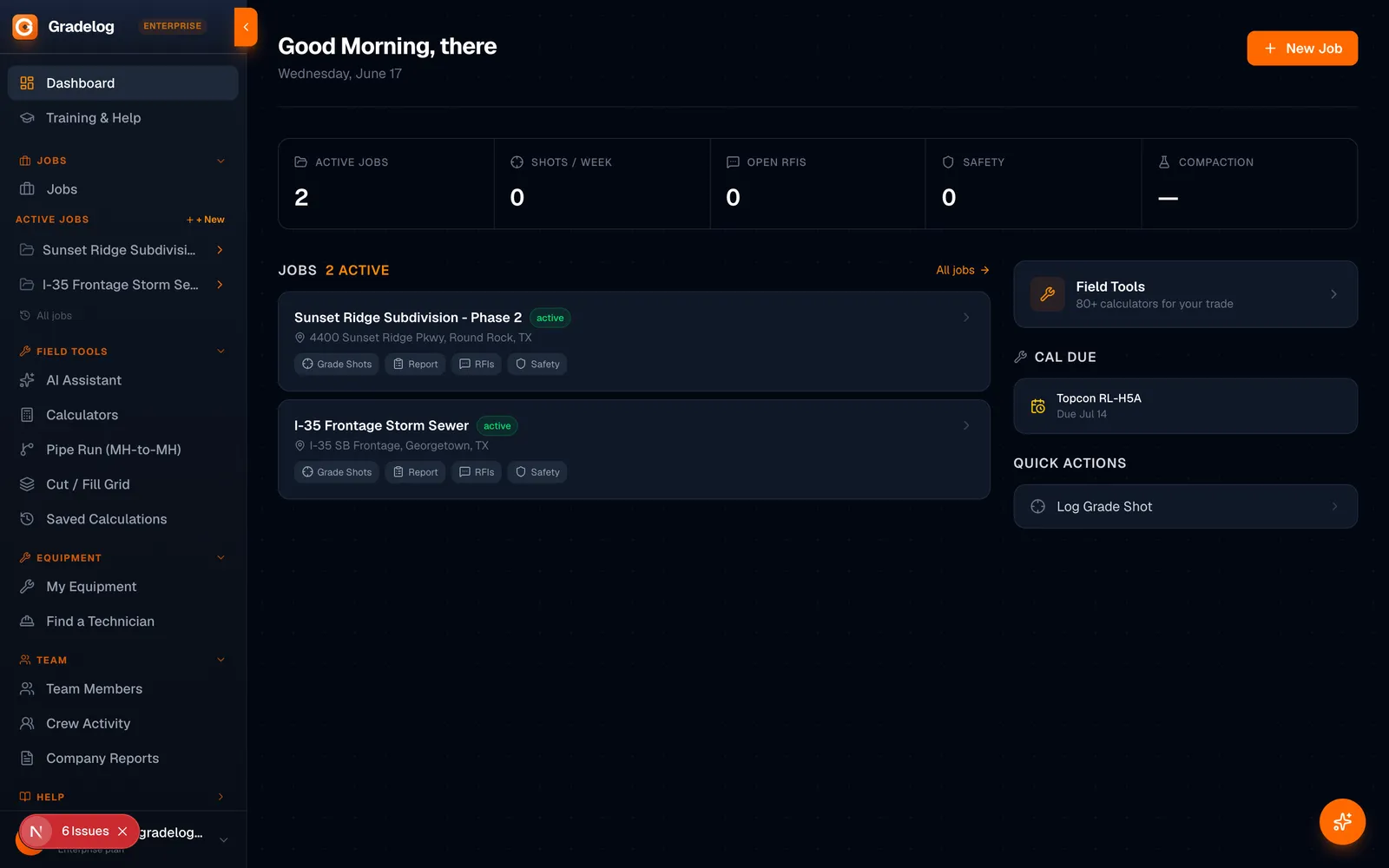
Gradelog is the AI field platform for contractors — grade shots, photo documentation, calibration tracking, and as-built reports, all tied to your gear.
- Equipment & calibration tracking
- Photo + grade documentation
- AI field assistant, 8 languages
Free 14 days with every Express Tools purchase
Your equipment. Your data. All in one place.
Gradelog is the field-execution platform built for grading and earthwork crews. Log grade shots, track cut/fill, document phases with photos, and generate as-built reports — from the cab to the office.
- Grade shots & cut/fill tracking per job
- Photo documentation by phase, task, and equipment
- As-built reports ready for inspector sign-off
- AI field assistant — troubleshoot on the jobsite
Built by the same team as Express Tools
Try Free →14 days
Free trial
8 languages
Supported
iPhone + Android
Works on