

Spectra LL500 vs LL300N Rotary Laser: Is the Upgrade Worth It?
Quick Answer
Professional-grade comparison for contractors deciding between Spectra's workhorse LL300N and the advanced LL500 self-leveling rotary laser systems
Professional-grade comparison for contractors deciding between Spectra's workhorse LL300N and the advanced LL500 self-leveling rotary laser systems
The Spectra Precision LL300N has dominated job sites for years as a reliable single-grade rotary laser, while the LL500 represents Spectra's push into dual-grade territory with enhanced accuracy and advanced features. For contractors running excavation, grading, or site prep operations, the $700-900 price gap between these models demands a clear understanding of what you're actually getting.
Both units deliver the durability Trimble's Spectra line is known for, but they serve fundamentally different operational needs. The LL300N ($1,400-1,600 street price) remains the go-to for straightforward elevation control and basic grading. The LL500 ($2,100-2,500) adds dual-grade capability, tighter accuracy specs, and motorized slope matching that can eliminate manual setup time on complex grades.
This comparison breaks down real-world performance differences, accuracy requirements for specific applications, and the ROI calculation for crews considering the upgrade path.
Technical Specifications: Side-by-Side Comparison
Accuracy Requirements: When 1/16" Matters
The LL300N's ±1/8" accuracy at 100 feet meets requirements for foundation work, concrete pours, and general site grading where tolerances typically run ±1/4" over those distances. For footings, pad prep, and drainage grades, this specification delivers reliable results without overbuying precision you won't use.
The LL500's tighter ±1/16" specification becomes relevant in three scenarios: finished concrete floors requiring FF/FL numbers, asphalt paving operations with strict smoothness specs, and large-diameter work where errors compound. On a 300-foot parking lot, the LL300N's cumulative error could reach ±3/8", while the LL500 holds closer to ±3/16"—meaningful when working to engineered plans with tight vertical tolerances.
Surveyors and machine control operators will appreciate the LL500's accuracy for establishing reference points and control networks. The tighter spec reduces the need for interpolation and checking when extending grades across larger sites.
Dual-Grade Capability: The Real Differentiator
Single-axis slope on the LL300N handles the majority of construction grading: building pads with fall to one side, parking lots with single-plane drainage, and trenching operations. You set your grade with the manual slope adjustment or remote, rotate the laser head to orient the slope direction, and work.
Dual-grade changes the game for complex drainage, four-way slopes, and valley configurations. The LL500's motorized X and Y axis controls let you create compound slopes without manual calculations or multiple setups. For site contractors running storm water management or commercial parking with multi-directional fall, this eliminates the time spent shooting intermediate benchmarks and resetting equipment.
The motorized slope matching function on the LL500 deserves specific mention. Point the laser at two known elevation points, trigger the auto-match via remote, and the unit calculates and sets the grade plane. This feature alone can save 15-20 minutes per setup when matching existing grades or tying into engineered elevations—time that compounds across multiple daily setups.
Range and Receiver Performance
Both units pair with Spectra's HR series receivers (HR320, HR350, HR550) and rod-mounted HL750 packages. The LL300N's 1,300-foot diameter range covers most building sites and residential developments. The LL500 extends this to 1,600 feet, beneficial for large commercial pads, highway work, and agricultural land leveling where you need extended coverage from a single setup.
The LL500's additional rotation speeds (900 and 1200 RPM) improve receiver lock-on time at extreme distances and in bright ambient conditions. The higher rotation speed puts more laser pulses on the detector per second, helping maintain signal strength when working long ranges or in direct sunlight. Crews running machine control systems will see better receiver stability with the variable speed options.
Both units support the same detector ecosystem, so existing receiver investments carry forward. The upgraded RC602 remote with the LL500 offers backlit display and dual-axis graphic interface showing slope settings on both axes simultaneously—clearer than the LL300N's RC502 single-axis display.
Durability and Environmental Protection
The LL300N's IP67 rating and 1-meter drop spec handle typical construction abuse. The unit survives rain, dust storms, and accidental tumbles from tripods during equipment moves. We've seen these lasers run for 5+ years in rental fleet service with only routine calibration maintenance.
The LL500 bumps protection to IP68 and survives 1.5-meter drops. In practical terms, the enhanced water resistance means better long-term reliability in wet conditions—the seals handle sustained rain and temporary submersion during flash flooding or equipment washdown. The improved drop rating matters for crews working from scaffolding or elevated positions where tripod tips are more likely.
Both units use similar battery configurations (4x D-cell alkaline or rechargeable battery packs). The LL500's extended runtime (80-100 hours vs 60+ hours) reduces mid-day battery swaps and supports longer survey sessions without interruption.
Application-Specific Recommendations
LL300N Remains the Right Choice For:
- Residential foundation contractors — Single-grade footings, slab prep, and simple drainage fall within the accuracy envelope at lower capital cost
- Small commercial builders — Building pads, parking lot subbase, and utility trenching with straightforward grades
- Landscaping and hardscaping crews — Patio bases, retaining wall alignment, and irrigation grade work
- Budget-conscious operations — New businesses establishing tool inventory or backup laser requirements
- Rental fleet applications — Simplicity reduces customer training time and support calls
LL500 Justifies the Investment For:
- Site development contractors — Multi-directional drainage, complex pad layouts, and large-area grading benefit from dual-axis capability
- Paving operations — Tighter accuracy supports asphalt smoothness specs and finished surface requirements
- Civil crews on large projects — Extended range and motorized slope matching reduce setup time on highway, airport, and commercial development work
- Surveyors establishing control networks — Enhanced accuracy and auto-matching streamline benchmark and control point establishment
- Machine control integration — Dozer and grader automation systems benefit from the improved accuracy and receiver tracking at variable rotation speeds
Cost Analysis and ROI Considerations
The $700-900 price differential between a complete LL300N package and equivalent LL500 setup requires approximately 35-45 billable hours of saved setup time to break even at typical crew rates ($60-80 loaded hourly cost). For site contractors running dual-grade work three times weekly, the motorized slope matching alone can recover 20-30 minutes per setup—reaching payback in 3-4 months of regular use.
Accuracy-driven savings are harder to quantify but real. Tighter tolerances reduce material waste from over-excavation, minimize rework on finished surfaces, and improve first-time inspection pass rates. A single failed inspection and rework cycle on a commercial slab can cost more than the upgrade differential.
For operations primarily running single-grade work, the LL300N delivers better value. The accuracy specification handles the work, and dual-grade capability sits unused. Invest the $800 savings in additional receivers, better tripod and rod systems, or backup equipment inventory.
Verdict: Match the Tool to Your Work
The LL300N remains Spectra's volume leader for good reason—it covers 75% of construction grading applications at a price point accessible to small contractors and large fleets alike. The accuracy specification, single-grade range, and proven durability deliver reliable performance for foundation work, basic site grading, and general elevation control.
The LL500 targets contractors whose work consistently demands compound slopes, extended range, or tighter tolerances. If you're regularly creating multi-directional drainage, matching existing grades on complex sites, or supporting machine control systems, the advanced features justify the investment. The motorized slope functions and dual-grade capability eliminate workarounds and reduce setup cycles enough to generate measurable ROI.
For most residential and light commercial operations, start with the LL300N and upgrade when project requirements push beyond its capabilities. For site development, paving, and civil contractors, the LL500 should be your baseline—the advanced features become daily-use tools rather than occasional nice-to-haves.
Ready to Upgrade Your Layout Equipment?
View Spectra LL500 packages and pricing | Shop LL300N kits in stock | Browse all professional rotary lasers
Need application advice? Our technical team works with contractors daily to match laser systems to specific job requirements. Call 800-XXX-XXXX or contact our equipment specialists.
Frequently Asked Questions
Can I use my existing Spectra receivers with both the LL300N and LL500?
Yes, both rotary lasers are compatible with the complete Spectra HR series detector lineup including the HR320, HR350, HR550, and rod-mounted HL450/HL750 systems. The laser beam characteristics are identical for receiver purposes. The primary difference is the remote control units—the LL300N uses the RC502 single-axis remote while the LL500 requires the RC601 or RC602 for dual-grade control. Your existing receivers will work without modification on either laser.
How often do these rotary lasers need calibration, and what does it cost?
Spectra recommends annual calibration for both models to maintain accuracy specifications, with additional checks after significant drops or impacts. Factory-authorized calibration typically runs $150-200 and includes leveling accuracy verification, rotation speed checks, and environmental seal inspection. Most contractors schedule calibration during winter downtime. If you're working to tight specs on commercial or municipal projects, some GCs require calibration certificates dated within six months—plan accordingly for documentation requirements.
What's the practical working range difference between 1,300 ft and 1,600 ft diameter?
Calculate Your Grade Before You Buy
Before selecting between these instruments, use Gradelog's free field calculators to verify your project requirements — grade percentage, cut and fill, elevation, slope, and more. No account required.
Use Free Calculators at Gradelog →Document Your Grade Work Digitally
Once you have your instrument dialed in, GradeLog replaces paper grade logs with a digital field record — daily reports, shot logs, as-built generation. Pairs with every instrument on this page. $19–$149/mo.
Try GradeLog →Our Verdict
Quick Answer Professional-grade comparison for contractors deciding between Spectra's workhorse LL300N and the advanced LL500 self-leveling rotary laser systems
For the full breakdown, see the sections above covering specifications, pros and cons, and use case recommendations for each option.

Built for equipment owners
Run the jobsite around your equipment
Gradelog is the AI field platform for contractors — grade shots, photo documentation, calibration tracking, and as-built reports, all tied to your gear.
- Equipment & calibration tracking
- Photo + grade documentation
- AI field assistant, 8 languages
Free 14 days with every Express Tools purchase
Your equipment. Your data. All in one place.
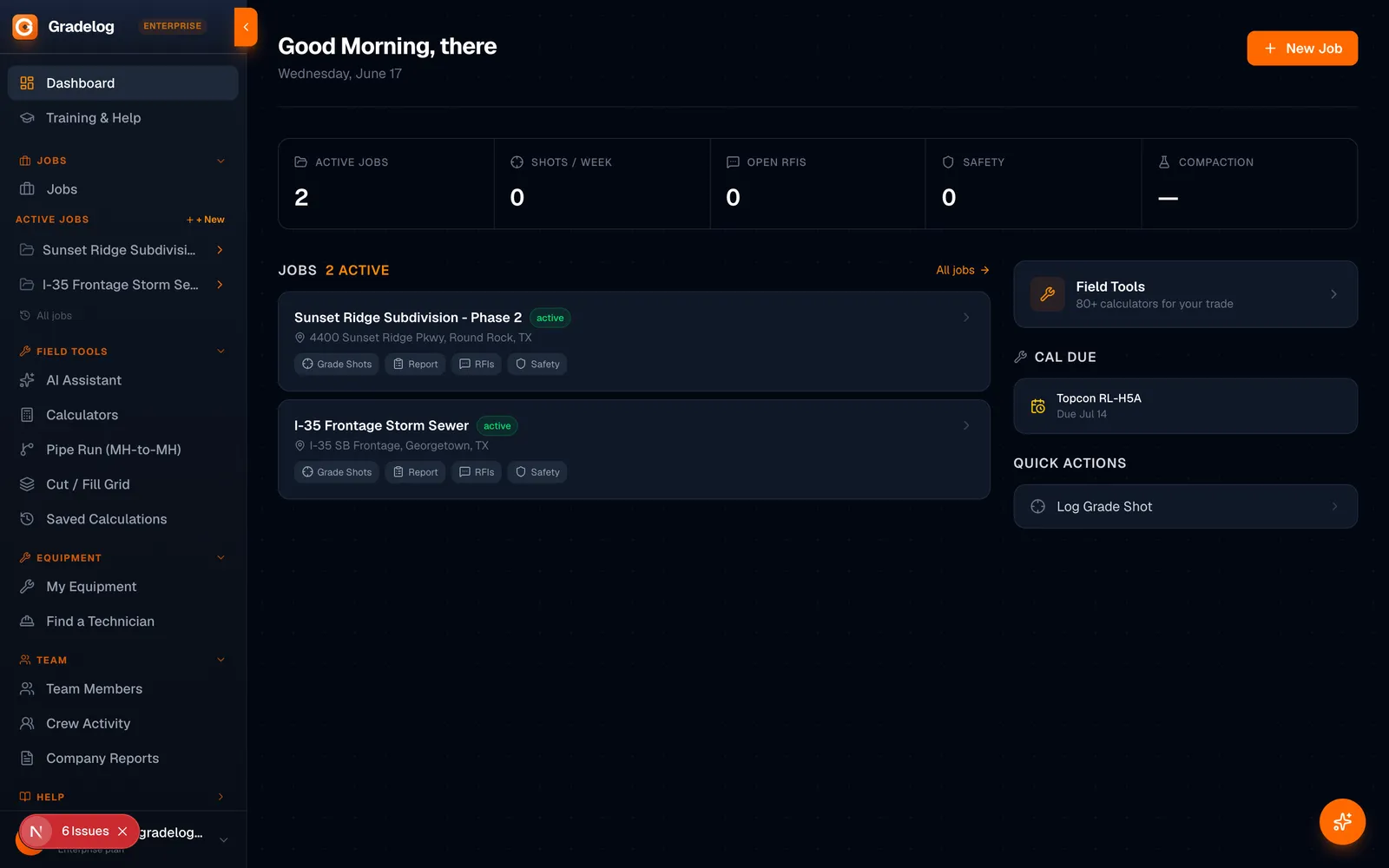
Gradelog is the field-execution platform built for grading and earthwork crews. Log grade shots, track cut/fill, document phases with photos, and generate as-built reports — from the cab to the office.
- Grade shots & cut/fill tracking per job
- Photo documentation by phase, task, and equipment
- As-built reports ready for inspector sign-off
- AI field assistant — troubleshoot on the jobsite
Built by the same team as Express Tools
Try Free →14 days
Free trial
8 languages
Supported
iPhone + Android
Works on