

Spectra HL450 vs HL760 Laser Receiver: Which Detector Is Right for Your Job?
Quick Answer
Choosing the right laser receiver for rotary laser work directly impacts your crew's productivity and accuracy on grade work, foundation layout, and excavation projects. Spectra Precision offers two solid options in their handheld detector lineup: the HL450 and the HL760. Both wo
Choosing the right laser receiver for rotary laser work directly impacts your crew's productivity and accuracy on grade work, foundation layout, and excavation projects. Spectra Precision offers two solid options in their handheld detector lineup: the HL450 and the HL760. Both work seamlessly with Spectra's rotary laser systems like the HV302, LL300N, and LL500, but they serve different operational needs and budgets.
The HL450 positions itself as the value-driven workhorse for crews running standard grade checking and elevation work. The HL760 steps up with digital readout, remote control capability, and enhanced accuracy features that matter when you're working on tighter-tolerance commercial projects or managing multiple laser setups across a site.
This comparison breaks down real-world performance differences, specific use cases where each receiver excels, and the actual cost-benefit analysis for contractors making this investment decision.
Quick Specifications Comparison
Detection Range and Accuracy: Where the Differences Matter
The HL760's 2,600-foot diameter detection range doubles what the HL450 offers. For site work beyond 650 feet from your laser setup, the HL450 simply won't pick up the beam. This becomes critical on large commercial pads, parking lot grading, or agricultural land leveling where you're covering significant acreage with a single laser position.
The accuracy differential—±1/32" versus ±1/16" at 100 feet—translates to real consequences on projects with tight elevation tolerances. Foundation work for tilt-up construction, elevator pits, or engineered floor systems often spec ±1/8" over distance. The HL760's tighter accuracy gives you working margin; the HL450 puts you right at the edge of acceptable variance before accounting for rod reading error and laser accuracy specs.
On residential footings, standard concrete pads, and rough grading where you're working to ±1/4" or greater tolerances, the HL450's accuracy performs identically in practical terms. You're not gaining productivity from the HL760's precision in these applications.
Display and Readability in Field Conditions
The HL450 uses a five-LED array system: center green LED for on-grade, two amber LEDs for elevation direction, and two red LEDs for out-of-range. Simple, proven, readable in direct sunlight. Your rod operator knows instantly whether to move up or down without interpretation.
The HL760's LCD digital display shows numeric distance from grade in millimeters or fractional inches. When you're chasing a specific elevation and need to know you're 3/16" high versus just "above grade," this precision feedback speeds up fine adjustments. The backlit display works in low-light conditions—early morning starts, late finishes, or underground work where the LED array becomes harder to read.
For excavation work where you're cutting 6 inches at a time and checking frequently, the LED simplicity on the HL450 actually reduces cognitive load. Your operator isn't reading numbers—just following green lights. On finish grade work where you're feathering in the last half-inch, the HL760's numeric feedback eliminates guesswork.
Remote Control Capability: One-Person Operation
The HL760's compatibility with Spectra's RC602 remote control changes workflow on specific job types. When you're working solo or running a two-person crew across a large site, the ability to power the laser on/off, adjust rotation speed, or activate alignment from the rod position eliminates trips back to the instrument.
This matters most on projects where you're shooting multiple elevations across separated areas—think multi-building commercial sites, highway work with offset grade checking, or utility installations where your laser setup is 400 feet from your active work zone.
The HL450 requires manual laser adjustments at the instrument. For most residential and small commercial work where your laser is centrally located and easily accessible, this creates minimal inefficiency. Factor approximately 8-12 minutes per day in walk time on typical projects.
Detection Window and Rough Grade Acquisition
The HL760's 4.7-inch detection window versus the HL450's 2.4-inch window significantly impacts initial beam acquisition when you're substantially off-grade. Starting with cut/fill depths beyond 2 feet, the wider window picks up the rotating laser beam faster as you sweep the rod vertically to locate grade.
On finish work where you're within 2-3 inches of final elevation, both receivers acquire the beam instantly. The window size difference becomes productivity noise rather than a measurable advantage.
For utility trenching, rough excavation, or initial site clearing where you might be 3-8 feet off finished grade and checking periodically, the HL760's larger window saves 15-30 seconds per elevation check during beam acquisition. Multiply across 80-100 checks per day, and you're recovering 20-40 minutes of productive time.
Battery Performance and Operating Costs
The HL450's 60-hour runtime on two AA batteries versus the HL760's 100-hour runtime on four AAs creates different operational economics. The HL450 uses fewer cells but requires more frequent changes—figure weekly battery swaps on active crews. The HL760 runs two weeks between changes but doubles the battery cost per swap.
Annual battery costs assuming 230 work days: HL450 runs approximately $85 in alkaline batteries; HL760 runs $95. The difference is negligible. Both receivers accept NiMH rechargeables if you're running battery management across multiple tools.
The HL760's battery life advantage shows up more in cold weather performance. The four-cell configuration maintains voltage better in sub-freezing temperatures where two-cell setups start showing reduced runtime and dimmer displays below 25°F.
Durability and Environmental Protection
Both receivers handle standard construction site abuse—drops from rod height onto dirt, concrete splatter, rain exposure. The IP67 rating on the HL450 means submersion protection to 3 feet for 30 minutes. The HL760's IP68 rating extends this to continuous submersion beyond 3 feet.
For utility work where receivers occasionally drop into wet trenches, storm drain installation, or marine construction, the HL760's enhanced water resistance prevents downtime. Standard site work rarely tests these limits. Both units survive typical rain, mud, and dust exposure without issue.
The HL450's lighter weight (0.66 lbs vs 1.1 lbs) reduces fatigue on all-day rod work. Your crew will notice this difference by hour six of an eight-hour day. The HL760's additional features add physical mass that shows up in operator comfort over extended periods.
Compatibility with Spectra Laser Systems
Both receivers work across the full Spectra rotary laser line: HV101, HV302, HV1305C, LL300 series, LL400 series, and LL500. They also detect beams from other manufacturers' rotary lasers, though some advanced features may not function with non-Spectra units.
The HL760 integrates with Spectra's machine control systems and automated grade solutions. If you're running or planning to run machine control packages on dozers, excavators, or motor graders, the HL760 becomes part of a larger grade management ecosystem. The HL450 remains a standalone checking tool.
Real-World Use Case Recommendations
Choose the HL450 if you:
- Run primarily residential foundation and flatwork projects
- Work within 500-600 feet of your laser setup consistently
- Operate in teams where laser access is easy (central job placement)
- Need reliable elevation checking at ±1/4" tolerance or greater
- Equip multiple crews and need to control per-unit costs
- Prefer lightweight tools for all-day rod work comfort
Choose the HL760 if you:
- Handle large-scale commercial, industrial, or civil projects regularly
- Work beyond 700-800 feet from laser positions frequently
- Run solo or small crews where remote laser control improves efficiency
- Bid projects with ±1/8" elevation tolerances or tighter
- Perform utility work, trenching, or applications with potential water exposure
- Integrate with machine control or digital grade management systems
- Value digital numeric feedback for precision finishing work
Price-to-Performance Analysis
The $350-450 price premium for the HL760 represents roughly 85% additional cost over the HL450. You need to justify this investment through productivity gains, reduced rework, or access to projects requiring the additional capabilities.
For contractors running 3+ concurrent projects where remote control and extended range prevent crew downtime, the HL760 pays back within 40-60 working days through efficiency gains. For single-crew residential operators working standard lot sizes, the HL450 delivers equivalent productivity at lower capital cost.
The HL760 holds resale value better due to the feature set appealing to a broader range of buyers. Expect 60-65% value retention after three years of normal use versus 50-55% for the HL450. This narrows the effective cost difference for contractors who upgrade equipment on regular cycles.
Verdict and Buying Recommendations
The HL450 remains the intelligent choice for residential and light commercial contractors who prioritize simplicity, weight, and cost-effectiveness. It performs the core function—accurate elevation detection for rotary laser work—without complexity or features that go unused on 80% of typical projects. Crews appreciate the straightforward LED interface and all-day comfort.
The HL760 justifies its premium pricing for commercial contractors, civil operations, and survey crews who regularly encounter the specific conditions where its advantages matter: extended range requirements, precision tolerance work, remote operation needs, or integration with digital workflows. The numeric display and enhanced durability deliver measurable value in these applications.
For mixed-use contractors running both residential and commercial work, consider the split approach: HL450 units for standard residential crews, an HL760 for the commercial/lead crew. This optimizes capital allocation while ensuring capability matches project requirements.
Ready to upgrade your laser detection equipment? Browse our complete selection of laser receivers and rotary laser systems. Need help matching receivers to your existing laser setup? Our technical team provides free compatibility verification—call 1-800-XXX-XXXX or contact us online.
Frequently Asked Questions
Can I use the HL450 or HL760 with non-Spectra rotary lasers?
Yes, both receivers detect the rotating laser beam from any manufacturer's rotary laser operating on standard frequencies. You'll get full detection functionality with brands like Topcon, Leica, Trimble, and Johnson. However, remote control features on the HL760 only work with compatible Spectra laser models. Basic detection, accuracy, and display functions operate universally regardless of laser brand.
How does detection accuracy compare to my laser's accuracy specification?
Receiver accuracy and laser accuracy combine to determine total system accuracy. If you're running a laser rated at ±1/16" at 100 feet with an HL450 (±1/16"), your combined system accuracy is approximately ±1/8" at 100 feet. Pairing the same laser with an HL760 (±1/32") tightens system accuracy to roughly ±3/32". Match your receiver accuracy to your laser's capability—using an HL760 with a ±1/8" laser doesn't improve system performance.
Will the HL760's remote control work if I buy the receiver without the RC602 remote?
Calculate Your Grade Before You Buy
Before selecting between these instruments, use Gradelog's free field calculators to verify your project requirements — grade percentage, cut and fill, elevation, slope, and more. No account required.
Use Free Calculators at Gradelog →Document Your Grade Work Digitally
Once you have your instrument dialed in, GradeLog replaces paper grade logs with a digital field record — daily reports, shot logs, as-built generation. Pairs with every instrument on this page. $19–$149/mo.
Try GradeLog →Our Verdict
Home » Rotary Lasers » Laser Receivers » HL450 vs HL760 Comparison
For the full breakdown, see the sections above covering specifications, pros and cons, and use case recommendations for each option.

Built for equipment owners
Run the jobsite around your equipment
Gradelog is the AI field platform for contractors — grade shots, photo documentation, calibration tracking, and as-built reports, all tied to your gear.
- Equipment & calibration tracking
- Photo + grade documentation
- AI field assistant, 8 languages
Free 14 days with every Express Tools purchase
Your equipment. Your data. All in one place.
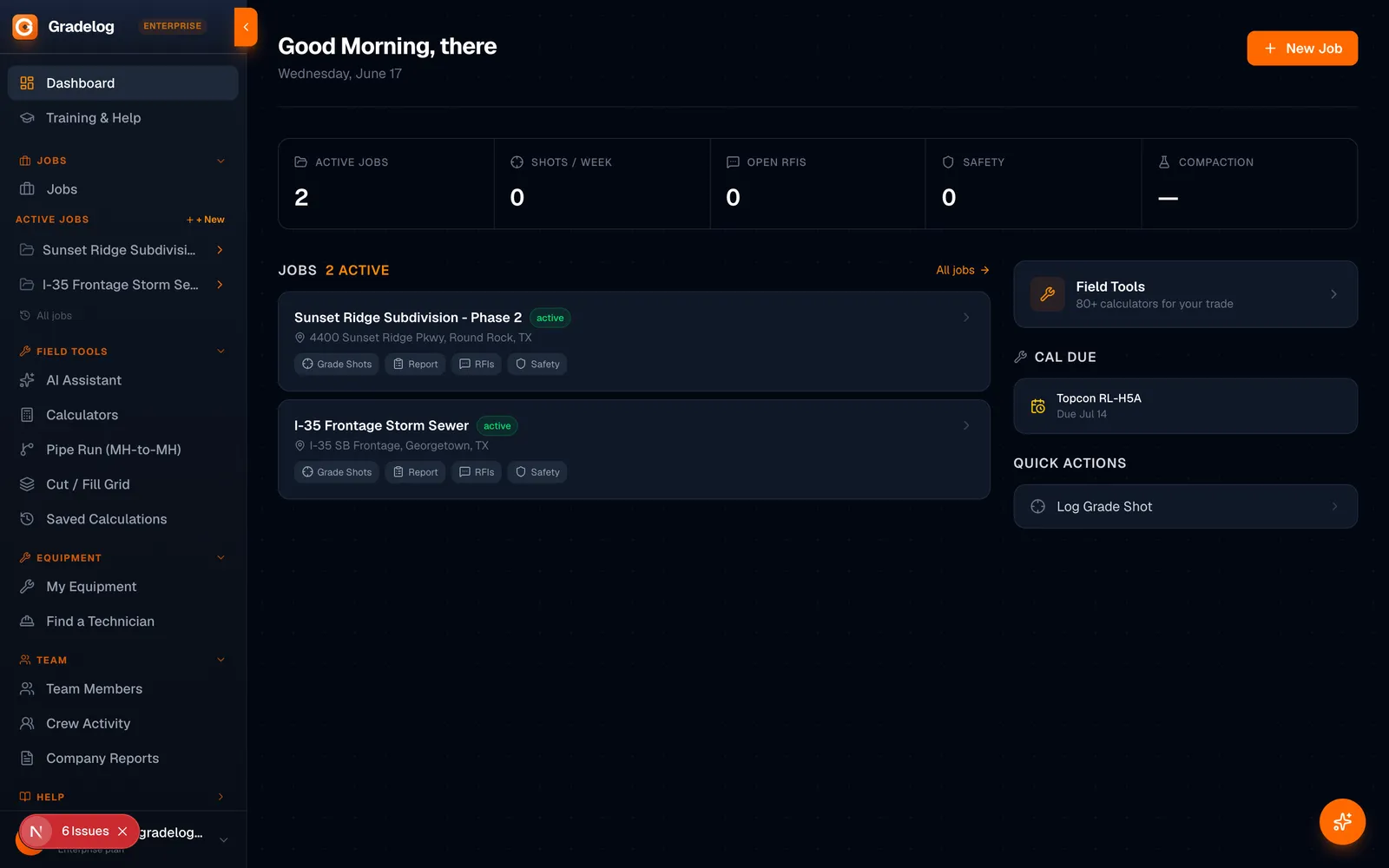
Gradelog is the field-execution platform built for grading and earthwork crews. Log grade shots, track cut/fill, document phases with photos, and generate as-built reports — from the cab to the office.
- Grade shots & cut/fill tracking per job
- Photo documentation by phase, task, and equipment
- As-built reports ready for inspector sign-off
- AI field assistant — troubleshoot on the jobsite
Built by the same team as Express Tools
Try Free →14 days
Free trial
8 languages
Supported
iPhone + Android
Works on