
Calculate Your Grade Before You Buy
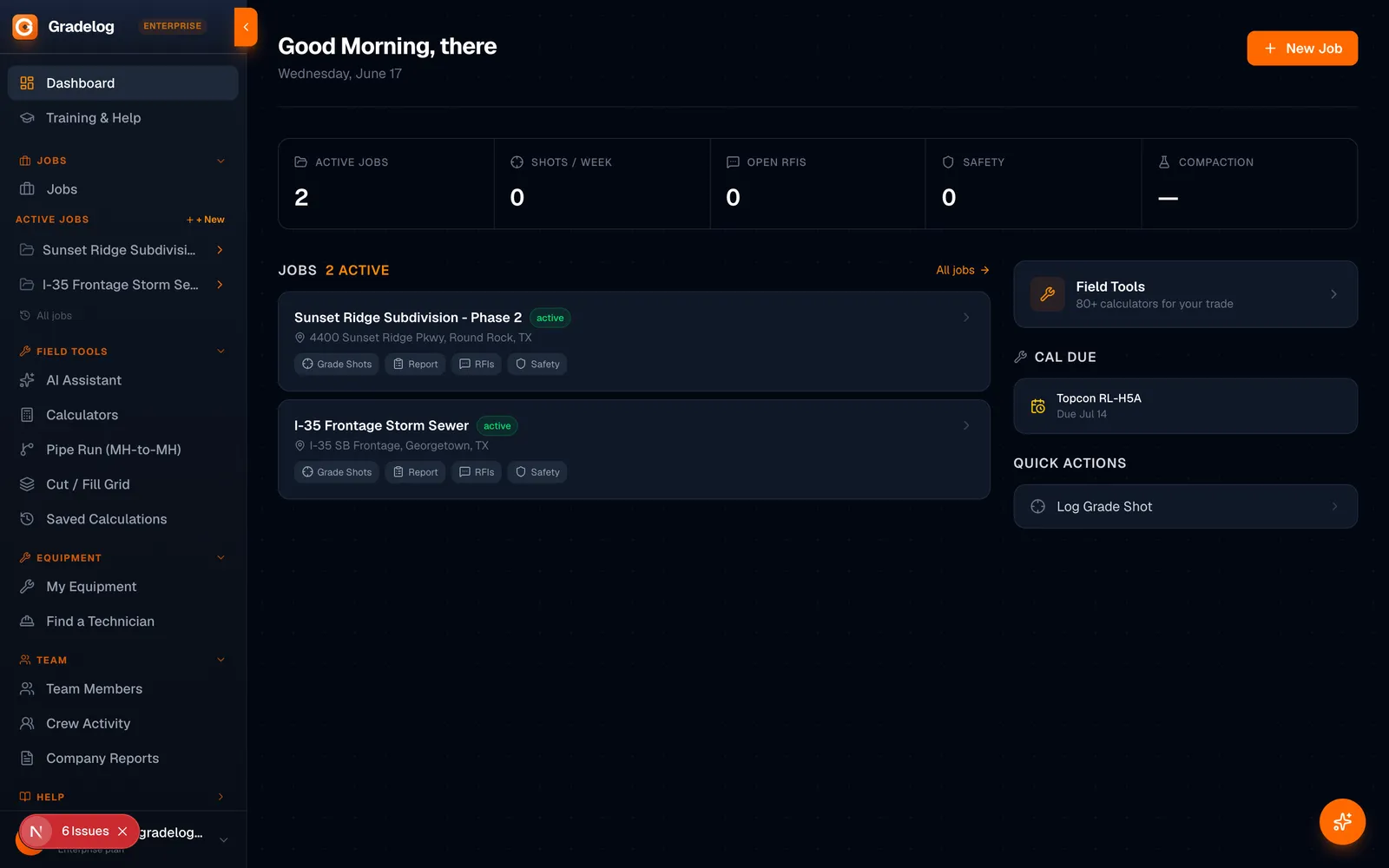
Before selecting between these instruments, use Gradelog's free field calculators to verify your project requirements — grade percentage, cut and fill, elevation, slope, and more. No account required.
Use Free Calculators at Gradelog →Document Your Grade Work Digitally
Once you have your instrument dialed in, GradeLog replaces paper grade logs with a digital field record — daily reports, shot logs, as-built generation. Pairs with every instrument on this page. $19–$149/mo.
Try GradeLog →Spectra GL412N vs GL622N: Grade Laser Comparison
Quick Answer
Before selecting between these instruments, use Gradelog's free field calculators to verify your project requirements — grade percentage, cut and fill, elevation, slope, and more. No account required.
If you're shopping for a dual-grade laser for machine control, grading, or site prep work, you've probably narrowed it down to Spectra's GL series. The GL412N and GL622N are two of the most popular models we sell at Express Tools, and for good reason—they're both rugged, reliable, and proven on job sites across the country. But there's a $2,000 price difference and some significant spec variations that matter when you're laying pipe, cutting pads, or setting slopes for drainage.
I've been selling construction lasers for over fifteen years, and the question I hear most often is: "Do I really need the GL622N, or will the GL412N do the job?" The short answer depends on your accuracy requirements, working radius, and how much grade capacity you need. Let's break down both models so you can make the right call for your operation.
Quick Overview: What You're Comparing
Both the Spectra GL412N and GL622N are dual-axis grade lasers designed for machine control and manual grading applications. They're built by Trimble (the parent company of Spectra Precision), so you're getting proven technology and solid North American support either way.
The GL412N is Spectra's entry-level dual-grade model—perfect for residential grading contractors, smaller site work companies, and utility crews who need reliable dual-slope capability without breaking the bank. The GL622N steps up to mid-tier performance with tighter accuracy, longer range, greater grade capacity, and better environmental protection. It's the tool you want when you're working larger commercial sites, running multiple machines, or bidding jobs with tight tolerance specs.
Need Help Choosing the Right Grade Laser?
Our equipment specialists work with contractors every day to match the right laser to the job. We stock both Spectra models and can answer your questions about compatibility with your machine control receivers.
Shop Grade LasersDetailed Specifications Comparison
Spectra GL412N: Pros and Cons
What Works Well With the GL412N
Price point makes it accessible. At around $3,500, this is a dual-grade laser that smaller contractors can actually afford. If you're doing residential grading, building pads for homes, or running utility trenches, you're getting professional-grade dual-slope capability without the mid-five-figure investment some other brands require.
Accuracy is sufficient for most grading work. The ±1.5mm at 30 meters spec translates to about ±0.05 feet at 100 feet. That's tight enough for almost all residential and light commercial grading, parking lot subgrades, and utility work. Unless you're bidding jobs with unusually tight specs, this accuracy won't be your limiting factor.
750-meter diameter covers typical residential and small commercial sites. That's roughly 375 meters (1,230 feet) in any direction from the laser. For single-lot grading, small commercial pads, or utility corridors, you're rarely setting up and moving the laser. One setup often covers your whole work area.
Proven reliability with Spectra's rugged build quality. The IP56 rating means it handles dust and water spray without issues. I've had customers run these lasers in rain (though I don't recommend it) and through dusty desert conditions without failures. It's built for real job sites, not clean survey environments.
Where the GL412N Falls Short
±10% grade range limits steep slope applications. If you're working in hilly terrain, building terraced sites, or doing mountain road work, that 10% maximum grade can be restrictive. You'll find yourself releveling or working in segments when the natural terrain exceeds that range.
750m range isn't enough for large commercial sites. Shopping center pads, big box developments, industrial parks, and large earthmoving jobs often require working beyond that 375-meter radius. You'll spend time moving and resetting the laser, which costs production time.
IP56 rating means you need to be more careful in extreme conditions. While it's dust and water-resistant, it's not waterproof. Extended exposure to heavy rain or submersion (like tipping over in a puddle) can damage the unit. You'll want to shelter it during downpours.
Less suitable for precision commercial work. If you're bidding jobs with tight tolerance requirements—airport grading, athletic fields, or work with engineered spec sheets calling for sub-millimeter accuracy—you may struggle to meet those requirements consistently with the GL412N's ±1.5mm spec.
Spectra GL622N: Pros and Cons
What Works Well With the GL622N
±1.0mm accuracy meets commercial and DOT specifications. That tighter tolerance means you can confidently bid jobs with strict grading specs. State highway work, airport grading, engineered athletic fields, and commercial developments with detailed civil engineering plans—the GL622N's accuracy keeps you within tolerance with less rework.
1,200-meter diameter handles large sites with fewer setups. That 600-meter (nearly 2,000-foot) radius from center means you can cover massive areas from a single setup. Shopping centers, industrial parks, large earthmoving jobs, and pipeline corridors all become more efficient because you're not constantly moving the laser.
±25% grade range works in challenging terrain. Steep slopes, terraced sites, mountain construction, and hillside development all become more manageable. You can set dual slopes up to 25% and still maintain accuracy, which is critical for drainage work and challenging site conditions.
IP67 rating provides real waterproof protection. This laser can handle submersion up to 1 meter for 30 minutes. In practical terms, that means rain doesn't slow you down, and if it tips into a puddle or gets caught in a downpour, you're not facing a repair bill. For contractors working in wet climates or unpredictable weather, this peace of mind is worth money.
Better self-leveling range (±25%) means easier setup on rough sites. When you're setting up on unfinished grade or rough terrain, that wider self-leveling range means the laser compensates for more initial tilt. You spend less time shimming and adjusting your tripod to get the unit level.
Where the GL622N Falls Short
$5,500 price point is a barrier for smaller contractors. That's $2,000 more than the GL412N—a significant jump for companies running tight margins or just getting into machine control grading. If your work doesn't demand the extra capability, that's money that could go toward other equipment.
Slightly heavier at 15.4 pounds. Not a dealbreaker, but if you're hand-carrying this laser around job sites regularly, that extra pound adds up over a long day. Mounted on a tripod or machine, you won't notice the difference.
More capability than many residential contractors need. If you're primarily doing single-lot home grading, small additions, or residential utility work, you're paying for range, accuracy, and grade capacity you'll rarely use. That's not wrong, but it's worth considering whether that money is better spent elsewhere in your tool fleet.
Which Laser is Right for Your Operation?
Choose the GL412N If:
- You're primarily doing residential grading and site work. Single-family home pads, small multi-family developments, and residential utility work rarely need more than this laser offers.
- Your typical job sites are under 10 acres. The 750m diameter range covers these sites efficiently without constant relocation.
- You're not bidding work with strict tolerance specifications. If your specs say "grade to within 0.1 feet" rather than calling out millimeter tolerances, the GL412N handles it fine.
- Budget is a primary concern. Saving $2,000 on the laser means you can invest in better receivers, additional grade rods, or other equipment that improves productivity.
- You work in relatively flat terrain. If most
Our Verdict
Calculate Your Grade Before You Buy Before selecting between these instruments, use Gradelog's free field calculators to verify your project requirements — grade percentage, cut and fill, elevation, slope, and more. No account required. Use Free Calculators at Gradelog →
For the full breakdown, see the sections above covering specifications, pros and cons, and use case recommendations for each option.