
Spectra Focus 35 vs Focus 30: Laser Scanner Compared
Quick Answer
Spectra Precision's Focus laser scanners represent the cutting edge in 3D scanning technology for surveying professionals. Whether you're tackling BIM projects, as-built documentation, or volumetric measurements, the Focus 35 and Focus 30 offer powerful solutions—but which is rig
Spectra Precision's Focus laser scanners represent the cutting edge in 3D scanning technology for surveying professionals. Whether you're tackling BIM projects, as-built documentation, or volumetric measurements, the Focus 35 and Focus 30 offer powerful solutions—but which is right for your operation? This guide compares both models across key specifications, features, and use cases to help you make an informed decision.
Spectra Focus 35: Premium 3D Laser Scanner
Specifications
✓ Advantages:
- Fastest point measurement speed in its class
- Extended scanning range up to 120 meters
- Superior accuracy for detail-heavy projects
- Advanced software integration with Spectra Office Suite
- Excellent color imaging capabilities
- Robust IP54 rating for outdoor durability
✗ Disadvantages:
- Higher price point—significant investment
- Steep learning curve for new operators
- May be overkill for smaller or routine projects
- Requires more frequent software updates
Spectra Focus 30: Versatile Mid-Range 3D Scanner
Specifications
✓ Advantages:
- Excellent value for mid-range surveying operations
- Still delivers strong scanning speed and range
- User-friendly interface for operators of all skill levels
- Good accuracy for most construction and survey applications
- Solid battery life for full-day fieldwork
- More cost-effective software licensing
✗ Disadvantages:
- 30 meters less range than Focus 35
- Lower point measurement speed (614k vs 976k points/sec)
- Slightly lower accuracy at distance
- May require multiple setups on very large projects
Head-to-Head Specifications Comparison
Which Should You Buy?
Scenario 1: Growing Surveying Firm with Mixed Projects
Best Choice: Spectra Focus 30
If you handle a mix of small to medium projects and want to grow without massive capital expense, the Focus 30 delivers excellent performance at a better price point. You'll have the speed and accuracy needed for most jobs, and can add a second unit later if demand increases.
Scenario 2: Large-Scale BIM and Volumetric Projects
Best Choice: Spectra Focus 35
For firms handling complex BIM models, large industrial as-builts, or volumetric site measurements, the Focus 35's superior range (120m), point speed, and accuracy justify the investment. Faster scanning reduces fieldwork time and improves project profitability on high-value contracts.
Scenario 3: Budget-Conscious New Entrant to 3D Scanning
Best Choice: Spectra Focus 30
Starting your first 3D scanning service? The Focus 30 offers manageable pricing while still delivering professional-grade results. The lower investment reduces risk as you build your scanning expertise and client base.
Scenario 4: High-Volume Daily Scanning Operations
Best Choice: Spectra Focus 35
If your team scans multiple sites per day or requires the absolute best in speed and range, the Focus 35's 976k points/second capability pays for itself through improved field efficiency and faster project delivery times.
Frequently Asked Questions
The Focus 35 excels in scanning speed (976k vs 614k points/sec), range (120m vs 90m), accuracy (±3mm vs ±4mm), and battery life (8 vs 7 hours). The Focus 30 offers strong performance at a significantly lower price point—ideal for firms that don't need maximum throughput.
Yes, the Focus 30 can scan up to 90 meters, which covers most construction sites effectively. For larger areas or very distant objects, you may need multiple setups, which adds minimal time. The Focus 35's 120-meter range is better for sprawling industrial sites or open-area projects.
Both models work well indoors. The Focus 30's slightly shorter range is less of a limitation in confined spaces, making it very practical for interior documentation. The Focus 35 adds flexibility for larger interior spaces like warehouses or atriums.
The Focus 35 delivers ±3mm accuracy at 10 meters, while the Focus 30 provides ±4mm. In practical terms, both exceed industry standards for most surveying and construction work. The 1mm difference matters most on precision-critical projects like interior renovations or mechanical plant documentation.
Both models integrate with Spectra Office Suite and industry-standard CAD/BIM software. The Focus 35 includes advanced software packages; the Focus 30 uses a streamlined version that covers most needs. Upgrading software is straightforward on both platforms.
Do I need field management software with this equipment?
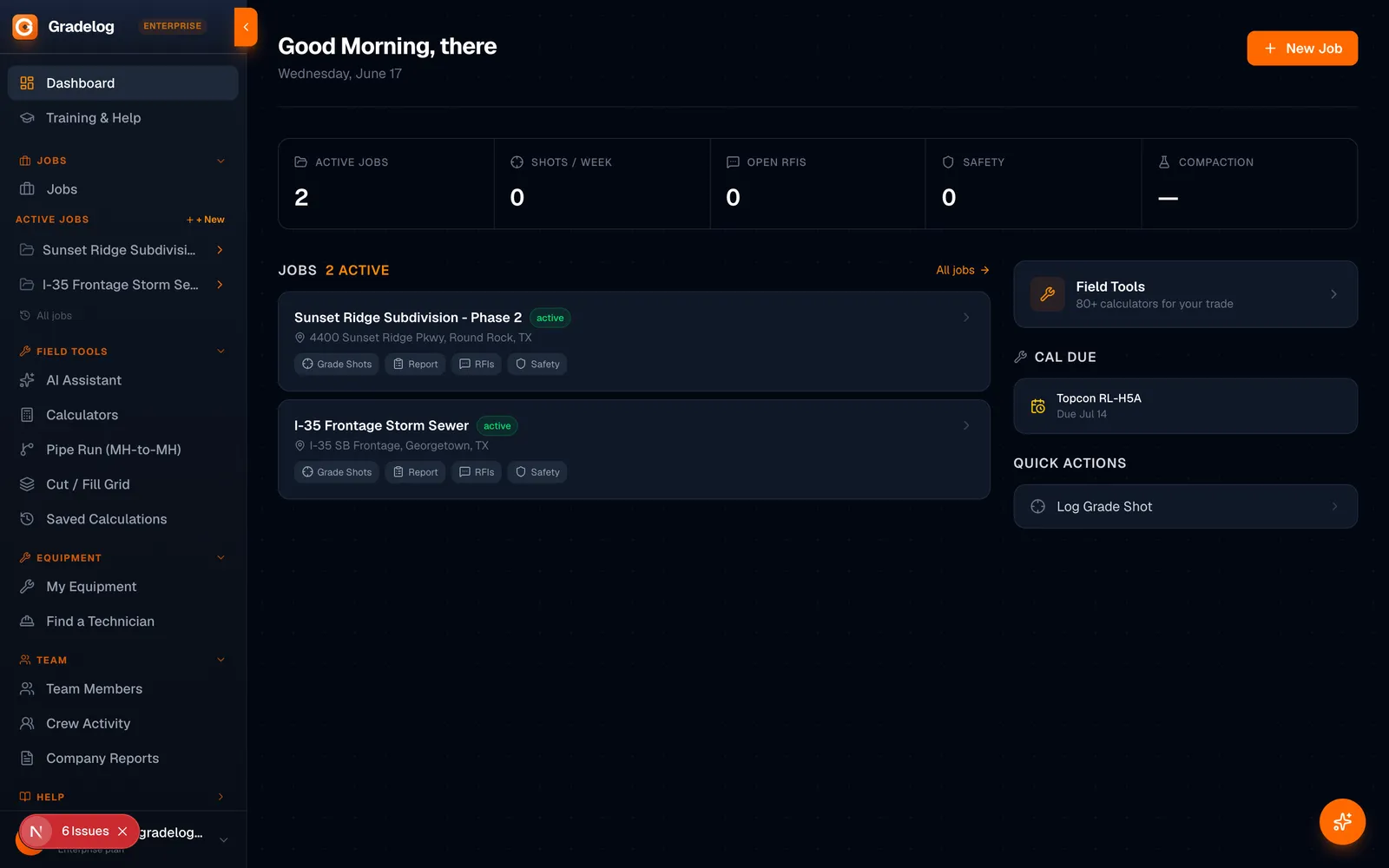
Gradelog is an AI field assistant designed for contractors using precision grade equipment. Free calculators for grade percentage, cut/fill, elevation, and slope are available with no account required. Paid plans add job logs, equipment tracking, and as-built exports.
How do I document grade work on a job site?
GradeLog replaces paper grade logs with digital field records — shot logs, daily reports, as-built generation. $19–$149/mo.
Yes! Express Tools offers trade-in programs and bundle pricing on Spectra scanners. Contact our sales team at expresstools.com or call to discuss financing options, lease-to-own arrangements, and equipment upgrade programs tailored to your firm's needs.
Ready to Choose Your 3D Laser Scanner?
Both the Spectra Focus 35 and Focus 30 represent excellent investments in professional scanning technology. Your choice depends on your project scope, budget, and scanning volume. Express Tools stocks both models and offers expert consultation to match you with the right equipment.
Express Tools specializes in laser grade-control and layout equipment. For field documentation, Gradelog organizes your job logs, calibration records, and as-built reports — free to start.
Express Tools specializes in laser grade-control and layout equipment. For field documentation, Gradelog organizes your job logs, calibration records, and as-built reports — free to start.
Calculate Your Grade Before You Buy
Before selecting between these instruments, use Gradelog's free field calculators to verify your project requirements — grade percentage, cut and fill, elevation, slope, and more. No account required.
Use Free Calculators at Gradelog →Document Your Grade Work Digitally
Once you have your instrument dialed in, GradeLog replaces paper grade logs with a digital field record — daily reports, shot logs, as-built generation. Pairs with every instrument on this page. $19–$149/mo.
Try GradeLog →