
Pipe Laser vs Optical Level for Underground Work
Quick Answer
When you're laying pipe or working on underground utilities, getting the grade right isn't optional. Two tools dominate this space: pipe lasers and optical levels. Both establish grade for trenching and pipe installation, but they work differently and suit different job requireme
When you're laying pipe or working on underground utilities, getting the grade right isn't optional. Two tools dominate this space: pipe lasers and optical levels. Both establish grade for trenching and pipe installation, but they work differently and suit different job requirements. Here's what you need to know to pick the right one for your crew.
The Core Difference
A pipe laser projects a visible laser beam down the pipe barrel or along the trench line, giving you a constant reference point. Set it once, and your crew can work independently checking grade with a target or receiver. An optical level uses line-of-sight measurement through a telescope—your instrument operator manually shoots elevations to a grade rod, calculating cut and fill on the fly.
Pipe lasers run themselves. Optical levels require a dedicated operator. That's the fundamental trade-off you're making.
Side-by-Side Comparison
When to Use a Pipe Laser
Pipe lasers excel when you're running long, continuous grade lines. Sanitary sewer installation, storm drain work, and water main projects between 6" and 60" diameter—that's pipe laser territory. The Topcon TP-L5B or Leica Piper 200 will handle most commercial and municipal underground work.
Your crew can station the laser at the manhole or start point, dial in the grade percentage, and let it run. Workers down the line use a handheld target or receiver mounted on the pipe to check elevation. No radio communication needed, no waiting on the instrument man. On jobs where you're laying 200-300 feet of pipe per day, that efficiency compounds fast.
The downside is cost and complexity. You're spending three to four times what an optical level costs, and you need to maintain batteries, calibration, and protect sensitive electronics. If you're running pipe below grade in confined trenches or through casing, though, nothing else works as well.
When to Use an Optical Level
An optical level like the Sokkia B40A or CST/Berger PAL26D makes sense for grading, site prep, foundation work, and jobs where you're shooting multiple different elevations rather than following a single grade line. Parking lots, building pads, and general excavation work suit optical levels perfectly.
You'll need someone running the instrument full-time, calling out cuts and fills to the equipment operator or grade crew. That's a labor cost, but the tool itself is bulletproof. No batteries, no electronics to fry, no firmware updates. Drop it in the truck, abuse it on the job, and it keeps working. Many contractors run optical levels that are 15-20 years old without issues.
Optical levels also adapt to any grade or slope configuration. Your instrument operator does the math, not the tool. That flexibility matters when job conditions change or you're working on complex sites with multiple grade transitions.
The Verdict
Buy a pipe laser if: You specialize in underground utility installation, regularly lay pipe over 100 feet, work with small crews, or need to maintain precise grade in deep or confined trenches. The labor savings pay for the tool within a season on most dedicated pipe crews.
Buy an optical level if: You run general excavation and grading work, need a versatile tool across multiple job types, work with experienced instrument operators, or want a no-maintenance workhorse that lasts decades. It's the default choice for contractors who aren't pipe specialists.
Buy both if: You're large enough to run dedicated crews for different work types. Many mid-size contractors keep optical levels for site work and a pipe laser that moves between utility jobs as needed.
Frequently Asked Questions
Can I use a pipe laser for grading and site work?
Technically yes, but it's inefficient. Pipe lasers project a beam in one direction at a fixed grade. For general grading where you're shooting multiple elevations across a site, you'll waste time repositioning the laser constantly. An optical level or rotating laser serves you better for surface work. Save the pipe laser for what it's built for—establishing grade inside pipe or along a trench line.
Do I need a receiver with a pipe laser?
For most underground work, yes. The laser beam itself is visible, but in bright daylight or at distances beyond 50-75 feet, you can't see it clearly. A receiver (target) picks up the beam and indicates whether you're on grade, high, or low. Budget $400-600 for a decent receiver when you buy the laser. Some newer models like the Leica Piper 100 include integrated targets.
How often do these tools need calibration?
Pipe lasers should be professionally calibrated annually or after any hard impact. Most manufacturers recommend checking calibration every 3-6 months if you're using the tool daily. Optical levels are more forgiving—calibrate when you notice accuracy issues or every 2-3 years with normal use. Many contractors check their optical level against known benchmarks monthly as a field verification.
What's the learning curve for crew members?
Reading a target or receiver on a pipe laser takes about 15 minutes to teach. Any crew member can do it. Running an optical level competently requires 2-3 days of training for someone with no experience, plus weeks of practice to develop speed and accuracy. That's why pipe lasers reduce your dependency on specialized labor—the tool does the technical work, and your pipe layers just read the target.
Our Verdict
Quick Answer When you're laying pipe or working on underground utilities, getting the grade right isn't optional. Two tools dominate this space: pipe lasers and optical levels. Both establish grade for trenching and pipe installation, but they work differently and suit different job requireme
For the full breakdown, see the sections above covering specifications, pros and cons, and use case recommendations for each option.
Verify Your Pipe Grade Before You Buy
Before committing to a pipe laser, use Gradelog's free pipe grade calculator to verify your project requirements — invert elevation, pipe fall, percent grade, and required accuracy. No account needed.
Use Free Pipe Grade Calculators at Gradelog →Document Your Pipe Grade Work Digitally
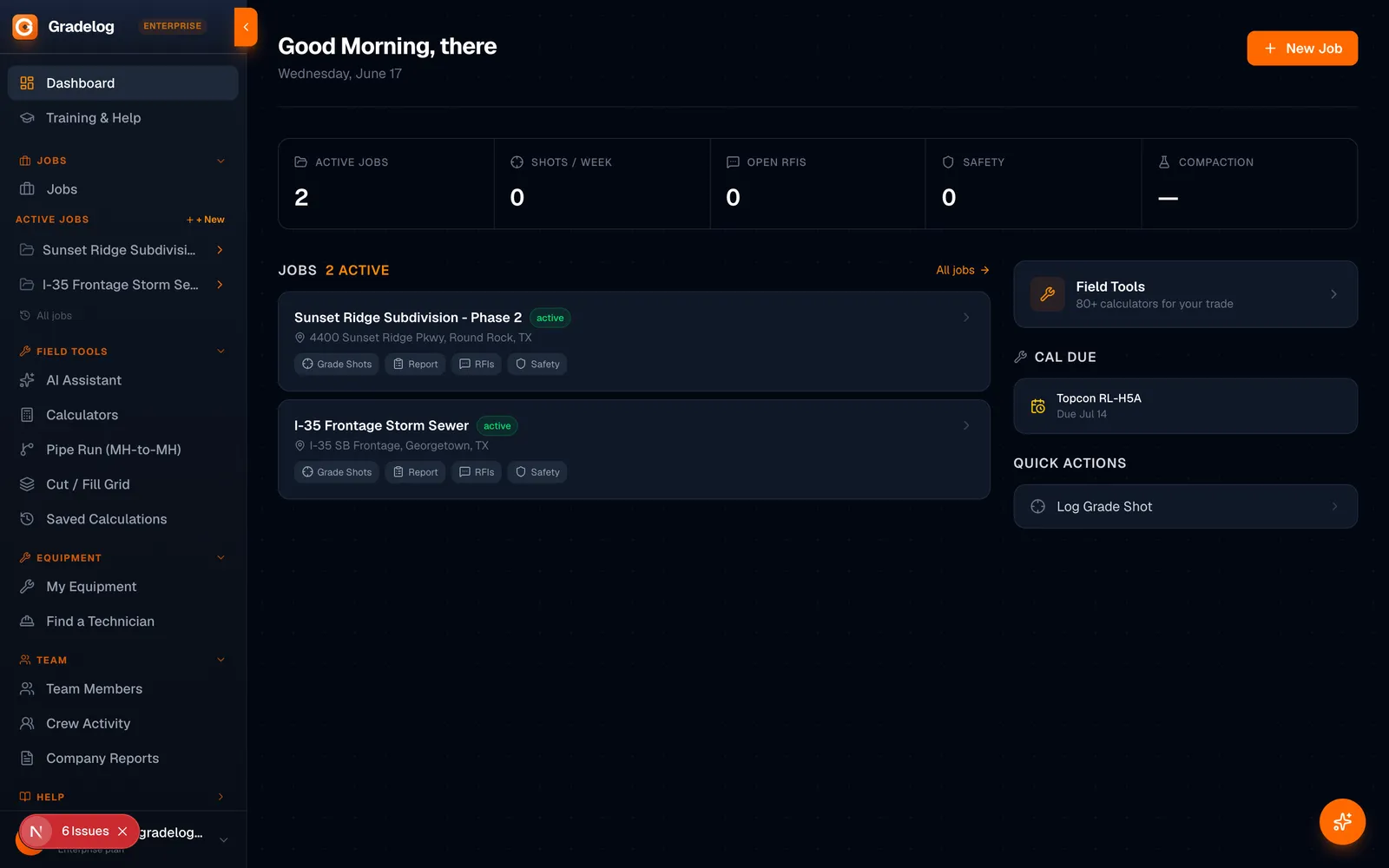
Once your pipe laser is dialed in, GradeLog replaces paper shot logs with digital field records — invert elevations, pipe grades, as-built reports. Replace the clipboard with a system that generates reports automatically. $19–$149/mo.
Try GradeLog →