Free Shipping on orders over $500

Machine Control vs Traditional Stakes: Is GPS Grade Worth It?

Quick Answer

Grading contractors face a critical decision: continue relying on traditional survey stakes and laser levels, or invest in GPS-enabled machine control systems. This comprehensive guide is designed for construction managers, general contractors, and equipment operators who want to

Grading contractors face a critical decision: continue relying on traditional survey stakes and laser levels, or invest in GPS-enabled machine control systems. This comprehensive guide is designed for construction managers, general contractors, and equipment operators who want to understand the real-world differences, costs, and ROI of each method. We'll break down the technology, compare accuracy, speed, and long-term value to help you make an informed decision for your operation.

Best Overall
Machine Control (Topcon/Trimble)
Best for Large Projects
GPS Machine Control
Best Budget Option
Traditional Stakes
Best for High-Volume Work
Machine Control Systems

Traditional Survey Stakes & Laser Levels

Overview

Traditional staking methods have been the industry standard for decades. A licensed surveyor establishes grade stakes across the project site, typically at 25-50 foot intervals. Operators use laser levels or grade rods to reference these stakes while operating equipment. This proven method requires manual labor and operator skill but has minimal equipment investment.

Specification Traditional Stakes
Accuracy ±0.1 to ±0.3 feet (depending on distance)
Initial Setup Time 2-4 hours for typical site
Coverage Area Stakes required every 25-50 feet
Operator Skill Required Moderate to High
Weather Dependency High (laser visibility, visibility issues)
Equipment Cost $2,000-$8,000 (laser level, rod)
Crew Size 3-4 people (operator + spotters)
Real-Time Data No
Restaking Frequency Daily to weekly

Advantages

  • Low equipment cost
  • No learning curve for experienced operators
  • Works on any terrain
  • Minimal technology dependence
  • Effective for small-to-medium sites
  • No subscription or calibration costs
  • Proven method with established workflows

Disadvantages

  • Labor intensive (requires spotters)
  • Slower grading progress
  • Higher operator error rates
  • Requires frequent restaking
  • Not suitable for large areas
  • Limited to line-of-sight laser coverage
  • No record of actual grades achieved
Best For: Small residential projects, tight urban sites, contractors with limited capital, occasional grading work, or projects where GPS signal is unreliable.

GPS Machine Control Systems

Overview

Machine control systems integrate GPS/GNSS technology with onboard computers and hydraulic controls to automatically guide dozers, scrapers, and graders to exact grade specifications. Systems from Topcon and Trimble use RTK (Real-Time Kinematic) corrections to achieve sub-inch accuracy. The operator maintains control but receives real-time guidance, reducing reliance on external spotters and grade stakes.

Specification GPS Machine Control
Accuracy ±0.05 to ±0.15 feet (sub-inch with RTK)
Initial Setup Time 1-2 hours (site calibration)
Coverage Area Full site with single base station
Operator Skill Required Moderate (training required)
Weather Dependency Low-Moderate (clouds minimal impact)
Equipment Cost $8,000-$25,000 per machine
Crew Size 1-2 people (operator only)
Real-Time Data Yes (elevation, position, blade position)
Restaking Frequency None (design model drives grading)

Advantages

  • Superior accuracy (sub-inch RTK)
  • Reduces crew from 4 to 1-2 people
  • Faster project completion
  • No stakes to set or maintain
  • Works in low-light conditions
  • Real-time data and documentation
  • Lower per-yard grading costs at scale
  • Reduced material waste (fewer passes)
  • Better grade consistency

Disadvantages

  • High upfront equipment cost
  • Requires GPS signal (limited in dense urban/forest)
  • RTK base station needed or subscription service
  • Operator training required
  • Software/calibration complexity
  • Maintenance and tech support needed
  • Less effective near tall buildings/obstructions
  • Weather can briefly impact RTK signal
Best For: Highway construction, large site development, high-volume grading contractors, projects requiring precision grades, long-term operations, commercial/industrial sites, and contractors seeking ROI through efficiency gains.

Head-to-Head Comparison

Metric Traditional Stakes GPS Machine Control
Accuracy ±0.1 to ±0.3 ft ±0.05 to ±0.15 ft (RTK)
Setup Time (site) 2-4 hours 1-2 hours
Daily Crew Size 3-4 people 1-2 people
Equipment Cost $2,000-$8,000 $8,000-$25,000
Annual Operating Cost $5,000-$15,000 $2,000-$5,000
Grading Speed Standard 30-50% faster
Per-Cubic-Yard Cost $1.50-$3.00 $0.80-$1.50
Learning Curve Minimal 2-4 weeks
Data Documentation Manual Automated
Works Without Stakes No Yes
Weather Impact High (rain, fog) Low (clouds OK)
Scalability Limited (labor intensive) Excellent (automation)

ROI Analysis: When Machine Control Pays For Itself

Cost Breakdown Example (Annual Operation)

Traditional Stakes (Per Year)

Calculate Cut & Fill Before You Buy

Before choosing your machine control system, use Gradelog's free calculators to model cut/fill volumes, excavation requirements, and elevation changes — so you size the right system before you invest. No account required.

Use Free Cut & Fill Calculators at Gradelog →

Document Your Earthwork Digitally

Once your machine control system is running, GradeLog gives you a digital field record for every cut and fill pass — daily reports, as-built generation, equipment logs. Pairs with every system on this page. $19–$149/mo.

Try GradeLog →

Our Verdict

Machine Control vs Traditional Stakes: Is GPS Grade Worth It? | Express Tools * { margin: 0; padding: 0; box-sizing: border-box; } body { font-family: 'Segoe UI', Tahoma, Geneva, Verdana, sans-serif; l

For the full breakdown, see the sections above covering specifications, pros and cons, and use case recommendations for each option.

Gradelog — AI field platform for contractors

Built for equipment owners

Run the jobsite around your equipment

Gradelog is the AI field platform for contractors — grade shots, photo documentation, calibration tracking, and as-built reports, all tied to your gear.

  • Equipment & calibration tracking
  • Photo + grade documentation
  • AI field assistant, 8 languages
Try Gradelog FreeFree to start · iPhone & Android · 8 languages
Gradelog — Earthwork Operating System

Free 30 days with every Express Tools purchase

Your equipment. Your data. All in one place.

Gradelog is the field-execution platform built for grading and earthwork crews. Log grade shots, track cut/fill, document phases with photos, and generate as-built reports — from the cab to the office.

  • Grade shots & cut/fill tracking per job
  • Photo documentation by phase, task, and equipment
  • As-built reports ready for inspector sign-off
  • AI field assistant — troubleshoot on the jobsite
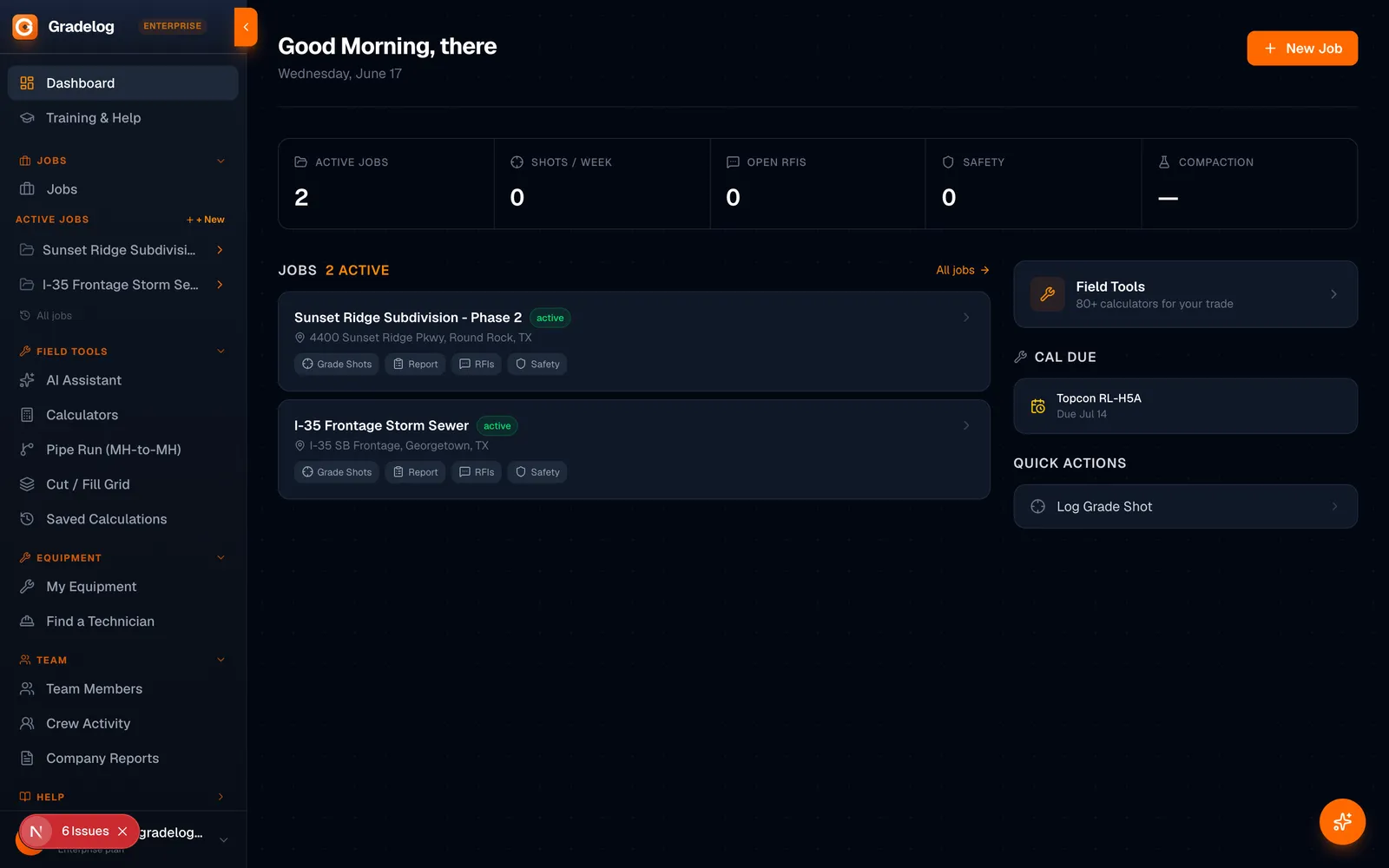
Gradelog dashboard — live field overview with grade shots, photos, and equipment status

Built by the same team as Express Tools

Try Free →

30 days

Free trial

8 languages

Supported

iPhone + Android

Works on

Laser Level System $1,500
Surveyor (setup/restaking) $3,000/month × 6 months = $18,000
Grade Spotters (additional labor) $25/hr × 40 hrs/week × 30 weeks = $30,000