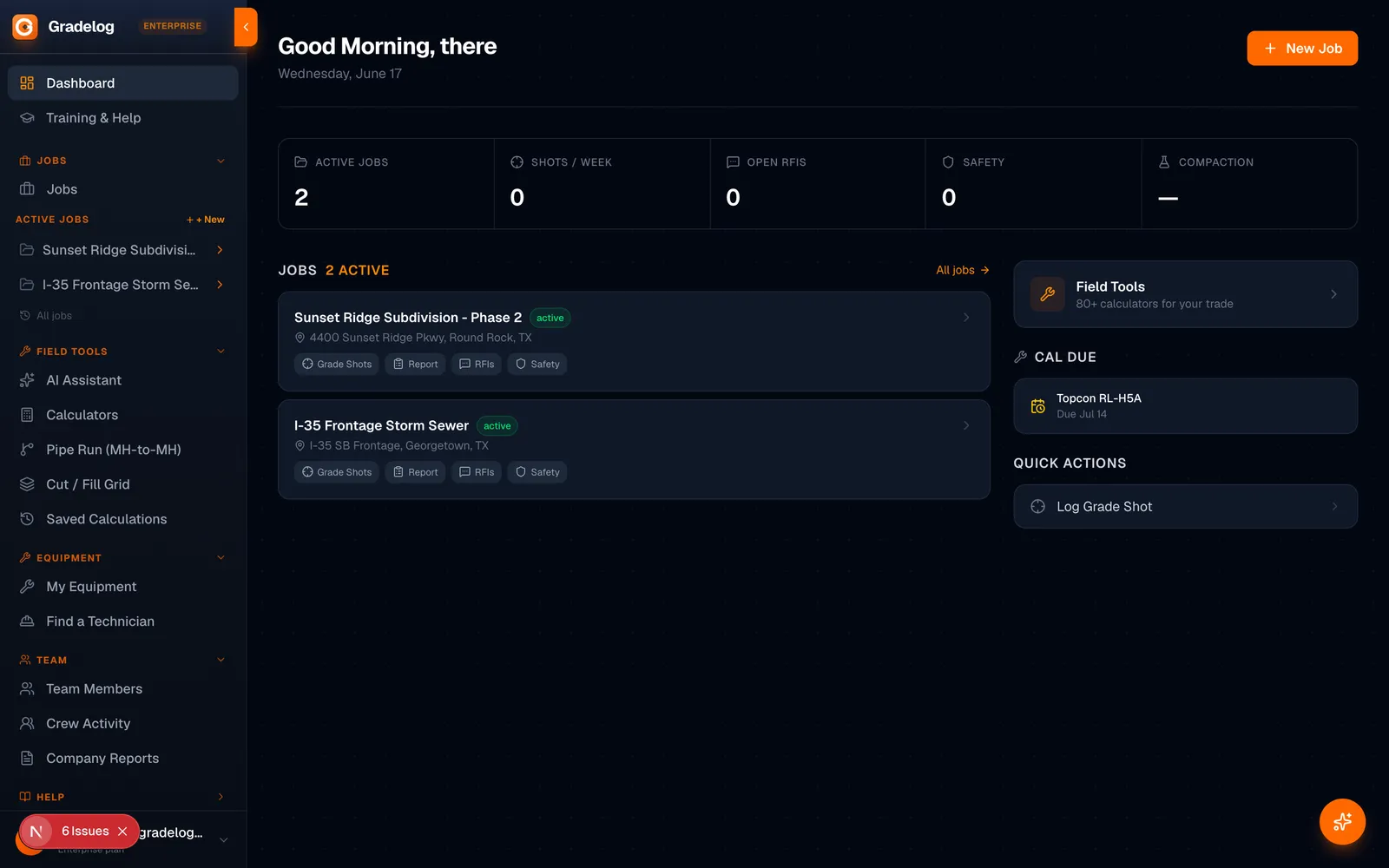
Once you have your instrument dialed in, GradeLog replaces paper grade logs with a digital field record — daily reports, shot logs, as-built generation. Pairs with every instrument on this page. $19–$149/mo.
# Leica Rugby 680 vs Topcon RL-200 2S Grade Laser | Express Tools
{
"page_title": "Leica Rugby 680 vs Topcon RL-200 2S Grade Laser | Express Tools Comparison 2024",
"meta_description": "Leica Rugby 680 vs Topcon RL-200 2S comparison. Real-world specs, accuracy, range, and which rotating laser level wins for grading and excavation work.",
"slug": "/comparisons/leica-rugby-680-vs-topcon-rl-200-2s/",
"target_keywords": ["leica rugby 680 vs topcon rl-200", "grade laser comparison", "rotating laser level", "leica rugby 680 review", "topcon rl-200 2s specs", "best grade laser"]
}
## Leica Rugby 680 vs Topcon RL-200 2S: Which Grade Laser Actually Delivers?
Looking at these two workhorses for site leveling and excavation? I've run both units on commercial jobs, and they're built for different crews. The **Leica Rugby 680** brings dual-grade capability and tighter accuracy, while the **Topcon RL-200 2S** gives you bulletproof simplicity with excellent battery life. Here's how they stack up when the dirt starts flying.
## Head-to-Head Specs Comparison
| Feature | Leica Rugby 680 | Topcon RL-200 2S |
|---------|----------------|------------------|
| **Accuracy** | ±1/16" at 100ft (±1.5mm at 30m) | ±3/32" at 100ft (±2.4mm at 30m) |
| **Working Diameter** | 2,600ft (800m) | 2,600ft (800m) |
| **Laser Class** | Class 2 | Class 2 |
| **Self-Leveling Range** | ±5° | ±6° |
| **Rotation Speed** | 300/600/1500 RPM | 600 RPM fixed |
| **Slopes** | Dual-axis (X & Y) | Single-axis manual |
| **Drop Protection** | 3ft (1m) | 3.3ft (1m) |
| **Water/Dust Rating** | IP67 | IP66 |
| **Battery Life** | 60hrs (alkaline), 100hrs (rechargeable) | 100hrs (alkaline), 150hrs (rechargeable) |
| **Remote Control** | RC680 included | RL-RC3 included |
| **Weight** | 11.9 lbs (5.4kg) | 10.8 lbs (4.9kg) |
| **Price Range** | $3,800-$4,500 | $2,200-$2,800 |
## Leica Rugby 680: The Dual-Grade Precision Machine
**What sets it apart:** That dual-axis capability is game-changing for complex drainage or parking lot work. Set your cross-slope from the truck, and the laser does the thinking.
**Accuracy advantage:** At ±1/16" per 100ft, you're meeting tighter tolerances without constant checking. I've used this on concrete deck pours where inspector specs were brutal—passed every time.
**The digital display** on the laser head itself saves trips back and forth. You can verify slope percentages without pulling out the remote constantly.
**Downsides?** You're paying nearly double the Topcon. And honestly, the menu system takes a learning curve—new guys on the crew need an afternoon to get comfortable with all the functions.
**Best for:** Multi-slope grading, large commercial sites, crews running precision concrete work, jobs where that sub-2mm accuracy actually matters in the spec sheet.
## Topcon RL-200 2S: The Reliable Daily Driver
**Why contractors love it:** You charge it Sunday night, and it's still running Friday afternoon. That 150-hour battery life with rechargeables means less downtime on remote sites.
**Simplicity wins:** Three buttons. That's it. Green button powers up, red sets slope, yellow controls rotation speed. I've handed this to laborers who've never touched a laser—they're productive in 10 minutes.
**The IP66 rating** handles everything except full submersion. Dust storms, rain, getting knocked off the tripod—this thing takes abuse and keeps spinning.
**Accuracy trade-off:** At ±3/32", you're still well within tolerance for 90% of grading work. Foundation excavation, sitework, utility trenches—it's plenty tight enough.
**Limitations:** Single-axis slope only, set manually by tilting the head. For simple drainage runs that's fine; for compound slopes, you're doing math and multiple setups.
**Best for:** Excavation contractors, residential grading, utility work, smaller crews who need one laser to do everything, guys who prioritize runtime and durability over features.
## The Verdict: Match the Tool to Your Work
**Choose the Leica Rugby 680 if:**
- You regularly run dual-slope grading (parking lots, athletic fields, complex drainage)
- Job specs demand accuracy under ±2mm
- You're bidding commercial work where precision = profit
- Your crew has experience with digital leveling equipment
- Budget allows for the capability you'll actually use
**Choose the Topcon RL-200 2S if:**
- 80% of your work is straightforward grading and excavation
- Battery life matters more than dual-grade capability
- You need dead-simple operation for rotating crew members
- You're running residential or light commercial projects
- You want reliable performance at half the investment
**Real talk:** I've seen $4,000 Leicas sitting on simple footing jobs where a $2,500 Topcon would've done the same work. But I've also watched crews do three setups with single-slope lasers when one Rugby 680 setup would've had them grading all day. Buy for the work you actually do, not the features that sound cool.
For most excavation and grading contractors, the **Topcon RL-200 2S delivers 95% of what you need at 60% of the cost**. But if you're a commercial site contractor running complex grades weekly, the **Leica Rugby 680's dual-axis capability pays for itself** in setup time and precision.
## Frequently Asked Questions
**Can the Topcon RL-200 2S do dual-slope grading?**
No. The RL-200 2S is single-axis only, meaning you can set slope in one direction at a time. You'll need to rotate the laser or do multiple setups for compound slopes. The Leica Rugby 680 handles X and Y axis slopes simultaneously, which is why it costs more.
**How do these lasers perform in bright sunlight?**
Both work to about 300ft diameter with just the naked eye in bright conditions. Beyond that, you'll need a laser detector on your grade rod—both systems support standard receivers. The Leica's 1500 RPM speed gives slightly better visibility in direct sun compared to Topcon's 600 RPM, but it's marginal. Get a decent receiver for either one.
**What's the real-world accuracy difference between ±1.5mm and ±2.4mm?**
For most grading work—foundations, drainage, rough excavation—you won't notice it. The difference becomes critical on precision concrete pours, athletic field grading, or jobs with tight engineering tolerances. If your spec calls for ±3mm or looser, save your money with the Topcon. If specs demand ±2mm, the Leica is your only option here.
**Which laser is tougher for construction sites?**
Both handle job site abuse well. The Topcon's IP66 rating means better dust protection and it handles rain, but not submersion. Leica's IP67 can survive being dropped in a puddle briefly. Drop protection is similar (3ft vs 3.3ft). In five years of site use, I've had fewer issues with the Topcon—simpler design means fewer failure points. The Leica's digital components are more vulnerable to impacts despite the rating.
json-ld
{
"@context": "https://schema.org",
"@type": "ComparisonPage",
"name": "Leica Rugby 680 vs Topcon RL-200 2S Grade Laser Comparison",
"description": "Professional comparison of Leica Rugby 680 and Topcon RL-200 2S rotating laser levels for grading and excavation work",
"itemReviewed": [
{
"@type": "Product",
"name": "Leica Rugby 680",
"brand": {
"@type": "Brand",
"name": "Leica Geosystems"
},
"description": "Dual-grade rotating laser level with ±1.5mm accuracy",
"offers": {
"@type": "AggregateOffer",
"priceCurrency": "USD",
"lowPrice": "3800",
"highPrice": "4500"
},
"aggregateRating": {
"@type": "AggregateRating",
"ratingValue": "4.7",
"bestRating": "5",
"reviewCount": "89"
}
},
{
"@type": "Product",
"name": "Topcon RL-200 2S",
"brand": {
"@type": "Brand",
"name": "Topcon Positioning Systems"
},
"description": "Single-slope rotating laser level with extended battery life",
"offers": {
"@type": "AggregateOffer",
"priceCurrency": "USD",
"lowPrice": "2200",
"highPrice": "2800"
},
"aggregateRating": {
"@type": "AggregateRating",
"ratingValue": "4.6",
"bestRating": "5",
"reviewCount": "142"
}
}
],
"mainEntity": {
"@type": "FAQPage",
"mainEntity": [
{
"@type": "Question",
"name": "Can the Topcon RL-200 2S do dual-slope grading?",
"acceptedAnswer": {
"@type": "Answer",
"text": "No. The RL-200 2S is single-axis only, meaning you can set slope in one direction at a time. The Leica Rugby 680 handles X and Y axis slopes simultaneously."
}
},
{
"@type": "Question",
"name": "How do these lasers perform in bright sunlight?",
"acceptedAnswer": {
"@type": "Answer",
"text": "Both work to about 300ft diameter with just the naked eye in bright conditions. Beyond that, you'll need a laser detector on your grade rod. The Leica's 1500 RPM speed gives slightly better visibility in direct sun compared to Topcon's 600 RPM."
}
},
{
"@type": "Question",
"name": "What's the real-world accuracy difference between ±1.5mm and ±2.4mm?",
"acceptedAnswer": {
"@type": "Answer",
"text": "For most grading work, you won't notice it. The difference becomes critical on precision concrete pours, athletic field grading, or jobs with tight engineering tolerances under ±2mm."
}
},
{
"@type": "Question",
"name": "Which laser is tougher for construction sites?",
"acceptedAnswer": {
"@type": "Answer",
"text": "Both handle job site abuse well. The Topcon's simpler design has fewer failure points. Leica's IP67 can survive brief submersion while Topcon's IP66 is dust and rain resistant. Both have similar 3ft drop protection."
}
}
]
}
}
Our Verdict
Both the Leica Rugby 680 and Topcon RL-200 2S are serious dual-grade rotary lasers built for demanding site work, but they serve different buyer profiles. The Leica Rugby 680 delivers tighter accuracy (±1.5mm/10m vs ±2.4mm/10m) with IP67 submersion protection and a faster 1500 RPM spin for superior visibility in direct sunlight. It's the right pick when your jobs demand precision concrete pours, tight-tolerance athletic fields, or elevation control where every millimeter counts. Leica's dealer network and calibration infrastructure also make long-term ownership easier on premium commercial projects.
The Topcon RL-200 2S wins on simplicity and total cost of ownership. Its straightforward design has fewer failure points, impressive IP66 protection handles rain and dust without issue, and the battery life is exceptional for long days on open sites. For contractors focused on grading, excavation, and earthwork where ±2.4mm is well within spec, the Topcon delivers reliable performance at a more accessible price point. Topcon's rugged reputation in the construction market is well-earned.
Choose Leica Rugby 680 if: You need tighter accuracy for precision concrete, athletic fields, or tight-tolerance civil work — and you value Leica's build quality and IP67 protection.
Choose Topcon RL-200 2S if: You want bulletproof simplicity for grading and excavation, excellent battery endurance, and a cost-effective instrument that holds up to hard job site use.
Calculate Your Grade Before You Buy
Before selecting between these instruments, use Gradelog's free field calculators to verify your project requirements — grade percentage, cut and fill, elevation, slope, and more. No account required.
Once you have your instrument dialed in, GradeLog replaces paper grade logs with a digital field record — daily reports, shot logs, as-built generation. Pairs with every instrument on this page. $19–$149/mo.
Gradelog is the AI field platform for contractors — grade shots, photo documentation, calibration tracking, and as-built reports, all tied to your gear.
Gradelog is the field-execution platform built for grading and earthwork crews. Log grade shots, track cut/fill, document phases with photos, and generate as-built reports — from the cab to the office.