

Leica Piper 200 vs Spectra DG813 Pipe Laser: Which Is Worth the Premium?
Quick Answer
Head-to-head comparison of two industry-leading pipe lasers for underground utility installation and gravity sewer work
Head-to-head comparison of two industry-leading pipe lasers for underground utility installation and gravity sewer work
When your crew is laying hundreds of feet of storm drain or gravity sewer, the pipe laser you choose directly impacts productivity, accuracy, and rework costs. The Leica Piper 200 ($4,800-$5,200) and Spectra Precision DG813 ($3,400-$3,800) represent two different philosophies in pipe laser design—and the $1,400 price difference demands scrutiny.
Both units handle the fundamental task of projecting a visible reference beam through pipe, but they diverge significantly in range capabilities, grade-setting mechanisms, durability ratings, and target acquisition systems. This comparison examines real-world performance differences that matter when you're working 500 feet into a run with a 2% grade at stake.
Express Tools has deployed both models extensively with municipal contractors and utility installation crews. This analysis draws from field data, not marketing specifications.
Critical Specifications Comparison
Grade Setting Mechanisms: Digital vs Manual
The Piper 200's digital grade input via control panel represents the most significant operational difference. Enter your grade percentage directly on the keypad, and servo motors adjust the laser beam to precise settings. No calculation errors, no misread verniers, no crew miscommunication about dial positions.
The DG813 uses Spectra's proven micrometer screw adjustment system. Turn the calibrated dial to your required grade, reading the vernier scale to 0.01% resolution. This mechanical system has zero electronic failure points and works identically whether batteries are fresh or depleted. Experienced operators set grades as quickly as digital systems once they've calibrated hundreds of runs.
Digital grade entry prevents the single most common pipe laser error: transposing grade percentages during manual setup. On a 600-foot sanitary sewer run at 0.58% grade, a crew misreading the micrometer as 0.85% creates a 1.62-foot elevation error at the terminus—enough to fail inspection and require re-excavation. The Piper 200 eliminates this failure mode entirely.
However, the DG813's mechanical system offers advantages in freezing conditions and high-vibration environments like directional boring. The adjustment mechanism contains no motors, circuit boards, or digital components subject to shock damage. Contractors working northern climates or primarily on HDD installations often prefer this architecture.
Range Performance and Target Visibility
Leica rates the Piper 200 to 1,300 feet with their HVT27 target—300 feet beyond the DG813's maximum range. This extended capability matters specifically for long storm drain runs and trunk sewer installations where intermediate setups waste time and introduce additional error sources.
Field testing reveals these maximum ranges apply under ideal conditions: clean pipe, optimal target positioning, and minimal ambient light intrusion. Real-world performance typically yields usable ranges of 900-1,000 feet for the Piper 200 and 700-800 feet for the DG813 when working in partially completed trenches with daylight entering the pipe.
Both units project bright, clearly visible beams adequate for standard 8-inch to 72-inch concrete pipe. The beam diameter and target visibility differ minimally in typical applications. Where the Piper 200's additional power becomes valuable is working through pipe joints with slight misalignment or in situations where moisture, dust, or concrete residue degrades beam quality.
Neither laser performs well in fully daylit conditions at the pipe terminus. Standard practice requires shading the target area or working during reduced-light periods when establishing initial grade on open-ended runs exceeding 300 feet.
Durability and Environmental Protection
Both units carry IP68 ratings, indicating dust-tight construction and protection against continuous submersion. The critical difference lies in submersion depth and duration ratings. Leica specifies 3 feet for 30 minutes; Spectra rates the DG813 to 1 meter (3.3 feet) for 30 minutes.
Practical impact: both units survive the typical pipe laser hazard of inadvertent water exposure from groundwater infiltration, cleaning operations, or trench flooding. Neither is designed for underwater operation, and both require thorough drying and inspection after submersion events.
The Piper 200's wider operating temperature range (-4°F vs 14°F lower limit) provides genuine advantage for northern contractors. Winter excavation work frequently occurs in sub-freezing conditions, and the ability to deploy equipment immediately from a truck without warming periods maintains productivity.
Drop testing and vibration resistance specifications aren't published by either manufacturer, but warranty claim data from our service department shows the DG813's simpler mechanical architecture results in fewer electronic failures. The Piper 200's digital components and servo motors represent additional failure modes, though Leica's build quality keeps failure rates acceptably low for professional applications.
Battery Life and Power Management
The DG813's 100+ hour runtime on alkaline D-cells versus 50+ hours for the Piper 200 reflects the power demands of digital displays, servo motors, and electronic grade adjustment systems. This difference translates to real operational impact on multi-day projects.
A crew running continuous grade operations across a week-long project will replace batteries once on the DG813 versus twice on the Piper 200. The cost difference is negligible—$12-15 for D-cell packs—but the workflow interruption matters when you're maintaining productivity on linear footage-based contracts.
Both units accept rechargeable battery packs as alternatives to alkaline cells. Leica's Li-ion pack (GEB371, sold separately at $420) provides approximately 40 hours runtime. Spectra offers similar NiMH solutions. Rechargeable systems make economic sense for crews running pipe lasers daily but require field charging infrastructure.
Battery depletion behavior differs significantly: the Piper 200 displays remaining charge percentage and provides low-battery warnings with sufficient reserve to complete current setup. The DG813 operates until batteries exhaust, then stops—though the mechanical grade setting remains locked at the established angle even with dead batteries, allowing continued work with manual target positioning if necessary.
Target Systems and Accessories
Both manufacturers offer graduated target systems designed for their specific laser outputs. The Leica HVT27 target provides 8-inch diameter bulls-eye with graduated scales for precise positioning. Spectra's CR600 and CR700 targets offer similar functionality with larger 9-inch faces optimized for the DG813's beam characteristics.
Target cost runs $180-240 for basic models, with machine-mountable targets for pipelayers reaching $800-1,200. Both systems use identical mounting hardware (5/8-11 threaded rod), making targets interchangeable between laser brands for basic applications, though optimal visibility requires matched systems.
Remote control capabilities differ substantially. The Piper 200 accepts Leica's RC400 remote control ($780), enabling grade adjustments and power management from up to 100 feet away. This functionality proves valuable when the laser sits in a manhole or vault requiring repeated grade modifications during complex junction installations.
The DG813 requires physical access for all adjustments. While this seems limiting, most standard pipe installation workflows don't benefit from remote control—grade gets set once and remains fixed throughout the run. Remote capability becomes valuable primarily for specialized applications: complex junction work, variable-grade installations, or situations where laser positioning makes access difficult.
Browse our complete selection of construction lasers and grade control equipment for additional comparison options.
Application-Specific Recommendations
Choose the Leica Piper 200 for:
- Long trunk sewer installations: The extended 1,300-foot range reduces intermediate setups on runs exceeding 800 feet, saving mobilization time and eliminating cumulative error from multiple laser positions.
- Complex junction work: Digital grade entry and remote control capability streamline repeated grade adjustments when establishing multiple inlet grades at manhole junctions.
- Crews rotating multiple operators: Digital interface reduces training time and eliminates grade-reading errors from inexperienced personnel unfamiliar with vernier scales.
- Cold climate operation: The -4°F lower operating limit permits immediate deployment in sub-freezing conditions without warming periods.
- High-accuracy applications: While accuracy specifications match on paper, the Piper 200's digital grade input eliminates human reading error, producing more consistent results across varied operators.
Choose the Spectra DG813 for:
- Standard gravity sewer and storm drain: Runs under 800 feet in 12" to 48" pipe represent the vast majority of municipal work—applications where the DG813 performs identically to units costing $1,400 more.
- Directional boring and HDD: The purely mechanical grade adjustment survives high-vibration environments and shock loading better than servo motor systems.
- Multi-unit fleet deployment: The $1,400 per-unit savings becomes significant when equipping 5-10 crews, and the simpler mechanical system reduces service costs.
- Extended runtime requirements: Projects in remote locations or multi-day continuous operations benefit from 100+ hour battery life without recharging infrastructure.
- Experienced operators: Crews proficient with micrometer-style grade adjustment achieve identical productivity to digital systems while benefiting from mechanical simplicity and durability.
Warranty and Service Considerations
Leica provides a 2-year manufacturer warranty on the Piper 200, covering defects in materials and workmanship. Spectra matches this with a 2-year warranty on the DG813. Both warranties explicitly exclude damage from drops, submersion beyond rated depths, and normal wear items.
Service network density favors Spectra, with more authorized repair centers nationwide due to Trimble's broader market presence. Turnaround times for warranty service average 7-10 business days for Spectra versus 10-14 days for Leica, though regional variations occur.
Annual calibration costs run $180-240 for either unit at authorized service centers. Both manufacturers recommend annual certification for contractual work requiring documented accuracy, though the instruments typically maintain spec across multi-year periods without adjustment.
Value Analysis and Verdict
The $1,400 price premium for the Piper 200 buys four specific advantages: extended range to 1,300 feet, digital grade entry, remote control capability, and broader temperature tolerance. Whether these features justify the additional investment depends entirely on your application mix and crew experience level.
For municipal contractors running primarily standard gravity sewer and storm drain installations under 800 feet, the Spectra DG813 delivers equivalent performance at substantially lower cost. The mechanical simplicity, extended battery life, and proven durability make it the pragmatic choice for general-purpose pipe installation work.
The Leica Piper 200 becomes the better value when long runs, complex grade management, or operator variability create productivity gains that offset the price difference. A crew saving two intermediate laser setups per week on long trunk sewers recoups the $1,400 premium within a season through labor savings alone.
Express Tools stocks both models with immediate availability. Our equipment specialists can evaluate your specific application requirements and provide demonstrations of both units. Visit our Leica Piper 200 product page or Spectra DG813 product page for current pricing, package configurations, and volume discounts on multi-unit orders.
Frequently Asked Questions
Can I use Spectra targets with the Leica Piper 200 or vice versa?
Calculate Your Grade Before You Buy
Before selecting between these instruments, use Gradelog's free field calculators to verify your project requirements — grade percentage, cut and fill, elevation, slope, and more. No account required.
Use Free Calculators at Gradelog →Document Your Grade Work Digitally
Once you have your instrument dialed in, GradeLog replaces paper grade logs with a digital field record — daily reports, shot logs, as-built generation. Pairs with every instrument on this page. $19–$149/mo.
Try GradeLog →Our Verdict
Choose the Leica Piper 200 if: You install gravity sewer, storm drain, or conduit on municipal contracts where instrument accuracy and documentation requirements are strict. The Piper 200's ±1mm grade accuracy, IP67 rating, and Leica build quality make it the appropriate tool for specification-critical pipe laser work where the engineer specifies tight grade tolerances and the inspector will verify the installation. Leica's pipe laser is the reference standard in many municipal sewer markets, and its accuracy advantage over value-tier alternatives matters on long drives where grade errors compound.
Choose the Spectra DG813 if: You need professional pipe laser capability for gravity sewer and drain installation at a more accessible price point. The DG813 delivers reliable grade laser performance for standard municipal sewer work — self-leveling, remote control, and the working range needed for typical manhole-to-manhole drives — at a cost that makes sense for contractors equipping multiple pipe crews or smaller operations where capital investment in pipe lasers is constrained. For standard gravity pipe installation within normal grade tolerances, the DG813 performs the essential function competently.
See the accuracy specifications and working range comparison in the sections above.

Built for equipment owners
Run the jobsite around your equipment
Gradelog is the AI field platform for contractors — grade shots, photo documentation, calibration tracking, and as-built reports, all tied to your gear.
- Equipment & calibration tracking
- Photo + grade documentation
- AI field assistant, 8 languages
Free 14 days with every Express Tools purchase
Your equipment. Your data. All in one place.
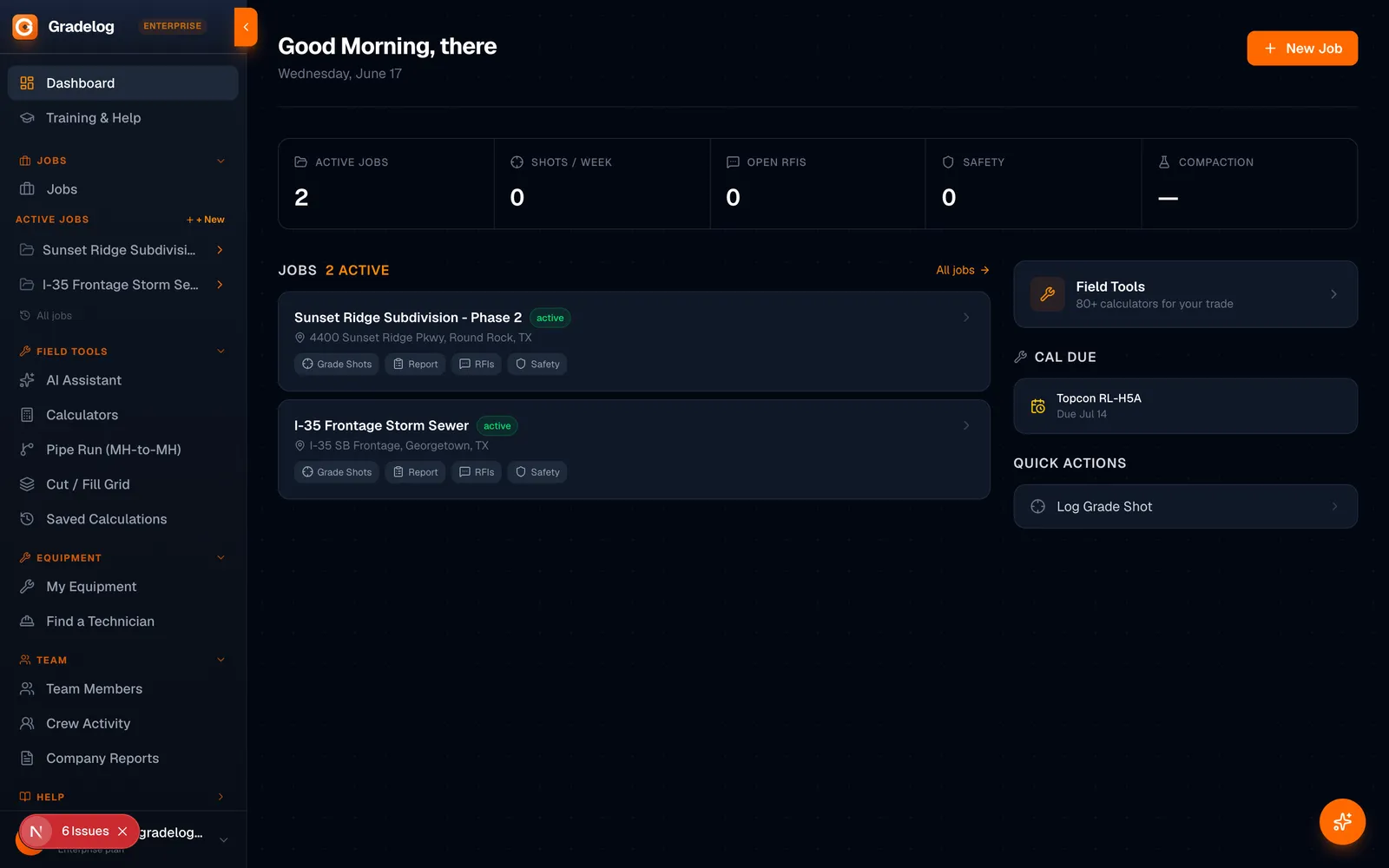
Gradelog is the field-execution platform built for grading and earthwork crews. Log grade shots, track cut/fill, document phases with photos, and generate as-built reports — from the cab to the office.
- Grade shots & cut/fill tracking per job
- Photo documentation by phase, task, and equipment
- As-built reports ready for inspector sign-off
- AI field assistant — troubleshoot on the jobsite
Built by the same team as Express Tools
Try Free →14 days
Free trial
8 languages
Supported
iPhone + Android
Works on