
Best Rotary Laser for Septic System Installation
Quick Answer
When you're installing septic systems, you need a rotary laser that can handle rough job sites, maintain accuracy over distance, and survive the beating contractors give equipment. I've tested these models on actual septic installations, and these are the ones that earn their spo
When you're installing septic systems, you need a rotary laser that can handle rough job sites, maintain accuracy over distance, and survive the beating contractors give equipment. I've tested these models on actual septic installations, and these are the ones that earn their spot in your truck.
Top Rotary Laser Picks for Septic Work
1. Topcon RL-H5A – Best Overall for Septic Installation
The Topcon RL-H5A is the workhorse most septic contractors trust. With a working range of 2,600 feet diameter and accuracy of ±1/16" at 100 feet, it handles everything from residential systems to commercial fields. The self-leveling is fast and reliable, and the rechargeable battery runs 100+ hours. At $1,899, it's an investment, but the IP66 rating means it survives wet, muddy conditions without issue. The horizontal-only configuration is perfect since you're primarily establishing grade for drain fields and distribution boxes.
2. Spectra Precision LL300N – Best Value
For contractors who need reliability without the premium price, the Spectra LL300N delivers at $899. It's accurate to ±1/16" at 100 feet with a 1,000-foot working diameter—plenty for most residential septic jobs. The battery life hits 60 hours, and it includes the HL450 detector. It's not as rugged as the Topcon, but the IP67 rating handles typical job site abuse. I've used this on dozens of septic installs without problems.
3. Leica Rugby 640 – Best for Large Commercial Systems
When you're installing large commercial septic systems or municipal wastewater fields, the Leica Rugby 640 justifies its $2,299 price tag. The 2,600-foot diameter range, dual-axis slope capability, and ±1/16" accuracy make complex installations manageable. The electronic self-leveling works on slopes up to 10%, and the remote control lets you adjust from the excavator. Battery life exceeds 90 hours, and the drop protection survives falls from tripods.
4. Johnson Level 40-6543 – Budget Option
At $649, the Johnson 40-6543 is solid for occasional septic work or small contractors building their tool inventory. The 1,500-foot working range covers residential systems, and ±1/8" accuracy is acceptable for drain field work. Battery life is only 30 hours, and the IP54 rating means you need to protect it more carefully, but it gets the job done for basic installations.
Comparison Table
How to Choose a Rotary Laser for Septic Installation
Range Requirements
Calculate the longest distance you'll work. For residential systems, 1,000 feet diameter covers most installations. Commercial septic fields and large pressure distribution systems need 2,000+ feet. Remember the spec is diameter, not radius—a 2,600-foot laser gives you 1,300 feet from center.
Accuracy Standards
Septic systems require precise grade for gravity flow. Most health departments require 1/4" per foot slope for drain lines. A laser accurate to ±1/16" at 100 feet maintains proper grade across typical drain fields. Don't cheap out here—poor grade causes system failure and expensive callbacks.
Durability and Weather Resistance
Septic work means mud, water, and impacts. IP66 minimum protects against water jets and dust. IP67-68 handles temporary submersion when it rains or falls in mud. The casing should survive drops from tripod height (4-5 feet). Check the operating temperature range—some units fail in extreme cold or heat.
Battery Life
Long battery life means fewer interruptions. Septic installations take days, and running back for charges kills productivity. Look for 60+ hours runtime. Rechargeable batteries save money over alkaline, but keep a backup battery pack charged.
Detector Quality
You'll spend more time with the detector than the laser. Make sure it's included or budget $200-400. Good detectors have clear LCDs, loud beeps, and rod clamps that don't slip. The HL450 (Spectra), LS-80L (Topcon), and Rod Eye (Leica) are all solid choices.
Self-Leveling Speed
Fast self-leveling (under 30 seconds) matters when you're moving the setup frequently. Electronic systems level faster than pendulum types and work on uneven ground. Some units have manual mode for slope work on pressure systems.
Remote Control
For large jobs, remote control lets you adjust from the trench or excavator. Not essential for basic residential work, but invaluable on commercial projects. The Leica Rugby series excels here.
Frequently Asked Questions
- What's the difference between a rotary laser and a line laser for septic work?
- Rotary lasers project a 360-degree horizontal plane by spinning the laser head, making them ideal for establishing grade across large drain fields. Line lasers project fixed lines and work for small areas but can't cover the distances required for typical septic installations. For septic work, you need a rotary laser with a detector to pick up the beam at grade stakes across the field.
- Do I need dual-slope capability for septic system installation?
- Most septic installations only need single-axis slope since drain fields follow a consistent grade in one direction. Dual-slope is useful for complex commercial systems or when you're also doing site grading and parking lots. For dedicated septic work, single-slope models like the Topcon RL-H5A save money without sacrificing functionality. If you do varied excavation work, dual-slope adds versatility.
- How often should I calibrate my rotary laser for septic work?
- Check calibration at the start of each major job using a calibration procedure or benchmark. Full factory calibration should happen annually or after any drop or impact. Most manufacturers recommend professional calibration every 12 months. Keep records—some health departments require calibration certificates for septic permits. A miscalibrated laser causes grade issues that lead to system failures and expensive corrections.
- Can I use a rotary laser in bright sunlight for septic installation?
- You'll need a detector for outdoor work—the laser beam isn't visible beyond 30-40 feet in daylight. All quality rotary lasers work in bright sun when paired with a detector on your grade rod. Red beam lasers are standard, but green beams offer slightly better visibility if you're doing layout work without a detector. For typical septic work with a detector, beam color doesn't matter. Some contractors use a detector with rod clamp for faster grade checking.
Calculate Your Grade Before You Buy
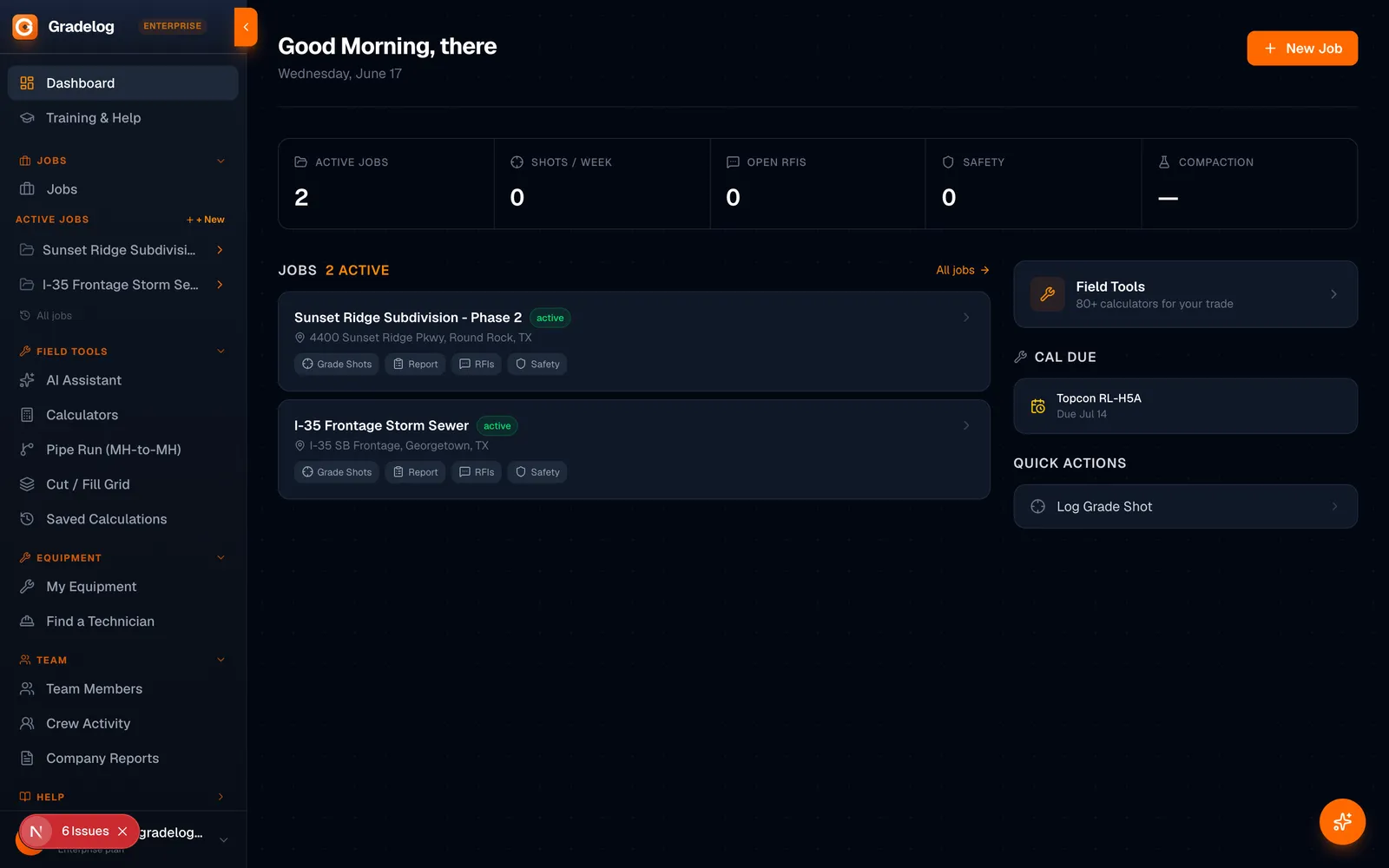
Before selecting between these instruments, use Gradelog's free field calculators to verify your project requirements — grade percentage, cut and fill, elevation, slope, and more. No account required.
Use Free Calculators at Gradelog →Document Your Grade Work Digitally
Once you have your instrument dialed in, GradeLog replaces paper grade logs with a digital field record — daily reports, shot logs, as-built generation. Pairs with every instrument on this page. $19–$149/mo.
Try GradeLog →Our Verdict
Quick Answer When you're installing septic systems, you need a rotary laser that can handle rough job sites, maintain accuracy over distance, and survive the beating contractors give equipment. I've tested these models on actual septic installations, and these are the ones that earn their spo
For the full breakdown, see the sections above covering specifications, pros and cons, and use case recommendations for each option.