
Best Rotary Laser for Remodeling Contractors
Quick Answer
Before selecting between these instruments, use Gradelog's free field calculators to verify your project requirements — grade percentage, cut and fill, elevation, slope, and more. No account required.
Rotary laser levels have become essential tools for remodeling contractors tackling everything from kitchen renovations to whole-house additions. Unlike basic line lasers, rotary lasers project a full 360-degree horizontal or vertical plane, allowing you to establish level reference points around entire rooms simultaneously. Whether you're installing drop ceilings, leveling cabinets, or setting foundations for additions, the right rotary laser saves time and ensures professional accuracy across large spaces.
This guide examines the top rotary lasers specifically for remodeling work, where durability, accuracy, and ease of setup matter most. We've focused on models that balance professional features with practical pricing for contractors who need reliability without the extreme cost of commercial-grade survey equipment.
Our Top Picks
🏆 Best Overall: Topcon RL-H5A
Accuracy: ±1/16" at 100 ft | Range: 2,600 ft diameter with detector | Price Range: $1,100-$1,300
The Topcon RL-H5A delivers professional-grade accuracy at a mid-range price point. Its horizontal self-leveling system handles jobsite vibrations exceptionally well, critical when working in active remodeling environments. The included LS-80L detector provides excellent range for exterior addition work, while the quick-release tribrach mount allows fast repositioning between rooms.
💰 Best Value: Johnson Level 40-6539
Accuracy: ±3/32" at 100 ft | Range: 1,500 ft diameter with detector | Price Range: $425-$525
For contractors seeking solid performance without premium pricing, the Johnson 40-6539 hits the sweet spot. While accuracy specs fall slightly below top-tier models, it's more than sufficient for cabinet installation, drywall, and general remodeling tasks. The electronic self-leveling system works within ±5 degrees, and the durable housing withstands typical jobsite abuse.
⚡ Best for Complex Projects: Hilti PR 30-HVS
Accuracy: ±1/16" at 100 ft | Range: 2,000 ft diameter with detector | Price Range: $1,500-$1,800
The Hilti PR 30-HVS features dual-slope capability in both axes, making it ideal for complex remodeling projects involving sloped ceilings, custom staircases, or drainage systems. The manual slope adjustment is precise and maintains calibration even when moved. Hilti's legendary build quality ensures this laser survives years of demanding remodeling work.
Detailed Comparison Table
How to Choose the Right Rotary Laser for Remodeling
Accuracy Requirements
Remodeling accuracy needs vary by application. For framing, general layout, and drywall installation, ±1/8 inch at 100 feet is perfectly adequate. However, finish carpentry, high-end kitchen installations, and tile work benefit from tighter tolerances of ±1/16 inch at 100 feet. Don't overpay for ±1/32 inch survey-grade accuracy unless you're doing specialized millwork or commercial build-outs requiring extreme precision.
Working Range Considerations
Indoor remodeling rarely requires ranges beyond 100-150 feet in diameter. However, the included or compatible detector determines outdoor capability for additions, decks, and exterior grading. Models with 2,000+ foot detector ranges provide flexibility for whole-property projects. Consider that detector quality matters as much as laser power—cheap detectors reduce effective range and accuracy.
Self-Leveling vs. Manual
Electronic self-leveling rotary lasers are standard for remodeling work. They automatically level within their range (typically ±5 degrees) and alert you if knocked out of level. This saves significant setup time when moving between rooms. Manual leveling lasers cost less but require bubble vial adjustment at each setup—impractical for fast-paced remodeling schedules.
Horizontal-Only vs. Dual-Grade Capability
Basic horizontal rotary lasers handle 90% of remodeling tasks: leveling cabinets, installing chair rails, ceiling work, and foundation layout. Dual-grade (slope) capability adds $400-$800 but enables precise grading for drainage, sloped ceiling installations, and ramp construction. Evaluate whether your typical projects justify the additional investment.
Durability and Protection
Remodeling jobsites are dusty, cluttered, and hazardous for precision instruments. Look for IP56 or better ingress protection against dust and water. Reinforced housings with rubber overmolding survive inevitable drops and impacts. Some manufacturers like Hilti and Leica offer superior drop protection (up to 5 feet onto concrete), worth considering for busy multi-crew operations.
Battery System
Rechargeable battery systems reduce operating costs but require charging discipline. Alkaline battery options provide backup for long days or when charging isn't convenient. The best systems accept both. Battery life varies dramatically: 40-hour models require mid-day changes on long projects, while 80-100 hour lasers run multiple days per charge. Factor replacement battery costs into total ownership calculations.
Mounting and Portability
Standard 5/8-11 tripod threading fits universal laser tripods and grade rods. Quick-release tribrach systems speed setup but add cost. For interior work, wall-mounting brackets allow positioning without floor space consumption. Weight matters when carrying equipment between floors—5-6 pound models are noticeably easier to transport than 8+ pound units.
Frequently Asked Questions
Do I need field management software with this equipment?
Gradelog is an AI field assistant designed for contractors using precision grade equipment. Free calculators for grade percentage, cut/fill, elevation, and slope are available with no account required. Paid plans add job logs, equipment tracking, and as-built exports.
How do I document grade work on a job site?
GradeLog replaces paper grade logs with digital field records — shot logs, daily reports, as-built generation. $19–$149/mo.
Do I need field management software with this equipment?
Gradelog is an AI field assistant designed for contractors using precision grade equipment. Free calculators for grade percentage, cut/fill, elevation, and slope with no account required. Paid plans add job logs, equipment tracking, and as-built exports.
How do I document grade work on a job site?
GradeLog replaces paper grade logs with digital field records — shot logs, daily reports, as-built generation. $19–$149/mo.
Our Verdict
Calculate Your Grade Before You Buy Before selecting between these instruments, use Gradelog's free field calculators to verify your project requirements — grade percentage, cut and fill, elevation, slope, and more. No account required. Use Free Calculators at Gradelog →
For the full breakdown, see the sections above covering specifications, pros and cons, and use case recommendations for each option.

Built for equipment owners
Run the jobsite around your equipment
Gradelog is the AI field platform for contractors — grade shots, photo documentation, calibration tracking, and as-built reports, all tied to your gear.
- Equipment & calibration tracking
- Photo + grade documentation
- AI field assistant, 8 languages
Free 14 days with every Express Tools purchase
Your equipment. Your data. All in one place.
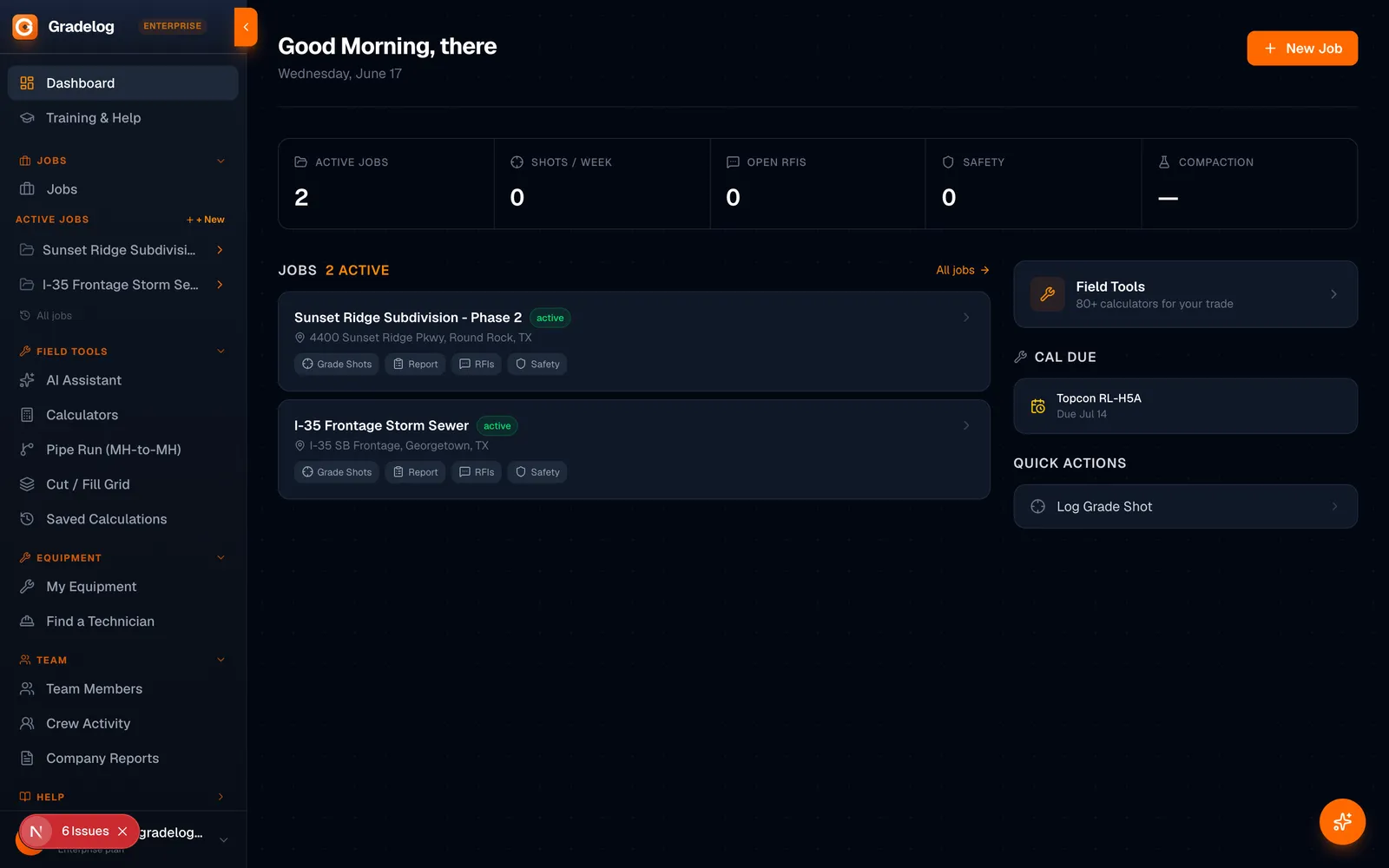
Gradelog is the field-execution platform built for grading and earthwork crews. Log grade shots, track cut/fill, document phases with photos, and generate as-built reports — from the cab to the office.
- Grade shots & cut/fill tracking per job
- Photo documentation by phase, task, and equipment
- As-built reports ready for inspector sign-off
- AI field assistant — troubleshoot on the jobsite
Built by the same team as Express Tools
Try Free →14 days
Free trial
8 languages
Supported
iPhone + Android
Works on