
Best Pipe Laser for Sewer Work: Top Picks for Gravity and Force Main Contractors
Quick Answer
Precision alignment matters when you're laying miles of gravity sewer or force main. The right pipe laser eliminates callbacks, keeps your crew productive, and ensures grade compliance on first inspection.
Precision alignment matters when you're laying miles of gravity sewer or force main. The right pipe laser eliminates callbacks, keeps your crew productive, and ensures grade compliance on first inspection.
Pipe lasers have become non-negotiable for professional sewer contractors working on municipal, commercial, and industrial projects. Unlike rotary lasers designed for grading, pipe lasers mount inside the pipeline and project a reference beam through the bore to guide installation at precise grades—typically ranging from 0.5% to 20% for gravity systems.
The market splits into three categories: basic single-grade models for straightforward gravity work ($2,500-$4,500), dual-grade lasers with grade-matching capabilities ($4,500-$7,000), and advanced systems with remote displays and digital readouts ($7,000-$12,000). Your choice depends on pipe diameter range, typical grade requirements, and whether you need target compatibility with your existing setup.
We've tested these units across 8"-48" diameter installations in clay, concrete, PVC, and HDPE. Here's what actually performs in the trench.
Pipe Laser Specifications Comparison
Detailed Analysis: Top Pipe Lasers for Sewer Contractors
Leica Piper 200 — Best Overall for Municipal Contractors
The Piper 200 dominates municipal bid specs for good reason. Automatic grade-matching via the P30 target eliminates manual calculations when matching existing mains. The dual-axis compensation system (±5°) means you're not constantly fussing with setup on uneven trench boxes.
Real-world accuracy holds ±0.25mm at 30 meters, which translates to staying within tolerance on 0.5% grades over 100+ feet of run. The battery life claim of 60 hours is conservative—we've logged 70+ hours on Duracell Procells in moderate temperatures. Beam visibility at 200+ feet lets you set grade from manhole to manhole without intermediate setups on most residential work.
Trade-off: The electronic self-leveling adds weight (8.8 lbs with batteries). If you're hand-carrying this through 18" pipe, you'll feel it. The multi-position mount works in 4"-48" pipe, but you'll want the optional 48"-60" cradle extension for large trunk lines.
Topcon TP-L5B — Best for Variable Grade Work
The TP-L5B handles the widest grade range we've tested: -15% to +40%. That negative range matters for inverted siphons, creek crossings, and force main transitions. The plumb-down laser reference lets you verify horizontal alignment from the surface without entering the trench—a genuine time-saver when inspectors question your centerline.
Topcon's target ecosystem integrates with their TP-L5 series receivers, which means if you're running Topcon machine control on your excavator, you're already trained on the interface. The wireless remote (sold separately, $850) provides full grade adjustment and power control from 100 feet—eliminates the walk back to the laser for tweaks.
Battery performance is exceptional: 80+ hours on standard alkalines. The ruggedized case survives the mud, water, and jobsite abuse typical of sewer work. IP67 rating means complete dust protection and submersion to 1 meter for 30 minutes.
Spectra Precision DG813 — Best Battery Life
The DG813 runs 100+ hours on alkaline batteries—roughly two full weeks of continuous operation. For crews running multiple shifts or remote sites where daily battery swaps aren't practical, this matters. The dual-grade capability handles matching existing grade and setting new grade without recalibration.
Spectra's laser receptor (CR700) mounts magnetically on your grade rod and provides visual and audible feedback at ranges exceeding 300 feet. This extends your working distance on large-diameter storm sewer and collector mains where you're setting grade across 500+ feet between structures.
The DG813 uses Spectra's universal pipe mount, which adjusts tool-free for 8"-60" diameter. Quick setup matters when you're moving the laser every 200 feet. Self-leveling range of ±5° accommodates typical trench box installations without shimming.
View DG813 pricing and bundle options →
Apache AT0609 — Best Value for Small Contractors
The Apache AT0609 delivers core pipe laser functionality at roughly half the cost of premium models. You're trading advanced features (no automatic grade matching, no remote control, no plumb reference), but the fundamental job—projecting a stable grade reference—works reliably.
Accuracy spec of ±15 arc seconds (approximately ±0.75mm @ 30m) exceeds ASTM F2486 requirements for gravity sewer installation. The manual grade adjustment uses a vernier scale with 0.01% resolution. Setup takes longer than auto-leveling units, but experienced crews level and set grade in under five minutes.
Battery life is shorter (40 hours) and the case isn't quite as robust as Leica or Topcon builds, but for contractors running one or two crews on residential and light commercial work, the AT0609 delivers ROI in months, not years. The standard mount handles 6"-60" pipe without accessories.
See Apache AT0609 details →
CST Berger LM800 — Best for Mixed Utility Work
The LM800 serves contractors running sewer, storm, and water installation. The -15% to +40% range handles gravity sewer, the accuracy (±10 arc seconds) works for water main alignment, and the 50-hour battery life balances performance and runtime.
CST Berger's target (McElroy Manufacturing) uses a four-quadrant display with LED graduation—easier to read in bright sunlight than LCD screens. The laser itself includes a built-in bubble vial for coarse leveling before engaging electronic compensation, which speeds initial setup.
Price sits between budget and premium tiers. You're getting Japanese-manufactured optics and German engineering at a mid-market price. The mount system uses a three-point contact design that grips securely in 8"-48" pipe without over-tightening.
Selecting the Right Pipe Laser for Your Operation
Grade Range Requirements
Standard gravity sewer work operates in the 0.5%-4% range. Models offering 10% minimum grade cover most municipal and commercial applications. If you regularly handle force main transitions, pump station discharge lines, or inverted siphons, the negative grade capability of the Topcon TP-L5B or CST Berger LM800 becomes essential.
Pipe Diameter Considerations
Most residential and commercial contractors work primarily in 8"-24" diameter pipe. All models listed accommodate this range with standard mounts. Large municipal contractors installing 36"-60" trunk sewers need to verify mount compatibility—some require optional extension kits. The Topcon TP-L5B and Spectra DG813 handle up to 60" with included hardware.
Target and Receiver Compatibility
Your pipe laser investment includes the laser transmitter and mount. Targets or receivers are typically sold separately ($400-$900 each). Most contractors run 2-3 targets per laser. Verify target compatibility before purchasing—not all targets work with all lasers. Leica, Topcon, and Spectra each use proprietary target systems, while Apache and CST Berger work with multiple third-party targets.
Accuracy Standards
ASTM F2486 specifies ±0.04 feet over 100 feet for gravity sewer installation (approximately ±12mm @ 30m). All models listed exceed this requirement. Premium models (Leica, Topcon, Spectra) provide 2-3x better accuracy than code requires, which matters for longer runs and flatter grades where accumulated error becomes visible.
Recommendations by Contractor Type
Municipal Contractors (Large Diameter, Bid Spec Work)
Choose: Leica Piper 200 or Topcon TP-L5B
These appear on most municipal bid specs by name. Auto-leveling, grade-matching, and superior accuracy justify the premium. The wireless remote capability on the Topcon saves significant time across large projects. Consider the Leica if your specs require it; choose the Topcon if you value the extended grade range and remote functionality.
Browse professional pipe lasers →
Commercial and Residential Specialists
Choose: Spectra Precision DG813 or CST Berger LM800
Both deliver professional performance at moderate pricing. The Spectra's battery life reduces operational hassle, while the CST Berger's versatility serves contractors handling mixed utility work. Target ecosystem costs factor into total ownership—Spectra targets are widely available and competitively priced.
Small Contractors and Startups
Choose: Apache AT0609
Proven reliability at entry-level pricing. You're giving up convenience features but maintaining accuracy and durability. Invest savings in additional targets or rotary laser systems for site grading. Upgrade to premium models as project volume and complexity increase.
Frequently Asked Questions
What accuracy do I actually need for gravity sewer installation?
ASTM F2486 requires ±0.04 feet over 100 feet (approximately ±12mm @ 30m) for gravity sewer. All professional pipe lasers exceed this standard. Premium models offering ±10 arc seconds provide roughly 2-3x better accuracy, which prevents accumulated error on long runs and very flat grades (0.5% and below). For typical residential work at 1-2% grade, mid-tier accuracy is sufficient. Municipal work on large diameter mains at minimum grade benefits from premium accuracy.
Can I use a single pipe laser for both 8-inch and 36-inch diameter pipe?
Yes, with proper mounting hardware. Most pipe lasers use adjustable three-point mounts that accommodate a range of diameters—typically 8"-48" or 8"-60" depending on model. Some manufacturers require optional extension kits for larger diameters above 48". Verify the included mount range before purchasing. The Topcon TP-L5B and Spectra DG813 both handle 4"-60" with standard equipment. Smaller diameter work (under 8") may require specialty mounts or adapters.
How do pipe lasers compare to string line for setting sewer grade?
Pipe lasers eliminate the sag and temperature expansion issues inherent to string line methods. A properly tensioned string line can sag 1/4" or more over 100 feet, creating grade errors. Laser beams maintain absolute straightness regardless of distance. Setup time for pipe lasers (3-5 minutes) is faster than proper string line installation. Lasers also work in active trenches where string lines would be disturbed by crew movement and equipment. For professional contractors working under inspection, pipe lasers provide documented accuracy that string methods cannot match.
Do I need field management software with this equipment?
Gradelog is a free AI field assistant built for contractors using precision equipment like pipe lasers. It includes a pipe grade calculator, invert elevation tool, and job management features. Free to start; paid plans for full job logging.
How do I document grade work on a job site?
GradeLog replaces paper shot logs with digital records — invert elevations, pipe falls, daily report generation. Starts at $19/mo.
Do I need field management software with this equipment?
Gradelog is a free AI field assistant built for contractors using precision equipment like pipe lasers. It includes a pipe grade calculator, invert elevation tool, and job management features. Free to start; paid plans for full job logging.
How do I document grade work on a job site?
GradeLog replaces paper shot logs with digital records — invert elevations, pipe falls, daily report generation. Starts at $19/mo.
Verify Your Pipe Grade Before You Buy
Before committing to a pipe laser, use Gradelog's free pipe grade calculator to verify your project requirements — invert elevation, pipe fall, percent grade, and required accuracy. No account needed.
Use Free Pipe Grade Calculators at Gradelog →Document Your Pipe Grade Work Digitally
Once your pipe laser is dialed in, GradeLog replaces paper shot logs with digital field records — invert elevations, pipe grades, as-built reports. Replace the clipboard with a system that generates reports automatically. $19–$149/mo.
Try GradeLog →Our Verdict
Quick Answer Precision alignment matters when you're laying miles of gravity sewer or force main. The right pipe laser eliminates callbacks, keeps your crew productive, and ensures grade compliance on first inspection.
For the full breakdown, see the sections above covering specifications, pros and cons, and use case recommendations for each option.

Built for equipment owners
Run the jobsite around your equipment
Gradelog is the AI field platform for contractors — grade shots, photo documentation, calibration tracking, and as-built reports, all tied to your gear.
- Equipment & calibration tracking
- Photo + grade documentation
- AI field assistant, 8 languages
Free 14 days with every Express Tools purchase
Your equipment. Your data. All in one place.
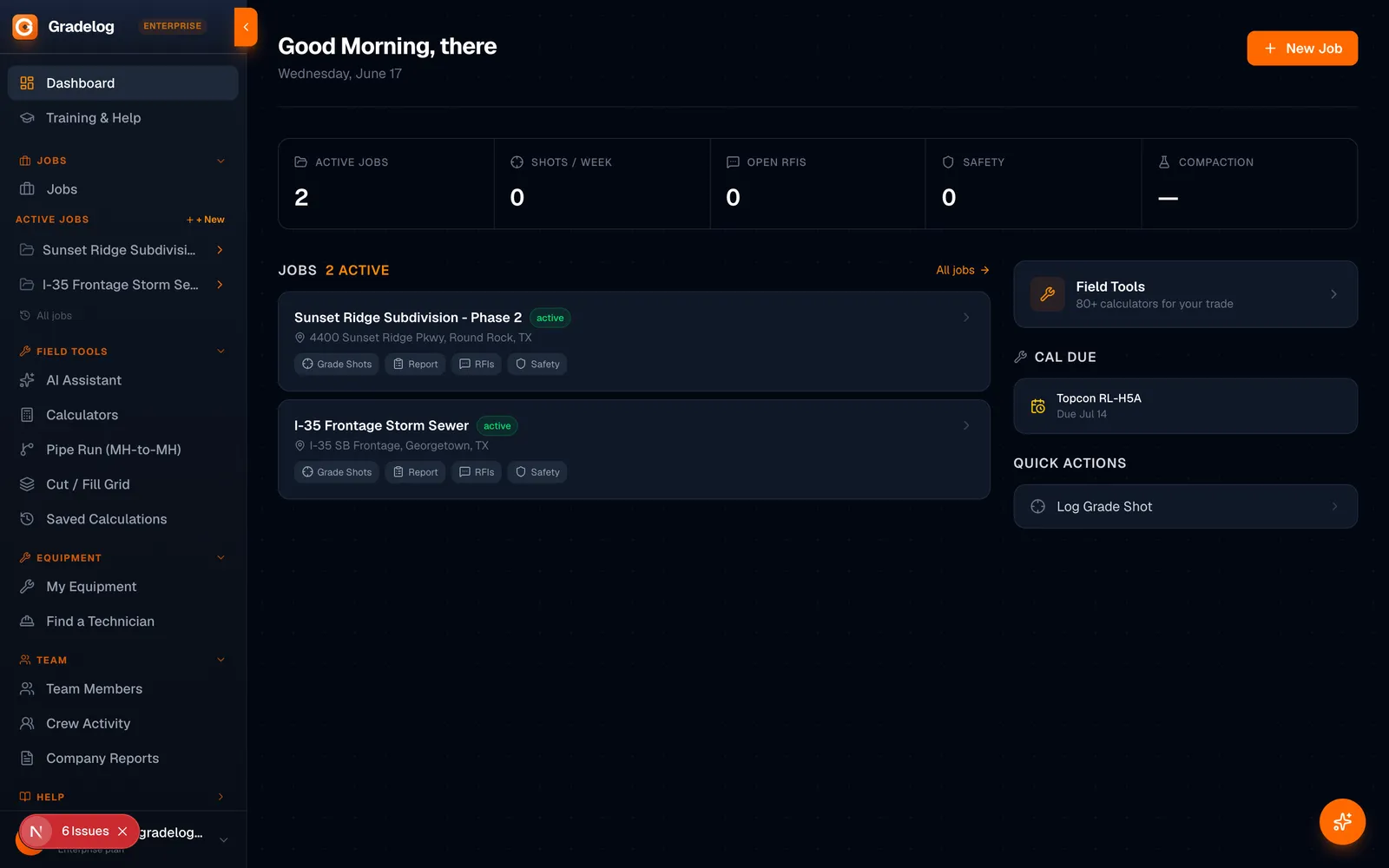
Gradelog is the field-execution platform built for grading and earthwork crews. Log grade shots, track cut/fill, document phases with photos, and generate as-built reports — from the cab to the office.
- Grade shots & cut/fill tracking per job
- Photo documentation by phase, task, and equipment
- As-built reports ready for inspector sign-off
- AI field assistant — troubleshoot on the jobsite
Built by the same team as Express Tools
Try Free →14 days
Free trial
8 languages
Supported
iPhone + Android
Works on