
Best Pipe Laser for Gravity Sewer Installation
Quick Answer
Gravity sewer installation demands absolute precision—even a fraction of a degree off-grade can result in costly callbacks, standing water, or failed inspections. Professional pipe lasers are the backbone of efficient, accurate sewer line work, projecting a reference beam down th
Gravity sewer installation demands absolute precision—even a fraction of a degree off-grade can result in costly callbacks, standing water, or failed inspections. Professional pipe lasers are the backbone of efficient, accurate sewer line work, projecting a reference beam down the pipe to ensure consistent grade from manhole to manhole. For contractors specializing in municipal sewer projects, subdivision developments, or commercial site work, investing in the right pipe laser means the difference between first-time approvals and expensive rework.
Unlike general construction lasers, pipe lasers are purpose-built for the harsh underground environment. They're designed to withstand the vibration of heavy equipment overhead, temperature fluctuations in trenches, and the occasional bump during installation. The best models offer remote grade adjustment, long beam visibility (up to 1,000 feet or more), and automatic self-leveling to maintain accuracy throughout the day.
This guide examines the top pipe lasers trusted by sewer installation crews, from compact single-grade models for straightforward residential work to dual-grade systems capable of handling complex alignment requirements on large-diameter mains.
Top Pipe Lasers for Gravity Sewer Work
Topcon RL-H5A – Best Overall for Professional Contractors
Price Range: $3,200-$3,800
The Topcon RL-H5A has earned its reputation as the workhorse of the sewer installation industry. This rotating laser delivers exceptional accuracy (±10 arc seconds) and features a working diameter of 2,600 feet—more than sufficient for the longest municipal runs. What sets the RL-H5A apart is its rugged construction; it's fully sealed against dust and water intrusion (IP66 rating) and can handle the jarring impacts common on active job sites.
The RL-H5A includes wireless remote control up to 300 feet, allowing your laser man to make grade adjustments from the receiving manhole without walking back through the trench. The self-leveling range of ±5 degrees means faster setup, and the long battery life (100+ hours on alkaline batteries) keeps your crew productive across multiple days without recharging interruptions. For contractors running 8-inch to 48-inch pipe on commercial and municipal projects, the RL-H5A delivers the reliability and precision that keeps inspectors satisfied.
View Topcon RL-H5A Specifications & Pricing
Spectra Precision GL412N – Best Dual-Grade Laser for Complex Projects
Price Range: $3,500-$4,200
When your projects involve curved alignments or dual-grade requirements, the Spectra Precision GL412N stands alone. This dual-grade laser can simultaneously project both horizontal and vertical alignment, making it indispensable for force main installations, curved sewer alignments around existing utilities, or projects requiring both line and grade control.
The GL412N features Spectra's proprietary NiMH rechargeable battery system that delivers 60+ hours of continuous operation. Its beam intensity is adjustable across six settings, allowing you to dial in the perfect brightness for conditions ranging from bright sunlight to deep manholes. The laser achieves accuracy of ±10 arc seconds and includes an integrated plumb beam for precise setup over survey points. The RC402N radio remote (included) provides 500-foot range for grade changes, and the digital display shows exact grade percentage—a time-saver when working from engineered plans.
While the GL412N commands a premium price, contractors working on challenging alignments or high-value projects find the dual-grade capability pays for itself in reduced setup time and eliminated mistakes.
Check Current GL412N Availability
Leica Piper 100 – Best Value for Residential & Light Commercial
Price Range: $1,800-$2,300
The Leica Piper 100 proves you don't need to spend $4,000 to get professional-grade accuracy. This single-grade laser delivers ±15 arc seconds accuracy—tight enough for residential subdivisions and light commercial work—at roughly half the price of premium models. It's an excellent choice for contractors who primarily install 4-inch to 12-inch gravity sewer lines and don't need extended range or dual-grade features.
Despite its accessible price point, the Piper 100 doesn't skimp on essential features. It includes automatic self-leveling, a working range of 1,000 feet (adequate for most residential runs), and IP67 waterproof rating. The manual grade adjustment is straightforward via the top-mounted dial, and while it lacks remote control, the trade-off is acceptable for smaller crews. Battery life reaches 40 hours on standard alkalines, and the compact design fits easily in standard pipe sizes down to 8 inches.
For contractors building their first pipe laser kit or adding a backup unit, the Piper 100 delivers dependable performance without the premium price tag.
Trimble DiNi 03 – Premium Choice for Survey-Grade Accuracy
Price Range: $4,500-$5,200
When projects demand survey-grade documentation and the tightest possible tolerances, the Trimble DiNi 03 represents the top tier of pipe laser technology. With accuracy of ±5 arc seconds, this digital level system is overkill for routine sewer work but essential for large-diameter interceptor sewers, low-pressure systems, or projects requiring certified elevation documentation.
The DiNi 03 integrates with Trimble's data collection ecosystem, allowing automatic recording of invert elevations and grade verification. This digital workflow eliminates transcription errors and provides permanent records for as-built documentation. The system works to 100 meters with a single setup and includes Bluetooth connectivity for field computers or tablets. While the price point limits it to specialized applications, contractors working on major municipal infrastructure projects appreciate the combination of laser precision and digital documentation.
Request Trimble DiNi 03 Quote
Comparison Table: Pipe Laser Specifications
How to Choose a Pipe Laser for Sewer Installation
Accuracy Requirements
Gravity sewer systems typically require grades between 0.5% and 4%, depending on pipe diameter and flow characteristics. Most specifications call for maintaining grade within ±0.04 feet per 100 feet. Lasers with accuracy of ±10 to ±15 arc seconds easily meet these requirements. For context, ±10 arc seconds translates to approximately ±0.03 feet over 100 feet—well within acceptable tolerances.
Survey-grade lasers (±5 arc seconds) are necessary only for specialized applications like low-pressure sewers, long-span force mains, or projects requiring certified elevation documentation. For 90% of gravity sewer work, the ±10 arc second accuracy of mainstream pipe lasers provides more than adequate precision.
Working Range
Consider your typical run lengths when evaluating laser range. Residential subdivisions rarely exceed 300-400 feet between manholes, making 1,000-foot range lasers perfectly adequate. Municipal collector sewers and commercial site work often involve 600-800 foot runs, where 2,000+ foot range prevents the need for intermediate setups.
Remember that effective range also depends on pipe diameter (smaller pipes limit visibility) and ambient light conditions. A laser rated for 2,600 feet in open air might reach only 1,800 feet in bright sunlight inside a 12-inch pipe. Always choose a laser with range exceeding your typical needs by at least 30%.
Remote Control vs. Manual Adjustment
Remote-controlled grade adjustment transforms efficiency on longer runs. Without remote capability, making a 0.1% grade adjustment requires walking back through the trench, adjusting the laser, returning to the target, and verifying—a process consuming 10-15 minutes. With a remote, your laser man makes the adjustment in seconds from the receiving manhole.
For contractors regularly installing runs over 300 feet or working in challenging terrain where trench access is difficult, remote control quickly justifies its cost premium. Smaller operations focusing on residential work may find manual adjustment acceptable, particularly if crew size limits the benefit of remote operation.
Durability and Environmental Protection
Pipe lasers endure punishing conditions: vibration from compactors and excavators, temperature swings, moisture, and occasional impacts. Look for IP66 or IP67 ratings, which indicate complete dust protection and water resistance. Construction should include rubberized housing and shock-mounted internals.
Budget models sometimes cut corners on environmental sealing, leading to premature failures when moisture infiltrates the electronics or optical components. Given that a single service call can cost $300-500, investing in proven durability pays dividends across the laser's 8-10 year service life.
Battery System
Long battery life reduces downtime and the frustration of mid-installation power failures. Models offering 60+ hours on a charge support multi-day installations without battery swaps. Alkaline battery compatibility provides flexibility—you can always grab fresh batteries from a hardware store if rechargeable cells die unexpectedly.
Some contractors prefer dedicated rechargeable systems for lower long-term operating costs, while others value the flexibility of alkaline compatibility. Consider your typical project duration and availability of charging infrastructure when evaluating battery systems.
Frequently Asked Questions
What accuracy do I need for residential sewer installation?
Residential gravity sewer installations typically require maintaining grade within ±0.05 feet per 100 feet. Pipe lasers with ±15 arc seconds accuracy (like the Leica Piper 100) easily meet this requirement, providing approximately ±0.04 feet per 100 feet precision. For residential work involving 4-inch to 8-inch pipe at standard grades (1% to 2%), mid-tier lasers deliver more than adequate accuracy. Premium ±10 arc second models offer tighter tolerances but aren't strictly necessary unless you're also handling commercial projects or working under particularly stringent municipal specifications.
Can I use a rotary laser instead of a dedicated pipe laser?
While rotary lasers can project a level reference plane, they lack several critical features for pipe work. Dedicated pipe lasers mount securely in the pipe, provide precise grade adjustment (not just level), and are sized to fit inside standard pipe diameters. Rotary lasers require external mounting (often impractical in trenches), lack fine grade control, and their larger size prevents positioning inside the pipe itself. For occasional pipe work, a rotary laser with grade capability might suffice, but contractors regularly installing sewer lines find dedicated pipe lasers dramatically more efficient and accurate.
How do I verify my pipe laser is still accurate?
Perform field verification monthly and after any significant impact. Set up the laser in a stable 100-foot pipe section, mark the beam position at the target end, rotate the laser 180 degrees, and check if the beam returns to the same point. Any deviation greater than your laser's specified accuracy indicates calibration issues. For formal verification, most manufacturers recommend annual factory calibration, which typically costs $200-400 and includes certification documents. Many municipalities and commercial specs require annual calibration certificates, so factor this maintenance cost into your operating budget.
What's the difference between single-grade and dual-grade pipe lasers?
Single-grade lasers project one reference beam, suitable for straight runs where you're establishing grade in one direction. Dual-grade lasers (like the Spectra GL412N) can simultaneously project horizontal and vertical reference beams, essential for curved alignments, compound grades, or situations requiring both line and grade control. Most gravity sewer work involves straight runs between manholes, making single-grade lasers sufficient. Dual-grade capability becomes valuable for force mains following curved alignments, installations around existing utilities, or projects requiring horizontal alignment verification in addition to grade control. The 20-30% price premium for dual-grade is justified primarily for contractors regularly handling complex alignments.
Our Verdict
Quick Answer Gravity sewer installation demands absolute precision—even a fraction of a degree off-grade can result in costly callbacks, standing water, or failed inspections. Professional pipe lasers are the backbone of efficient, accurate sewer line work, projecting a reference beam down th
For the full breakdown, see the sections above covering specifications, pros and cons, and use case recommendations for each option.
Verify Your Pipe Grade Before You Buy
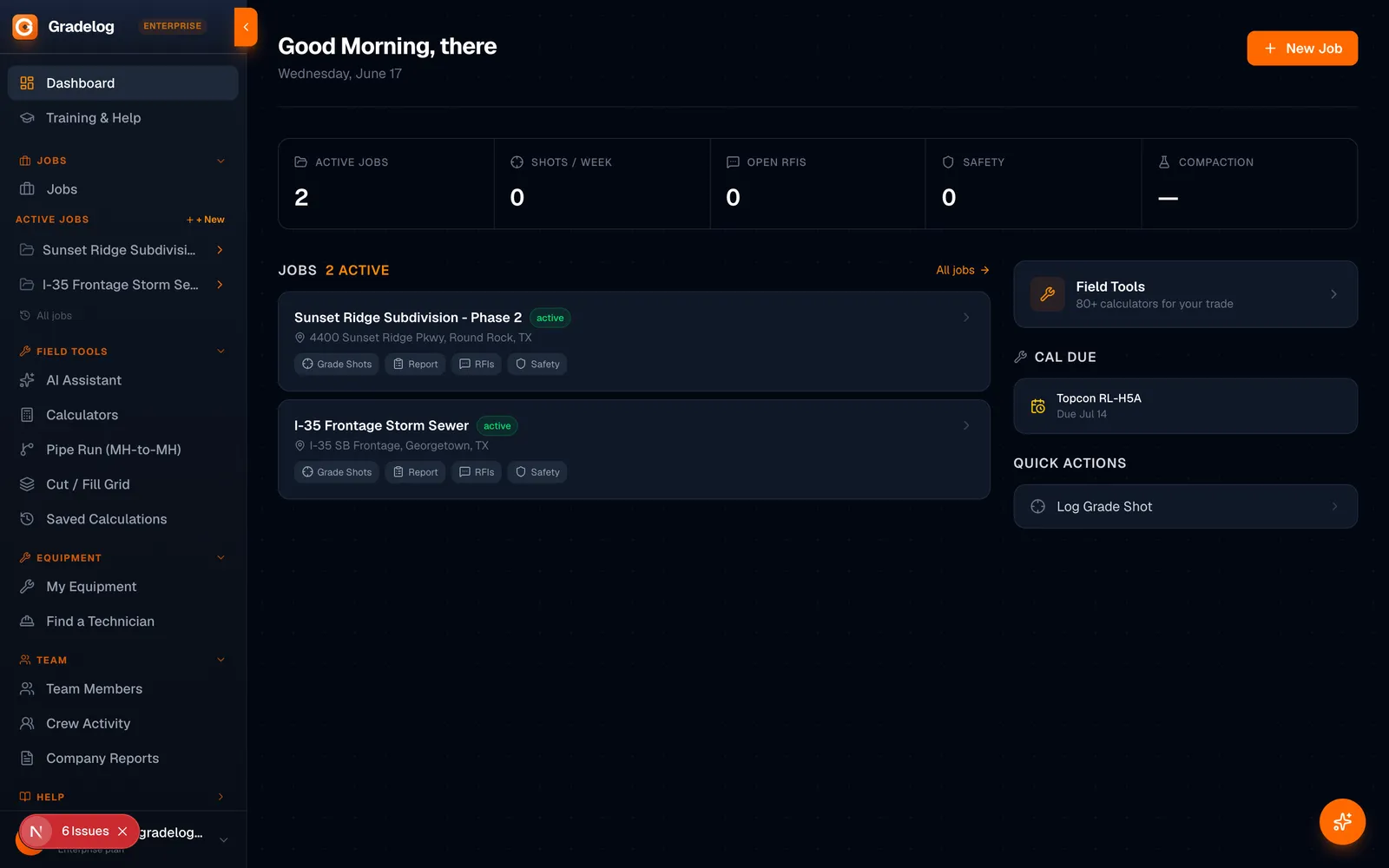
Before committing to a pipe laser, use Gradelog's free pipe grade calculator to verify your project requirements — invert elevation, pipe fall, percent grade, and required accuracy. No account needed.
Use Free Pipe Grade Calculators at Gradelog →Document Your Pipe Grade Work Digitally
Once your pipe laser is dialed in, GradeLog replaces paper shot logs with digital field records — invert elevations, pipe grades, as-built reports. Replace the clipboard with a system that generates reports automatically. $19–$149/mo.
Try GradeLog →