
Best Magnetic Locator for General Contractors
Quick Answer
When you're breaking ground on a job site, the last thing you need is to hit an unmarked utility line or spend half your day hunting for buried iron markers. A magnetic locator is the tool that saves you from costly mistakes and wasted time. These instruments detect ferrous metal
When you're breaking ground on a job site, the last thing you need is to hit an unmarked utility line or spend half your day hunting for buried iron markers. A magnetic locator is the tool that saves you from costly mistakes and wasted time. These instruments detect ferrous metals underground—think manhole covers, valve boxes, iron pipes, and survey markers—without requiring you to dig exploratory holes across the site.
I've tested dozens of magnetic locators on active construction sites, and the difference between a quality unit and a cheap knock-off is dramatic. The right locator pays for itself on the first job by preventing downtime and keeping your crew productive. Here's what actually works for general contractors in 2024.
Top Magnetic Locator Picks for Contractors
1. Schonstedt GA-92XTd – Best Overall for Professional Use
The Schonstedt GA-92XTd is the industry standard for good reason. This dual-mode locator gives you both audible and visual signals, with a detection depth of up to 16 feet for large ferrous objects. The gradient mode helps you pinpoint exact locations, while the full-field mode scans larger areas quickly.
At $1,899, it's not cheap, but the build quality is bulletproof. I've had mine on sites for five years—dropped it off tailgates, used it in pouring rain, and it keeps working. The sensitivity adjustment lets you filter out rebar in concrete slabs while still picking up deeper targets. Battery life runs about 100 hours on four D-cells, and the weatherproof housing is genuinely site-ready.
Best for: Commercial contractors, site development crews, and anyone who needs reliability over multiple job sites daily.
2. Schonstedt GA-52Cx – Best Mid-Range Option
If the GA-92XTd is beyond your budget, the Schonstedt GA-52Cx at $1,349 gives you 90% of the performance. You lose the digital display and get only audible signals, but the detection capability is nearly identical. This is the locator I recommend to residential contractors and smaller commercial crews.
The GA-52Cx still offers both gradient and full-field modes, and the detection depth reaches 14 feet. The analog meter is simple but effective—you won't miss the digital display once you're used to reading the needle deflection. This model has been around for years, and parts availability is excellent if you ever need service.
Best for: Residential contractors, utility contractors, and teams that need professional performance without the premium price.
3. SubSurface Instruments ML-1 – Best Budget Choice
The SubSurface ML-1 proves you don't need to spend two grand to find iron underground. At $649, this single-mode locator handles basic detection tasks with surprising competence. Maximum depth is about 10 feet, which covers most survey markers and shallow utilities.
The audio-only output keeps things simple—louder beeps mean you're getting closer. There's no sensitivity adjustment, so you'll get false positives from rebar and nails in disturbed soil, but for occasional use or tight budgets, it gets the job done. Construction is lighter-duty than Schonstedt units, so treat it with care.
Best for: Landscaping contractors, fencing crews, and general contractors who need a locator for occasional survey marker location.
4. Metrotech 810 – Best for Survey Work
If you're doing lot surveys or need to locate property corners frequently, the Metrotech 810 at $1,595 deserves consideration. This locator excels at pinpointing small targets like survey caps and rebar markers. The narrow detection field gives you exceptional accuracy—you can mark within an inch of the actual target.
The trade-off is reduced depth detection (about 12 feet maximum) and slower area scanning compared to the Schonstedt models. But if precision matters more than speed on your projects, the 810 delivers. The ergonomics are excellent for all-day use, with perfect balance and a comfortable grip.
Best for: Site layout, boundary surveys, and projects requiring precise marker location.
Magnetic Locator Comparison Table
| Model | Price | Max Depth | Modes | Display Type | Best Application |
|---|---|---|---|---|---|
| Schonstedt GA-92XTd | See expresstools.com for current pricing | 16 feet | Dual (gradient/full-field) | Digital + Audio | Professional daily use |
| Schonstedt GA-52Cx | See expresstools.com for current pricing | 14 feet | Dual (gradient/full-field) | Analog + Audio | Commercial/residential |
| SubSurface ML-1 | See expresstools.com for current pricing | 10 feet | Single | Audio only | Occasional use/budget |
| Metrotech 810 | See expresstools.com for current pricing | 12 feet | Single (precision) | Analog + Audio | Survey/precise location |
How to Choose the Right Magnetic Locator
Consider Your Primary Use Case
Start by honestly assessing what you'll use the locator for most often. If you're primarily hunting for survey markers on residential lots, you don't need the same tool as a site development crew locating valve boxes across 40-acre commercial sites. Match the detection depth and sensitivity to your actual targets—a survey cap at 18 inches deep requires different capabilities than a 6-inch cast iron pipe at 8 feet.
Dual-Mode vs. Single-Mode Operation
Dual-mode locators like the Schonstedt GA-92XTd switch between gradient mode (for pinpointing) and full-field mode (for area scanning). This dramatically speeds up workflow—scan large areas in full-field, then switch to gradient when you get a hit. Single-mode units require you to grid-search everything, which takes longer but costs less upfront.
Audio vs. Visual Indicators
Audio-only locators work fine in quiet environments, but on active job sites with equipment running, you'll miss subtle signal changes. Visual indicators—whether analog needles or digital displays—let you work effectively in noisy conditions. If you're often around excavators, pile drivers, or concrete trucks, budget for visual indication.
Build Quality and Warranty
Magnetic locators take abuse on construction sites. Look for sealed electronics, impact-resistant housings, and weatherproof construction. Schonstedt offers a 1-year warranty and has service centers nationwide. Budget brands often leave you stranded if something breaks. Calculate the cost of downtime when a critical tool fails—suddenly that extra $500 for quality seems reasonable.
Battery Life and Availability
Most professional locators run on standard D-cell batteries, giving you 80-100 hours of operation. Avoid proprietary rechargeable systems unless you're sure you can get replacement batteries years down the line. Nothing's worse than a perfectly good tool bricked because the manufacturer discontinued the battery pack.
Frequently Asked Questions
- What's the difference between a magnetic locator and a metal detector?
- Magnetic locators detect only ferrous (iron-based) metals by sensing distortions in the Earth's magnetic field. They ignore non-ferrous metals like copper, aluminum, and brass entirely. Metal detectors use electromagnetic induction to find all conductive metals but lack the depth and precision for utility location. For finding iron pipes, manhole covers, and survey markers, you want a magnetic locator. For finding a lost ring in dirt, use a metal detector. They're fundamentally different technologies solving different problems.
- How deep can magnetic locators actually detect targets?
- Manufacturer depth ratings assume ideal conditions with large ferrous objects. In reality, detection depth depends on target size, soil conditions, and interference from other metals. A large manhole cover might trigger the Schonstedt GA-92XTd at its rated 16 feet, but a survey cap might only be detectable to 3-4 feet. Wet clay soil extends detection range; dry sandy soil reduces it. Nearby rebar, nails, or iron slag creates noise that masks deeper targets. Always account for real-world conditions being less favorable than spec sheets suggest.
- Can I use a magnetic locator to find plastic utility lines?
- No, magnetic locators only detect ferrous metal. They won't find PVC pipes, HDPE gas lines, or fiber optic cables directly. However, many plastic utility lines have iron tracer wire installed alongside them, and some have metal connectors or markers at intervals. If you need to locate non-metallic utilities, you'll need a different tool like a cable locator with tracer wire capability or ground-penetrating radar. Always call 811 before digging—magnetic locators supplement professional utility locates, they don't replace them.
- Do magnetic locators require calibration or regular maintenance?
- Quality magnetic locators like Schonstedt models require minimal maintenance. There's no calibration procedure—they measure the Earth's magnetic field, which doesn't change. Keep the electronics dry, replace batteries before they leak, and inspect the housing for cracks. The main failure point is physical damage from drops or vehicle strikes. Store the locator away from strong magnets or electromagnetic fields when not in use. Most contractors get 10-15 years from a professional-grade unit with basic care. If performance degrades, the manufacturer can test and recondition the sensor assembly.
Calculate Your Grade Before You Buy
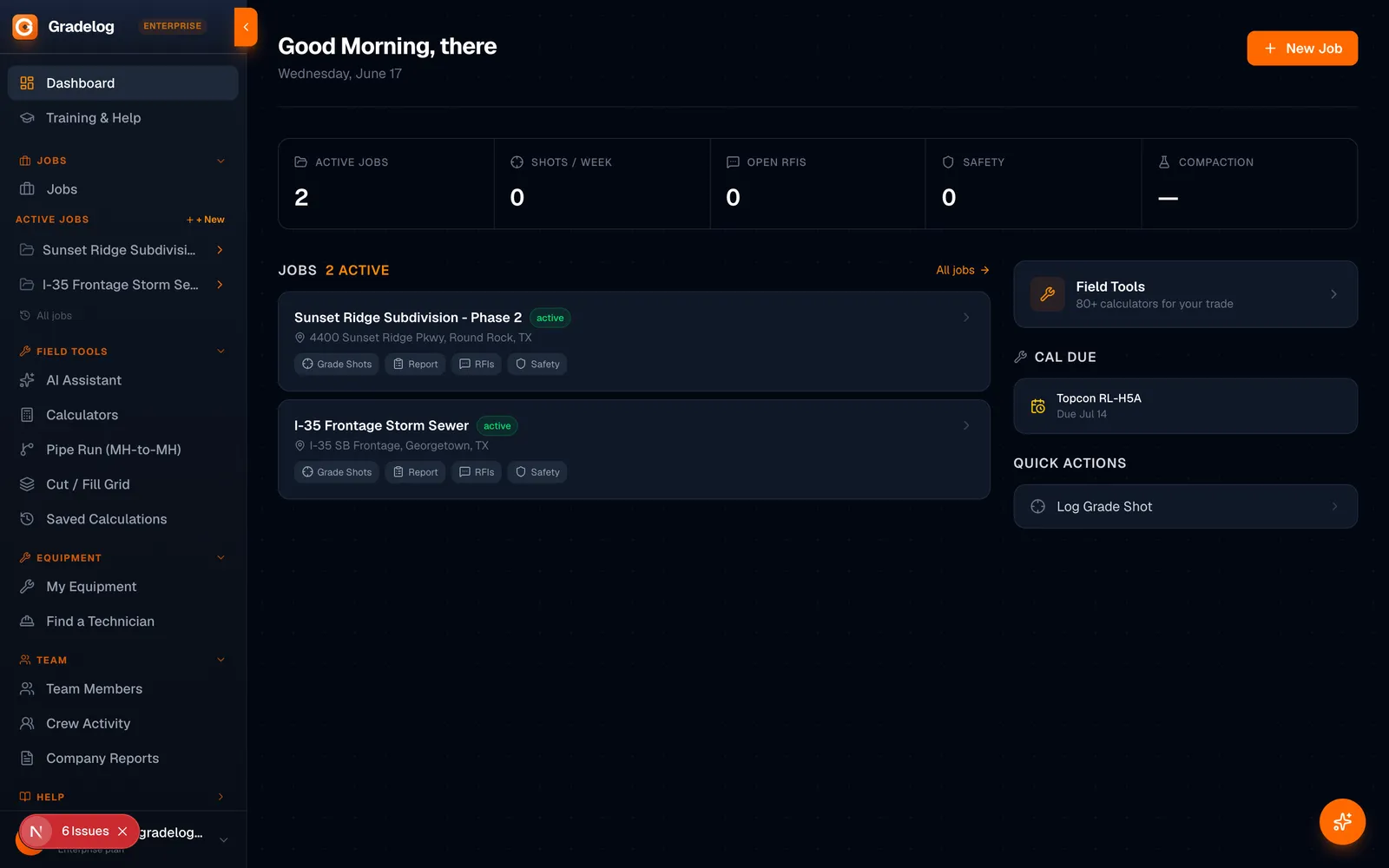
Before selecting between these instruments, use Gradelog's free field calculators to verify your project requirements — grade percentage, cut and fill, elevation, slope, and more. No account required.
Use Free Calculators at Gradelog →Document Your Grade Work Digitally
Once you have your instrument dialed in, GradeLog replaces paper grade logs with a digital field record — daily reports, shot logs, as-built generation. Pairs with every instrument on this page. $19–$149/mo.
Try GradeLog →Our Verdict
Quick Answer When you're breaking ground on a job site, the last thing you need is to hit an unmarked utility line or spend half your day hunting for buried iron markers. A magnetic locator is the tool that saves you from costly mistakes and wasted time. These instruments detect ferrous metal
For the full breakdown, see the sections above covering specifications, pros and cons, and use case recommendations for each option.