
Best Laser Level for Concrete Flatwork Contractors
Quick Answer
When you're pouring concrete slabs, laser levels aren't optional—they're essential for hitting grade and maintaining flatness tolerances. After years of working flatwork jobs from warehouse floors to residential slabs, I've tested dozens of rotating lasers in real-world condition
When you're pouring concrete slabs, laser levels aren't optional—they're essential for hitting grade and maintaining flatness tolerances. After years of working flatwork jobs from warehouse floors to residential slabs, I've tested dozens of rotating lasers in real-world conditions. The right laser level saves you time, reduces callbacks, and helps you meet F-number specifications consistently.
For concrete contractors, you need a laser that's accurate, durable enough to survive jobsite conditions, and has enough range to handle large pours. Here are the top picks that deliver on all three counts.
Top Laser Level Picks for Concrete Flatwork
1. Topcon RL-H5A – Best Overall for Professional Flatwork
The Topcon RL-H5A is the gold standard for concrete contractors who need accuracy and reliability. With horizontal accuracy of ±1/16" at 100 feet and a working diameter of 2,600 feet, this laser handles everything from residential slabs to commercial warehouse floors.
Price: $2,899
Why it's the best: The RL-H5A self-levels in about 8 seconds and includes rechargeable batteries that run 100+ hours on a single charge. The IP66 rating means it shrugs off dust and water, which matters when you're working around concrete trucks and wet conditions. The integrated slope matching function is invaluable for drainage applications, and the remote control lets you make adjustments without walking back to the unit.
I've used this laser on slabs over 20,000 square feet, and it maintains grade perfectly across the entire pour. The dual-slope capability is clutch for parking garages and loading docks.
2. Leica Rugby 640 – Best for Large Commercial Projects
The Leica Rugby 640 is built for contractors tackling major commercial flatwork where precision and range matter most.
Price: $3,495
Why choose it: This laser offers dual-grade capability and an incredible 3,500-foot diameter working range. TheRuggedX technology means it can survive a 6.5-foot drop onto concrete—something that'll happen eventually on busy jobsites. Accuracy is ±1/16" at 100 feet, matching the Topcon, but the Rugby 640 really shines on projects over 30,000 square feet where you need maximum range and minimal setups.
The digital receiver is extremely sensitive, which helps when you're working in bright sunlight or at maximum distances. Battery life exceeds 60 hours in standard mode.
3. Spectra Precision GL722 – Best Value for Small to Mid-Size Contractors
The Spectra GL722 delivers professional-grade performance at a price point that makes sense for contractors who don't need the absolute longest range.
Price: $2,199
Why it's a smart choice: Don't let the lower price fool you—this laser is accurate to ±1/16" at 100 feet and offers dual-grade capability for drainage work. The 2,600-foot diameter handles most residential and light commercial projects easily. The GL722 is built to military specs (MIL-STD-810G) and survives 3-foot drops.
What I appreciate most is the simple, intuitive controls. You can train new crew members in minutes, and the long-range remote works up to 800 feet. Battery life is solid at 60+ hours.
4. Hilti PR 30-HVS – Best for Tight Budgets
The Hilti PR 30-HVS is a single-grade rotating laser that works well for straightforward flatwork without complex drainage requirements.
Price: $1,649
When it makes sense: If you're primarily doing residential slabs, garage floors, and simple pads, the PR 30-HVS delivers solid performance without features you won't use. Accuracy is ±1/16" and range is 1,600 feet diameter—plenty for most residential work. The IP56 rating handles dust and splashing, though it's not quite as robust as higher-end models.
Comparison Table
How to Choose the Right Laser Level for Your Flatwork Business
Accuracy Requirements
For concrete flatwork, you need ±1/16" accuracy at 100 feet minimum. All the lasers listed here meet this standard. Some commercial specs require tighter tolerances—if you're bidding on projects with F-number requirements (FF50 or higher), verify your laser and technique can deliver.
Working Range
Measure your typical pour sizes. For residential work under 5,000 square feet, a 1,600-2,600 foot diameter works fine. Commercial warehouse floors and large slabs demand 3,000+ foot range to minimize setups. Remember, you're measuring diameter, not radius—a 2,600-foot laser gives you 1,300 feet from center.
Slope and Drainage Capability
Single-grade lasers work for level pours. If you do parking lots, loading docks, or any flatwork requiring drainage, dual-grade capability is non-negotiable. The ability to set precise slopes in two directions saves hours compared to manual grade checking.
Durability and IP Rating
Concrete jobsites are brutal. Look for IP66 or IP56 ratings minimum for dust and water resistance. Drop protection matters—you'll knock over a tripod eventually. Military spec construction (MIL-STD-810G) ensures the laser survives real-world abuse.
Battery Life and Power Options
Long pours mean long days. Choose lasers with 60+ hour battery life. Rechargeable batteries save money long-term, but having alkaline backup options prevents downtime when you forget to charge overnight.
Receiver Quality
The laser receiver on your grade rod is just as important as the laser itself. Digital receivers with LCD displays are easier to read than older LED models. Look for receivers with sensitivity adjustments for bright conditions and long-distance work.
Frequently Asked Questions
- What's the difference between single-grade and dual-grade laser levels?
- Single-grade lasers create a level plane or can slope in one direction only. Dual-grade lasers can slope independently in two directions (X and Y axes), which is essential for complex drainage applications like parking lots or loading docks. For simple level slabs, single-grade is sufficient. For anything requiring drainage to corners or multiple drains, dual-grade saves significant time and ensures proper water flow.
- How often do laser levels need calibration?
- Professional-grade rotating lasers should be calibrated annually at minimum, or immediately after any significant impact or drop. Many contractors send lasers in during slow winter months. If you notice grade issues or the laser won't self-level consistently, calibrate immediately. Keep calibration certificates on file—some commercial jobs require proof of recent calibration. Budget $150-250 for professional calibration through authorized service centers.
- Can I use a rotating laser level indoors and outdoors?
- Yes, rotating lasers work in both environments. Indoors, the laser beam is visible on walls and to receivers. Outdoors in sunlight, the beam isn't visible to the naked eye, so you must use a laser receiver (detector) mounted on a grade rod. All the lasers listed here include or are compatible with receivers. Indoor range is typically longer than outdoor range due to receiver limitations in bright conditions. Consider a laser detector package if you work in both environments regularly.
- What accuracy do I need for different concrete flatwork applications?
- Residential slabs and standard commercial floors work fine with ±1/16" accuracy at 100 feet. Warehouse floors with defined F-numbers (flatness specifications) may require tighter tolerances—FF25 floors need good technique with standard lasers, while FF50+ floors demand ±1/32" accuracy and precise installation methods. Parking lots and driveways are more forgiving at ±1/8". For superflat floors, consider specialized laser screed systems beyond standard rotating lasers. Always check project specifications before bidding.
Calculate Your Grade Before You Buy
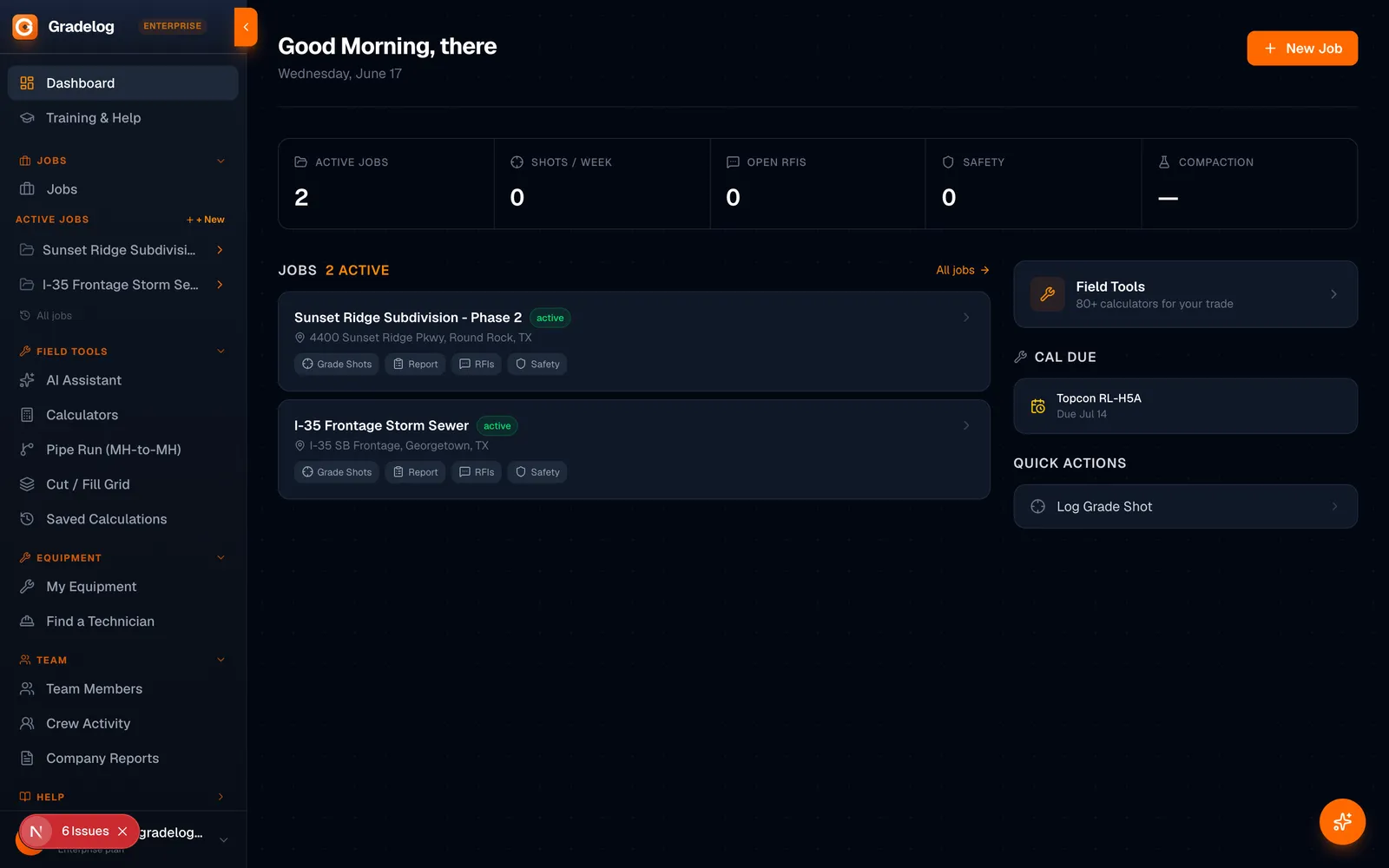
Before selecting between these instruments, use Gradelog's free field calculators to verify your project requirements — grade percentage, cut and fill, elevation, slope, and more. No account required.
Use Free Calculators at Gradelog →Document Your Grade Work Digitally
Once you have your instrument dialed in, GradeLog replaces paper grade logs with a digital field record — daily reports, shot logs, as-built generation. Pairs with every instrument on this page. $19–$149/mo.
Try GradeLog →Our Verdict
Quick Answer When you're pouring concrete slabs, laser levels aren't optional—they're essential for hitting grade and maintaining flatness tolerances. After years of working flatwork jobs from warehouse floors to residential slabs, I've tested dozens of rotating lasers in real-world condition
For the full breakdown, see the sections above covering specifications, pros and cons, and use case recommendations for each option.