
Best Interior Laser for Commercial Framing
Quick Answer
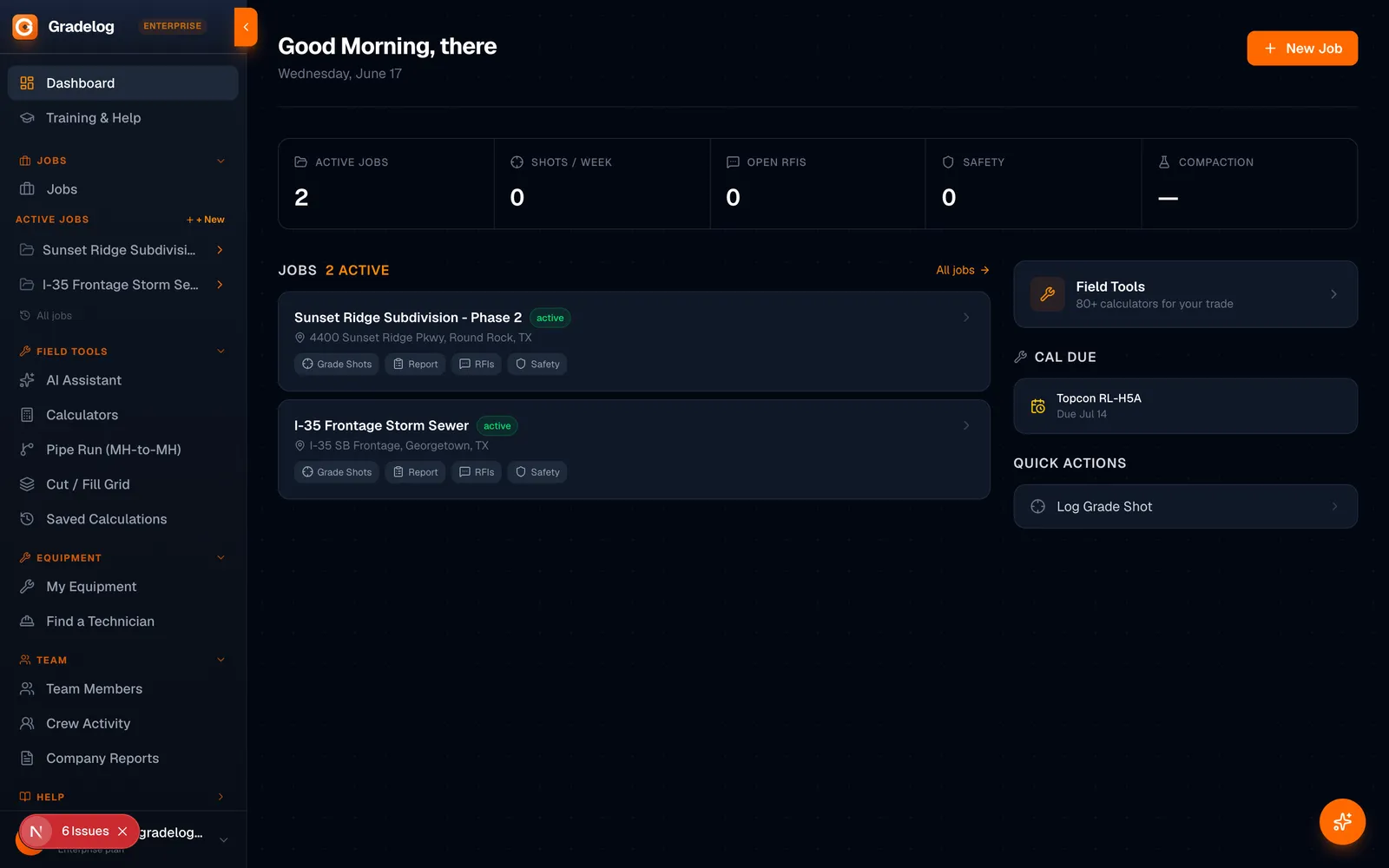
Before selecting between these instruments, use Gradelog's free field calculators to verify your project requirements — grade percentage, cut and fill, elevation, slope, and more. No account required.
Commercial framing demands precision, speed, and reliability. Whether you're laying out metal studs for office build-outs, framing multi-unit residential structures, or establishing reference points across expansive warehouse interiors, the right laser level makes the difference between profitable projects and costly rework. After testing the leading models on actual jobsites, we've identified the top interior lasers that deliver the accuracy and durability commercial framers need.
Top Picks for Commercial Framing Lasers
Best Overall: The Topcon RL-H5A combines exceptional accuracy (±1/16" at 100 ft) with rugged construction and 2,600-foot diameter range with detector. Its horizontal self-leveling system and long battery life make it ideal for all-day commercial use.
Best Value: The Dewalt DW079LG delivers professional-grade performance at a mid-range price. With green beam technology for superior visibility and ±1/8" accuracy, it handles most commercial framing tasks efficiently.
Best for Versatility: The Bosch GLL3-330CG three-plane leveling laser projects 360-degree horizontal and two vertical lines simultaneously, perfect for wall framing, drop ceilings, and partition layouts without repositioning.
Comparison Table
How to Choose an Interior Laser for Commercial Framing
Accuracy Requirements
Commercial building codes typically require framing tolerances within 1/4 inch over standard wall heights. To consistently meet these standards, select lasers with ±1/8 inch accuracy at 30 feet minimum. High-end rotary lasers offering ±1/16 inch at 100 feet provide the margin needed for critical reference points and long-span layouts. Remember that accuracy degrades with distance, so choose specifications that exceed your typical working range.
Rotary vs Line Lasers
Rotary lasers spin a single laser point to create a 360-degree level plane, ideal for establishing floor-to-floor elevations, drop ceiling grids, and perimeter layouts across large spaces. They work with laser detectors for outdoor or long-range applications. Multi-line lasers project multiple static beams—typically horizontal and vertical lines—perfect for wall framing, installing electrical boxes at consistent heights, and aligning partition tracks. For dedicated framing crews, a rotary laser for layout plus a multi-line laser for wall work offers maximum efficiency.
Beam Color and Visibility
Green laser beams appear up to 4x brighter than red beams to the human eye, significantly improving visibility in well-lit commercial interiors with ambient lighting from windows or work lights. However, green lasers consume more battery power and cost 20-40% more than equivalent red models. For primarily interior work in controlled lighting, quality red lasers with adequate brightness (typically 2-3 mW) perform well. Green beams justify the premium for bright environments or when working at maximum range.
Self-Leveling and Compensation
Electronic self-leveling systems automatically adjust the laser plane within a specified range (typically ±3° to ±5°), saving setup time and preventing errors from manual leveling. Out-of-level alerts—usually flashing or shut-off mechanisms—warn when the unit is bumped beyond its compensation range. For commercial work, motorized self-leveling rotary lasers maintain accuracy even if disturbed, while pendulum-based systems in line lasers offer reliability with fewer electronic components. Manual mode allows intentional grade slopes when needed for drainage or ramp layouts.
Working Range and Detector Compatibility
Assess your typical project size when selecting range capabilities. Small office build-outs work fine with 200-foot diameter coverage. Large commercial spaces—warehouses, retail centers, multi-story structures—require 800+ foot diameter coverage. Laser detectors (receivers) extend usable range by electronically locating the beam rather than relying on visual visibility, often tripling the effective working distance. Verify detector compatibility and consider purchasing matched systems for warranty coverage and optimal performance.
Durability and Job Site Protection
Commercial framing environments subject tools to dust, minor impacts, and variable temperatures. Look for IP54 or higher ingress protection ratings—indicating dust resistance and splash protection. Drop survival ratings (typically 3-5 feet) and rubberized housings protect against accidental falls from ladders or scaffolding. Metal frame cages add protection for rotary units. Quality lasers include temperature compensation that maintains accuracy across 14°F to 122°F operating ranges typical of climate-controlled commercial interiors.
Frequently Asked Questions
What accuracy do I need for commercial framing?
For commercial framing, look for lasers with ±1/8 inch at 30 feet or better. Professional-grade units typically offer ±1/16 inch accuracy, which ensures walls, ceilings, and partition layouts meet building codes and architectural specifications. This tolerance accounts for accumulated variance across multiple reference points and provides margin for material variations.
Rotary laser vs multi-line laser for framing?
Rotary lasers excel in large commercial spaces, providing 360-degree coverage for layout work across entire floors. They establish consistent elevations for sleeper tracks, ceiling grids, and perimeter references. Multi-line lasers work better for wall framing, door/window placement, and vertical alignment tasks where you need visible horizontal and vertical crosses simultaneously. Many framers use both depending on the specific task—rotary for layout, line laser for assembly.
How important is self-leveling for commercial work?
Self-leveling is essential for commercial framing. It saves significant time on setup across multiple daily setups, ensures consistent accuracy regardless of operator experience, and includes out-of-level alerts that prevent costly mistakes from bumped tripods or unstable surfaces. Look for units that self-level within ±3 to ±5 degrees and include manual mode lock for intentional grade work on ramps or drainage slopes.
What working range do I need for commercial projects?
For commercial framing, choose lasers with at least 200-foot diameter working range (100-foot radius) for the laser beam alone. With a laser detector, many rotary lasers extend to 1,000+ feet diameter, necessary for large warehouses, big-box retail spaces, and multi-story buildings where you're establishing floor-to-floor reference points. Consider your largest typical project and add 25% for flexibility.
Our Verdict
Calculate Your Grade Before You Buy Before selecting between these instruments, use Gradelog's free field calculators to verify your project requirements — grade percentage, cut and fill, elevation, slope, and more. No account required. Use Free Calculators at Gradelog →
For the full breakdown, see the sections above covering specifications, pros and cons, and use case recommendations for each option.