
Best Grade Laser for Land Clearing and Site Prep
Quick Answer
When you're clearing land or prepping a site, a quality grade laser isn't optional—it's the difference between a job that passes inspection and one that costs you time and money in rework. I've run crews on everything from residential lots to commercial pads, and the right rotati
When you're clearing land or prepping a site, a quality grade laser isn't optional—it's the difference between a job that passes inspection and one that costs you time and money in rework. I've run crews on everything from residential lots to commercial pads, and the right rotating laser level pays for itself on the first job.
For land clearing and site prep work, you need a laser that can handle rough conditions, maintain accuracy over distance, and keep working when you're pushing dirt in less-than-ideal weather. Here's what actually works in the field.
Top Grade Lasers for Site Work
1. Topcon RL-H5A – Best Overall for Heavy Site Work
The Topcon RL-H5A is the workhorse you'll see on serious grading jobs. With a working diameter of 2,600 feet and horizontal accuracy of ±1/16 inch at 100 feet, this dual-grade laser handles everything from initial rough grading to final prep.
Price: $3,295
What sets the RL-H5A apart is its IP66 rating and ability to survive drops up to 1 meter onto concrete. When you're working around dozers and excavators, equipment takes abuse. The electronic self-leveling works within ±5 degrees, and it alerts you if it gets knocked out of position. The rechargeable battery runs 100+ hours, meaning you're not swapping batteries mid-shift.
I run this with the Topcon LS-80L receiver and grade rod for single-grade work, but the dual-slope capability is clutch for drainage projects where you need to match existing grades in two directions.
2. Leica Rugby 640 – Best for Versatility and Range
The Leica Rugby 640 offers the longest range in this comparison at 3,280 feet diameter, making it ideal for larger site development projects where you need fewer setups.
Price: $4,150
The Rugby 640 includes a digital slope matcher that lets you set slopes in both X and Y axes with 0.01% resolution. For land clearing jobs where you're establishing drainage patterns across large areas, this precision matters. The unit operates in temperatures from -4°F to 122°F, and I've used it in everything from winter demo work to summer grading in direct sun.
The battery system is flexible—it runs on either rechargeable Li-ion or alkaline D-cells. Keep alkalines in the truck as backup, and you'll never have downtime. Pair it with the Leica Rod Eye 160 receiver for best results.
3. Spectra Precision LL500 – Best Value for Smaller Operations
If you're running a smaller operation or don't need extreme range, the Spectra LL500 delivers professional accuracy at a price that won't wreck your equipment budget.
Price: $2,295
With a 1,600-foot diameter and ±3/32 inch accuracy at 100 feet, the LL500 handles residential site prep, small commercial pads, and drainage work. It's not as rugged as the Topcon or Leica, but the IP67 rating means it survives rain and dust. The variable speed rotation (300-600-900 RPM) lets you optimize for range versus battery life.
The smart feature here is the electronic self-leveling that works in any rotation position. Set it on a tripod, turn it on, and get to work. I recommend the CR600 receiver and a quality aluminum grade rod to complete the package.
4. Hilti PR 30-HVS – Best for Tight Sites and Mixed Work
The Hilti PR 30-HVS is the choice when you're working on constrained sites where you need both horizontal and vertical reference.
Price: $2,850
This dual-grade laser includes vertical beam capability, making it valuable for site work that transitions into foundation or building work. The 1,000-foot working radius is smaller, but for residential developments or tight commercial sites, it's plenty. The PR 30-HVS levels and indicates plumb simultaneously, which speeds up layout work when you're transitioning from earthwork to forms.
Comparison Table
How to Choose the Right Grade Laser for Your Work
Consider Your Typical Site Size
Working diameter matters more than marketing specs suggest. For residential lots and small commercial sites (under 2 acres), the Spectra LL500 or Hilti PR 30-HVS provides adequate coverage. Larger sites, especially those exceeding 5 acres, benefit from the extended range of the Topcon RL-H5A or Leica Rugby 640. Fewer instrument setups mean faster work and fewer opportunities for error.
Accuracy Requirements
For rough grading and initial land clearing, ±3/32 inch accuracy is acceptable. Final grade work, especially for parking lots or building pads requiring precise drainage, demands ±1/16 inch or better. All four lasers here meet final grade requirements except the Spectra, which is better suited for rough-to-intermediate work.
Slope Capability
Single-grade lasers work fine for simple slopes—think basic drainage away from a building pad. Dual-grade capability becomes essential when you're matching existing terrain, creating compound drainage patterns, or working on roads and parking areas. The digital slope matching on the Leica Rugby 640 is the most precise, but the Topcon RL-H5A offers easier field operation if you're not chasing ultra-precise slope percentages.
Durability and Environmental Protection
IP ratings aren't marketing fluff—they predict how your laser survives real conditions. IP66 (RL-H5A, PR 30-HVS) provides dust-tight and heavy spray protection. IP67 (LL500) adds temporary water immersion protection. IP68 (Rugby 640) handles sustained submersion. All handle rain, but if you're working near water features or in flood-prone areas, the higher rating provides peace of mind.
Drop protection matters equally. Grade lasers get knocked off stakes, bumped by equipment, and generally abused. The Topcon's 1-meter drop rating reflects reality—lasers fall.
Receiver and Rod Compatibility
Don't cheap out on receivers and rods. A $3,000 laser paired with a bargain receiver defeats the purpose. Match manufacturers when possible—quality laser receivers from the same brand ensure optimal performance. For grade rods, aluminum construction beats fiberglass for durability, and get the 25-foot length for site work where you're shooting over rough terrain.
Power Systems
Rechargeable systems (Topcon, Leica) reduce operating costs and runtime is excellent—80 to 100+ hours. But keep alkaline-compatible capability (Leica) as backup insurance. Dead batteries stop work, and that costs more than any savings on rechargeable cells.
Frequently Asked Questions
- What's the difference between a construction laser and a grade laser for land clearing?
- Grade lasers for land clearing need longer range (1,500+ feet), better durability ratings (IP66 minimum), and slope-matching capability. Interior construction lasers prioritize plumb/level accuracy and multi-beam patterns but lack the range and ruggedness for earthwork. Site prep lasers also need receivers that work in bright outdoor conditions, unlike indoor lasers that rely on visible beams. For clearing and grading work, always choose a rotating laser designed for outdoor site work, not a multi-line interior laser.
- How accurate do I need for rough grading versus final grade?
- Rough grading tolerates ±1/4 inch over 100 feet—you're establishing basic drainage and moving bulk material. Final grade for building pads, parking areas, or areas receiving concrete requires ±1/16 inch at 100 feet. Most modern grade lasers exceed final grade requirements, but cheaper units marketed for "general construction" may only deliver ±1/8 inch. For professional site work, buy a laser that meets ±1/16 inch or better, which gives you versatility from clearing through final prep without equipment changes.
- Can I use a grade laser in rain or should I wait for clear weather?
- All four lasers reviewed here work in rain—that's what IP66+ ratings mean. The laser itself operates fine, but heavy rain affects receiver performance because water droplets scatter the beam. Light rain and mist cause minimal issues. Heavy downpours reduce effective range by 30-50%. Your bigger problem is the receiver getting wet—make sure it's rated for water exposure. I work through light rain regularly, but heavy weather means reduced accuracy and range. Use a stable tripod to prevent vibration from wind and rain impact.
- Do I need dual-grade capability or is single-grade sufficient for most site work?
- Single-grade handles probably 60% of site prep work—simple slopes for drainage, building pads with uniform fall, and basic land clearing. Dual-grade becomes essential for roads, parking lots, complex drainage patterns, and matching existing grades. If you're a residential-focused contractor doing mostly house pads and basic lots, single-grade works. Commercial site contractors or anyone doing road work needs dual-grade. The price difference ($500-800) is small compared to the cost of mistakes or multiple setups trying to match slopes with a single-grade unit. When in doubt, buy dual-grade capability—you'll use it more than you expect.
Calculate Your Grade Before You Buy
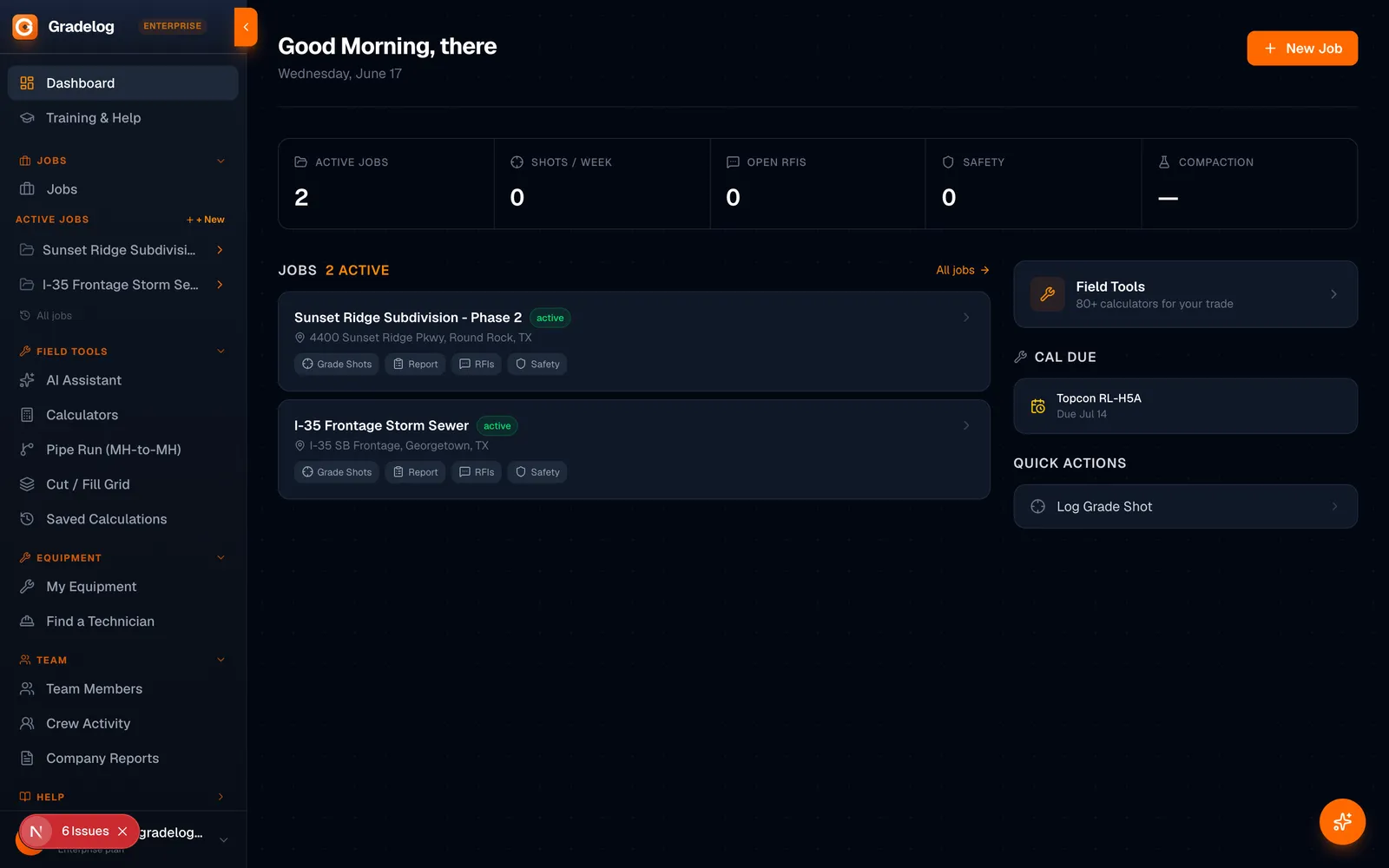
Before selecting between these instruments, use Gradelog's free field calculators to verify your project requirements — grade percentage, cut and fill, elevation, slope, and more. No account required.
Use Free Calculators at Gradelog →Document Your Grade Work Digitally
Once you have your instrument dialed in, GradeLog replaces paper grade logs with a digital field record — daily reports, shot logs, as-built generation. Pairs with every instrument on this page. $19–$149/mo.
Try GradeLog →Our Verdict
Quick Answer When you're clearing land or prepping a site, a quality grade laser isn't optional—it's the difference between a job that passes inspection and one that costs you time and money in rework. I've run crews on everything from residential lots to commercial pads, and the right rotati
For the full breakdown, see the sections above covering specifications, pros and cons, and use case recommendations for each option.