
Best Grade Laser for Drainage and Irrigation Work
Quick Answer
After spending nearly two decades in the drainage and irrigation business, I can tell you that a quality grade laser is one of the best investments you'll make. Whether you're installing French drains, setting up athletic field drainage, or laying irrigation lines across acres of
After spending nearly two decades in the drainage and irrigation business, I can tell you that a quality grade laser is one of the best investments you'll make. Whether you're installing French drains, setting up athletic field drainage, or laying irrigation lines across acres of farmland, having an accurate laser level saves time, reduces callbacks, and keeps your crews moving efficiently. I've tested dozens of these units on job sites from residential yards to commercial developments, and I'm sharing my top picks based on real-world performance.
Top Picks for Grade Lasers
1. Topcon RL-H5A - Best Overall
The Topcon RL-H5A ($2,899) is the workhorse that's been in my truck for the past five years. This self-leveling rotary laser offers horizontal and vertical leveling with ±1/16" accuracy at 100 feet, which is plenty tight for drainage and irrigation work. The IP66 rating means it handles dust and rain without missing a beat—I've had mine running during light rain more times than I can count. The rechargeable battery lasts about 100 hours, and you can run it on alkaline D-cells in a pinch. What really sets this apart is the LS-80L receiver with a 10" diameter detection range, making it easy for operators to pick up the beam even at 2,600 feet.
2. Spectra Precision LL300N-2 - Best Value
At $1,649, the Spectra LL300N-2 delivers professional-grade performance without the premium price tag. I recommend this to contractors just getting into drainage work or those running multiple crews who need several units. The accuracy is ±10 arc seconds (roughly 1/8" at 100 feet), which works perfectly for irrigation trenching and basic grading. It's a dual-grade laser, so you can set slopes in two directions simultaneously—incredibly useful when you're establishing drainage patterns across a property. The NiMH battery pack provides 60-70 hours of runtime, and the laser survived a 5-foot drop off my tailgate without calibration issues.
3. Leica Rugby 680 - Best for Large Sites
When I'm working on commercial irrigation systems or golf course drainage, I reach for the Leica Rugby 680 ($3,495). The working diameter of 2,600 feet means you can set up once and cover massive areas. The dual-slope capability with digital readout makes setting precise grades foolproof—just dial in your percentage, and you're running. I particularly appreciate theRuggedROOT technology that alerts you if someone bumps the laser out of level. The RC680 remote lets you control everything from 300 feet away, so you don't need to walk back to the laser every time you need an adjustment.
4. Johnson Level 99-006K - Best Budget Option
For smaller contractors or those handling mostly residential drainage, the Johnson 99-006K ($899) is hard to beat. It's a simple, single-slope rotary laser that does one job really well. The accuracy is ±1/8" at 100 feet, and the 1,000-foot diameter covers most residential properties with room to spare. I keep one of these for quick drain line projects where I don't need the features of my premium lasers. The manual slope matching is straightforward, and the detector is easy for new crew members to understand.
Comparison Table
How to Choose the Right Grade Laser
Accuracy Requirements
For drainage work, you typically need accuracy between 1/16" and 1/8" at 100 feet. Irrigation lines can tolerate slightly looser tolerances, but drainage systems need to be precise—water doesn't lie, and a poorly graded drain will let you know immediately. I've found that ±1/16" accuracy prevents callbacks and ensures proper flow rates. If you're doing finish grading for hardscapes or concrete work alongside your drainage projects, invest in the tighter tolerance.
Range and Working Area
Consider your typical job sites. Residential properties rarely need more than 1,000-1,500 feet of range, but agricultural irrigation or sports field drainage requires 2,000+ feet. Remember that the published range is diameter, not radius. A 2,600-foot diameter laser gives you 1,300 feet from center, which is about 30 acres of coverage. I learned early on that setting up multiple times because your laser can't reach costs more in labor than upgrading to a longer-range unit.
Slope Capabilities
Single-grade lasers work for straightforward drainage runs, but dual-grade units open up possibilities. When you're establishing a drainage swale or grading an area for sheet drainage, being able to set slopes in two directions simultaneously saves hours. The digital readout models like the Leica Rugby make setting precise percentages easy—just punch in 2% and you're done. Manual slope matching works fine but requires more setup time and skill.
Durability and Weather Resistance
You're going to drop your laser. Your crew will bump it with the excavator bucket. It'll sit in the rain. Look for IP66 or better ratings and solid warranty coverage. I've broken cheaper lasers by simply having them on vibrating equipment, while my Topcon has survived genuine abuse. The extra $500-1,000 for a rugged unit pays for itself the first time you avoid a $400 recalibration or complete replacement.
Battery System
Rechargeable battery packs are convenient, but make sure the laser accepts standard batteries as backup. I've been saved multiple times by throwing D-cells into my Topcon when the rechargeable died mid-job. Calculate battery life based on your typical job duration—if you're running 10-hour days, a 30-hour battery means charging every three days, which becomes a hassle.
Receiver Quality
The receiver is just as important as the laser itself. Large detection windows (8-10 inches) make it easier for excavator and skid steer operators to stay on grade. Some receivers like the Topcon LS-80L have LCD displays that show exactly how far off-grade you are, while basic models just have LED arrows. For training new operators, the detailed feedback is invaluable.
Remote Control
On larger sites, having a remote control changes everything. Instead of walking 500 feet back to the laser every time you need to adjust slope or check level, you control it from wherever you're working. The Leica RC680 remote has become essential for my golf course work. For smaller residential jobs, it's a nice-to-have but not critical.
Frequently Asked Questions
- What's the difference between a rotary laser and a pipe laser for drainage work?
- Rotary lasers create a 360-degree level or sloped plane, making them ideal for open excavation work, grading large areas, and setting forms. Pipe lasers fit inside the pipe and project a beam down the pipe run, which is perfect for sewer and storm drain installation where you're working in confined spaces. For general drainage and irrigation work involving trenches, swales, and grading, a rotary laser is more versatile. I use pipe lasers specifically for underground utility runs and rotary lasers for everything else.
- How often do grade lasers need calibration?
- Most manufacturers recommend annual calibration, but real-world needs depend on how much abuse the unit takes. I calibrate my primary lasers once a year and after any significant drop or impact. You can do field checks yourself using the two-point method—set up the laser, take readings from two points, then rotate the laser 180 degrees and check if readings match. If they're off by more than the published accuracy spec, send it in for calibration. Professional calibration typically costs $150-300 and takes about a week.
- Can I use a grade laser in bright sunlight?
- Yes, but you'll need a receiver—the beam is invisible to the naked eye in bright conditions beyond about 30 feet. Red beam lasers are easier to see than green in some conditions, but for professional drainage work, you should always be using a receiver anyway. The receiver detects the laser electronically and works perfectly in full sunlight at maximum range. Some receivers have larger detection windows that make picking up the beam easier in bright conditions. I've never had visibility issues when using proper receivers, even at noon in summer.
- What slope range do I need for typical drainage projects?
- Most drainage work falls between 0.5% and 2% slope (about 1/8" to 1/4" per foot), though some applications need steeper grades up to 10-15%. French drains typically run at 1%, yard drainage at 2%, and irrigation mains anywhere from 0.5-1%. Make sure your laser can handle at least ±8-10% in both axes. The Spectra LL300N-2 does ±15%, which covers everything I've encountered in 18 years. Some basic lasers only do ±8%, which is usually sufficient but can be limiting on hillside work.
Calculate Your Grade Before You Buy
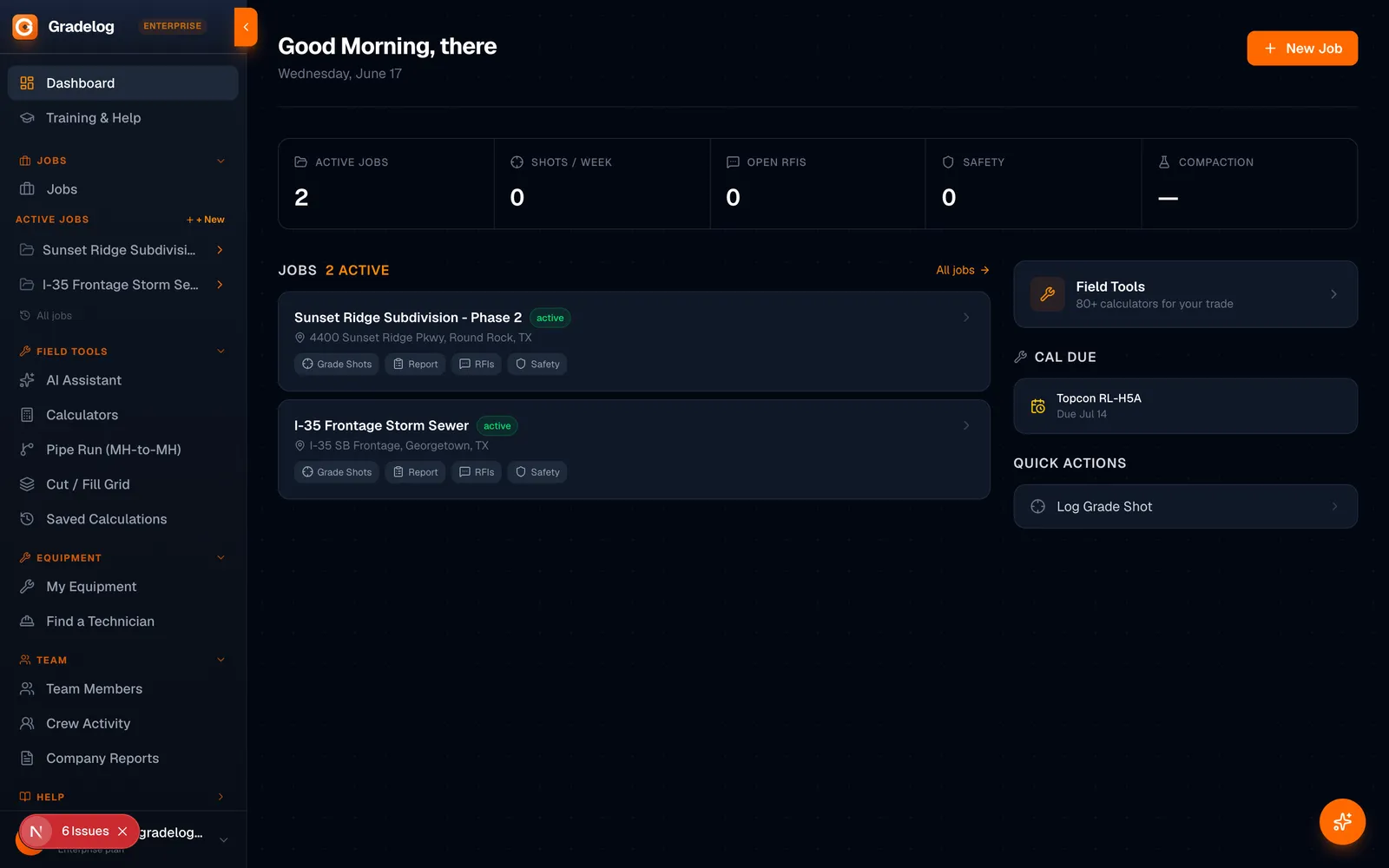
Before selecting between these instruments, use Gradelog's free field calculators to verify your project requirements — grade percentage, cut and fill, elevation, slope, and more. No account required.
Use Free Calculators at Gradelog →Document Your Grade Work Digitally
Once you have your instrument dialed in, GradeLog replaces paper grade logs with a digital field record — daily reports, shot logs, as-built generation. Pairs with every instrument on this page. $19–$149/mo.
Try GradeLog →Our Verdict
Quick Answer After spending nearly two decades in the drainage and irrigation business, I can tell you that a quality grade laser is one of the best investments you'll make. Whether you're installing French drains, setting up athletic field drainage, or laying irrigation lines across acres of
For the full breakdown, see the sections above covering specifications, pros and cons, and use case recommendations for each option.