
2D vs 3D Machine Control: Which System for Your Project?
Quick Answer
Machine control systems have revolutionized earthmoving, grading, and site development. But should you choose 2D or 3D GPS machine control? This guide is for contractors, equipment operators, and project managers deciding between these two proven technologies. You'll learn the co
Machine control systems have revolutionized earthmoving, grading, and site development. But should you choose 2D or 3D GPS machine control? This guide is for contractors, equipment operators, and project managers deciding between these two proven technologies. You'll learn the core differences, real-world applications, cost implications, and which system delivers the best ROI for your specific project type.
2D Machine Control Systems
✓ Pros
- Lower upfront capital investment
- Easier operator training and adoption
- Reliable for consistent slopes (highways, parking lots)
- Simpler software and fewer variables to configure
- Works well on smaller sites
- Fast ROI on straightforward projects
✗ Cons
- Cannot handle complex multi-slope designs
- Limited to single grade at a time
- Not ideal for curved or variable terrain
- Requires manual adjustment between passes
- Slower on large, complex sites
3D Machine Control Systems
✓ Pros
- Handles complex, multi-slope designs effortlessly
- Superior accuracy (±25mm–±50mm)
- Reduces rework and material waste significantly
- Faster on large, complex projects
- Future-proof for advanced site designs
- Highest productivity gains on multi-day projects
✗ Cons
- Higher initial capital investment
- Steeper learning curve for operators
- More complex software setup and calibration
- Requires more sophisticated RTK base station
- Overkill for simple projects
- Ongoing software and support costs
Head-to-Head Comparison
Which System Should You Buy?
🏗️ Scenario 1: Small to Mid-Size Contractor (5–15 Projects/Year)
Recommendation: Start with 2D
For smaller contractors handling routine grading, parking lots, and simple site prep, a 2D system delivers excellent ROI. Your payback period is typically 8–12 months. Once your team is proficient and project complexity increases, you can upgrade to 3D or add a second 3D unit to your fleet.
🏘️ Scenario 2: Heavy Earthworks / Subdivision Developer
Recommendation: Invest in 3D from the Start
If your projects involve complex drainage, variable slopes, curved designs, or multiple building pads, 3D is mandatory. The precision and speed justify the higher cost. On a 50-acre development, 3D can save $50,000–$100,000 in reduced material waste, rework, and time.
🛣️ Scenario 3: Road & Highway Contractor
Recommendation: Hybrid Approach
For straightforward highway grades, a 2D system suffices. But if you handle complex interchanges, roundabouts, or variable slope transitions, add 3D capability. Many top contractors fleet both: 2D for simple runs, 3D for complex designs.
✈️ Scenario 4: Precision-Critical Projects (Airfields, Utilities)
Recommendation: 3D with RTK Base Station
For utilities, stormwater, or airfield work where accuracy is non-negotiable, 3D with a dedicated RTK base station is essential. The cost of rework or regulatory violations far exceeds machine control investment.
Frequently Asked Questions
Can I upgrade a 2D system to 3D later?
Partially. Most modern systems allow you to add 3D components (display, software licenses, antenna upgrades), but you may need a new receiver or control box. A full upgrade typically costs 60–70% of a new 3D system. It's often more economical to start with 3D if you anticipate needing it within 2–3 years.
What's the real accuracy difference on a construction site?
2D (±50–100mm) is excellent for grading and general site work. 3D (±25–50mm) becomes critical when setting building pads, drainage slopes, or utility lines where precision directly impacts cost and safety. On a 100-lot subdivision, the difference amounts to thousands in material waste avoidance.
Do I need an RTK base station for either system?
Both 2D and 3D perform better with RTK (Real-Time Kinematic) correction, which provides centimeter-level accuracy. NTRIP networks are available in most populated areas, eliminating the need for a private base station. Budget $100–$200/month for NTRIP or $30,000–$50,000 for an on-site base station.
What's the learning curve for operators?
2D: Most operators become proficient in 5–10 days with hands-on training. 3D requires 2–3 weeks of training plus real-world experience. However, modern interfaces (Topcon, Trimble, Spectra) have become much more intuitive, reducing training time considerably.
Can I use 3D machine control on older equipment?
Yes. Most major brands (Topcon, Trimble, Spectra Precision) offer retrofit kits for dozers, graders, and excavators built in the last 15 years. Retrofits typically cost $25,000–$60,000 depending on equipment type and system complexity.
Which brand should I buy: Topcon, Trimble, or Spectra?
All three are industry leaders with strong support. Trimble excels in 3D complexity; Topcon offers excellent mid-range solutions; Spectra Precision provides great value for 2D and budget-conscious buyers. Visit Express Tools to compare specific models side-by-side and speak with our equipment specialists.
Do I need field management software with this equipment?
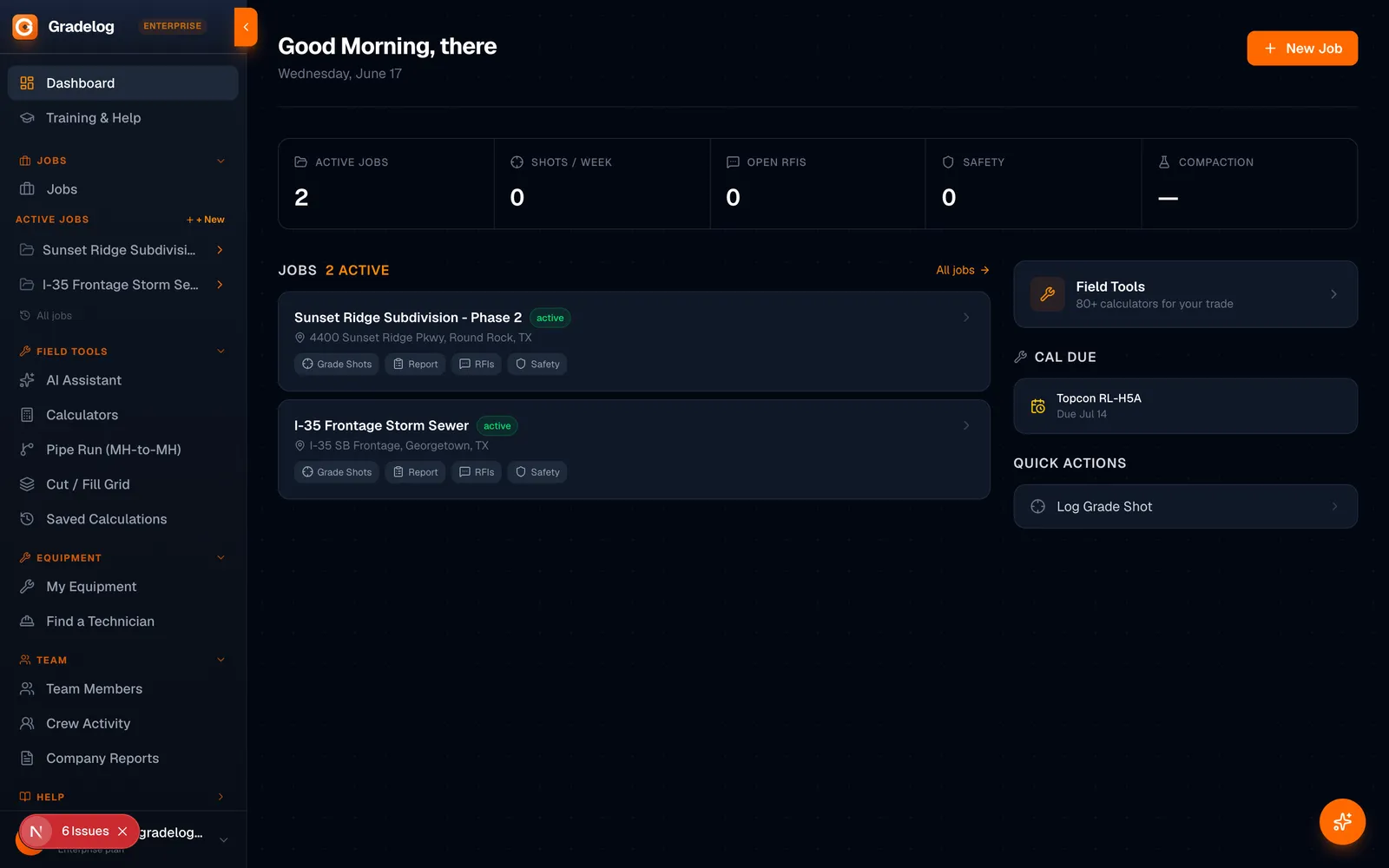
Gradelog complements machine control with free cut/fill and excavation calculators, plus paid features for job logs, equipment tracking, and as-built report generation. Built for Topcon, Trimble, and Spectra Precision users.
How do I document grade work on a job site?
GradeLog logs cut/fill passes, daily production, and generates as-built reports automatically. Replaces paper grade books. $19–$149/mo.
Ready to Choose Your System?
The right machine control system depends on your project portfolio, budget, and growth trajectory. Express Tools carries a full range of 2D and 3D machine control systems from Topcon, Trimble, Spectra Precision, and other top brands.
Express Tools specializes in laser grade-control and layout equipment. For field documentation, Gradelog organizes your job logs, calibration records, and as-built reports — free to start.
View Topcon SystemsExpress Tools specializes in laser grade-control and layout equipment. For field documentation, Gradelog organizes your job logs, calibration records, and as-built reports — free to start.
Calculate Cut & Fill Before You Buy
Before choosing your machine control system, use Gradelog's free calculators to model cut/fill volumes, excavation requirements, and elevation changes — so you size the right system before you invest. No account required.
Use Free Cut & Fill Calculators at Gradelog →Document Your Earthwork Digitally
Once your machine control system is running, GradeLog gives you a digital field record for every cut and fill pass — daily reports, as-built generation, equipment logs. Pairs with every system on this page. $19–$149/mo.
Try GradeLog →